
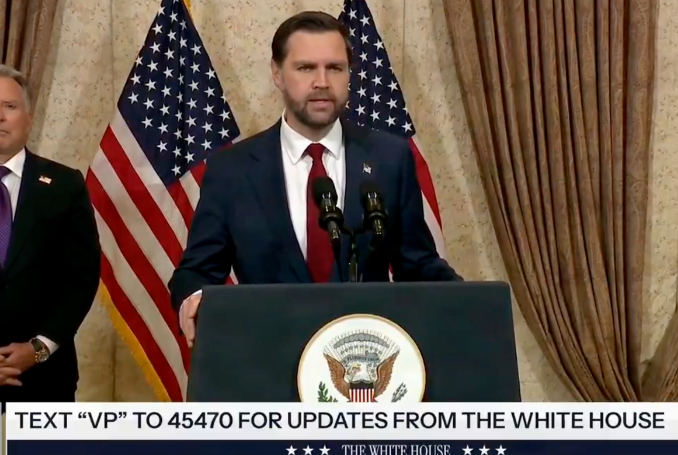

US Vice President JD Vance rejected calling the six-month confrontation with Iran a “war,” while refusing to predict when the fighting will end.
Key Takeaways
- Vance said, “I wouldn’t call it a war,” despite six months of US-Iran fighting and another round of American strikes this week.
- He refused to predict whether the confrontation would end before the November 3 midterm elections, saying he would not impose “artificial timelines.”
- The war has pushed Brent crude above $95 a barrel and US gasoline above $4 a gallon, complicating the administration’s efforts to contain its domestic political costs.
US Vice President JD Vance has rejected describing the six-month military confrontation between the United States and Iran as a “war,” even as Washington carries out new strikes against Iran and Tehran continues retaliatory attacks across the region.
“I wouldn’t call it a war,” Vance told reporters at the White House on Thursday when asked whether the fighting would end before Americans vote in the November 3 congressional elections.
“Right now, there is no active shooting,” he added.
Yet Iran struck US bases in Kuwait, a US Gulf ally, on the same day as part of its continuing response to another round of American attacks on Iran earlier in the week.
Vance said Washington had a “responsibility” to conduct those strikes because of Iranian attacks on commercial shipping in the Strait of Hormuz.
The exchange exposed an increasingly difficult political reality for the Trump administration: a military campaign that the White House initially suggested would last weeks has continued for six months, while American consumers are increasingly feeling its economic consequences.
Asked when it would end, Vance offered no timetable. “I don’t know the answer to that question,” he said.
‘Ask the Iranians’
Vance said he did not want to establish “artificial timelines” for ending the confrontation.
“But when you ask, ‘When will this end?’ You’re asking me a question like, ‘When will the Iranians stop shooting at ships?’” he said.
“I think the reality is, I don’t know the answer to that question. You would have to ask the Iranians.”
His refusal to call the confrontation a war comes amid scrutiny over how the administration itself has categorized US military casualties.
In July, four US soldiers killed in the fighting, along with dozens of wounded personnel, were reclassified in the Pentagon’s Defense Casualty Analysis System.
Personnel killed or wounded after a brief US-Iran ceasefire collapsed were moved into a new category called “Overseas Operations,” according to the Associated Press.
Oil above $95, Gas above $4
The most immediate domestic consequence has been energy prices. Brent crude traded above $95 a barrel on Thursday, compared with approximately $72 immediately before the war began.
US gasoline prices, meanwhile, are averaging above $4 a gallon — well above Treasury Secretary Scott Bessent’s earlier prediction that prices could fall to $3 a gallon by Labor Day.
The Trump administration has sought to reassure markets by arguing that the US Navy has restored significant oil traffic through Hormuz.
Vance claimed approximately 15 million barrels of oil were escorted through the strait on Wednesday, while Energy Secretary Chris Wright alleged 17 million barrels passed through with US Navy assistance on Monday.
Before the war, approximately 20 million barrels of Gulf oil moved through Hormuz.
Independent shipping data, however, paints a substantially different picture. TankerTrackers estimated that an average of approximately 5 million barrels of oil per day had exited through the strait over the previous 28 days.
Economic Strangulation
With Iran refusing to yield to the military campaign, the Trump administration has increasingly pursued what AP describes as a dual-track strategy: escalating economic pressure while retaining the threat of greater military force.
Bessent has emerged as a central advocate of the economic campaign. He said this week that the Strait of Hormuz would become a “worthless piece of water” within two years as planned pipelines allow Gulf oil exporters to bypass the strategic waterway.
The administration maintains that its sanctions are progressively choking off Iran economically, while simultaneously attempting to reduce the strategic importance of Tehran’s leverage over Hormuz.
Iran, however, has continued using attacks in and around the strait and strikes against US regional allies as leverage against Washington.
A War without an Exit
The political dilemma facing Trump is increasingly stark as the November elections approach.
According to analysts cited by AP, the White House appears unwilling either to return to sustained, large-scale bombing or to make the concessions to Tehran that could produce an agreement over Hormuz.
“The White House doesn’t want a massive war, and they don’t want to be seen as offering massive concessions,” Aaron David Miller, a senior fellow at the Carnegie Endowment for International Peace, said.
“The tack they are taking avoids both of those things.”
For now, that leaves Washington in a prolonged confrontation that Vance declines to call a war — while offering no answer as to when it will end.
‘Bullying Entire Populations into Submission’: Oman FM Blasts Economic Warfare
(PC, AP)



I hope this war reaches our shores.
What a scumbag!
The grieving parents of all those little girls he killed at the Minab school in Iran would disagree with his statement.
Dondolf Twitler and his entire Nutzi Party should be impeached, stripped of all wealth and privilege, then jailed for life. They are all common criminals.