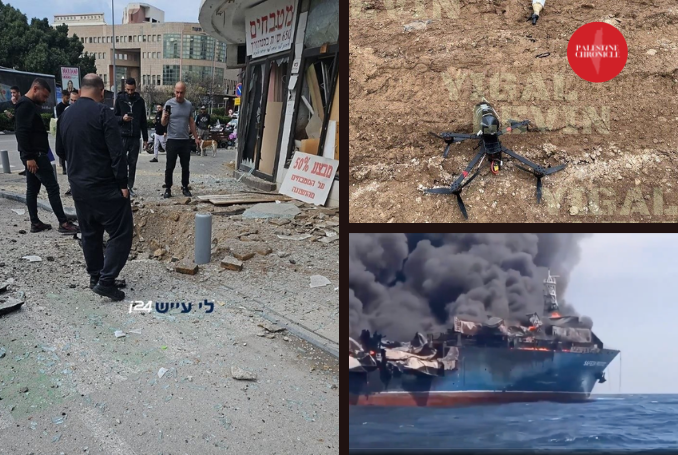

Iran expanded its offensive operations across multiple fronts, striking Tel Aviv, tightening control over the Strait of Hormuz, and escalating coordinated battlefield pressure alongside regional allies.
Key Developments
- Iran targets Israeli military infrastructure in Tel Aviv with drones and missiles.
- Tehran enforces restrictions in the Strait of Hormuz amid sharp drop in maritime traffic.
- Fighting intensifies across Lebanon as resistance operations expand.
Strikes on Tel Aviv
The Iranian army announced on Friday the execution of a large-scale offensive operation targeting the heart of the Israeli occupation entity in Tel Aviv, confirming that swarms of attack drones struck what it described as the main support base and largest transportation and supply center of the Israeli army.
According to the military statement, the strikes were part of a broader strategic plan aimed at disrupting logistical networks and damaging the operational backbone of Israeli forces, rather than isolated or symbolic attacks.
🚨⭕️ YEDIOTH AHRONOTH: Buildings and a hotel in Herzliya, Tel Aviv, were damaged. pic.twitter.com/JRsLsKyFcN
— The Palestine Chronicle (@PalestineChron) March 27, 2026
In parallel, the Islamic Revolutionary Guard Corps (IRGC) confirmed that the 82nd wave of Operation “True Promise 4” targeted military command centers and facilities linked to nuclear-related industries south of the Dead Sea, using coordinated missile and drone strikes.
Iranian officials said these operations are part of an ongoing response to US-Israeli attacks since February 28, framing the campaign as sustained and multi-layered, targeting both military infrastructure and support systems.
‘Firm Response’
Alongside the battlefield escalation, Iran has moved to tighten control over the Strait of Hormuz, with the IRGC declaring that the waterway is effectively closed to vessels linked to the United States, Israel, and their allies.
The Guard warned that any unauthorized attempt to cross would be met with a “firm response,” confirming that several cargo ships had already been turned back after approaching the designated passage without coordination.
🎦⭕️ WATCH: Iranian footage shows strike on a Thai cargo ship in the Strait of Hormuz, leaving it heavily damaged and run aground near Qeshm Island. pic.twitter.com/NC1Sj86xGc
— The Palestine Chronicle (@PalestineChron) March 27, 2026
Iranian officials said that navigation remains possible only under direct coordination with Iranian naval forces, while reports indicate that more than 350 oil tankers are currently waiting in surrounding waters for permission to pass.
Data cited by Iranian media suggested that maritime traffic through the strait has dropped by approximately 95 percent, with only a handful of vessels allowed through daily during the fourth week of the war.
Hezbollah Escalates Ground Operations
On the Lebanese front, the Lebanese resistance movement Hezbollah intensified its operations, engaging Israeli forces at close range and targeting armored units, troop gatherings, and military sites with guided missiles, drones, and rocket barrages.
Clashes were reported in multiple border towns, including Al-Bayada, Shamaa, and Deir Siryan, where resistance fighters confronted advancing Israeli forces and inflicted confirmed casualties.
Hezbollah fighters targeted Merkava tanks with guided missiles and carried out ambushes against infiltrating forces, while also striking Israeli troop concentrations and vehicles with rocket salvos.
The escalation reflects a widening battlefield dynamic, where ground engagements in southern Lebanon are increasingly synchronized with broader regional operations.
(PC, Al Mayadeen, IRGC Statement, Iranian media)