
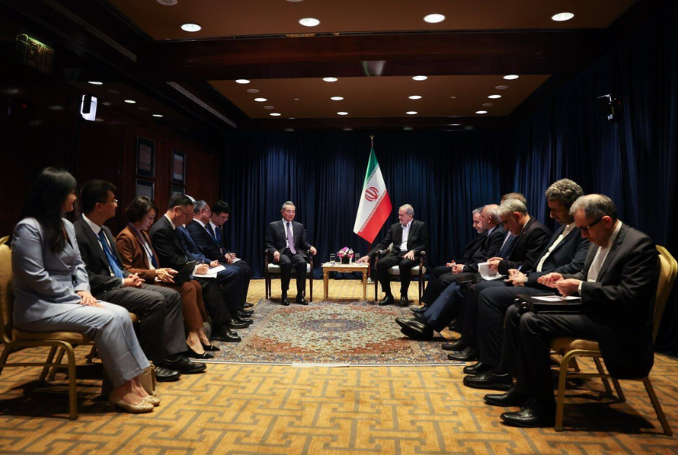
Iranian leaders warned against exploiting protests to fracture society, reaffirmed nuclear red lines and conditional openness to talks, as US military pressure and regional maneuvering intensify.
Key Developments
- Iranian President Masoud Pezeshkian warned that public protests must not be exploited to divide the country, stressing the need to distinguish peaceful dissent from attempts to incite violence and fragmentation.
- Iranian Foreign Minister Abbas Araghchi said Tehran is ready for a fair and equitable nuclear agreement, reiterating that Iran has never pursued nuclear weapons and insisting on sanctions relief under non-coercive terms.
- Iranian officials warned that any US military attack would draw a swift and comprehensive response, while maintaining that diplomacy remains possible under balanced conditions.
- Saudi Defense Minister Khalid bin Salman reportedly warned Washington that failure to act against Iran could strengthen Tehran’s leadership.
- With no confirmed direct US-Iran talks underway, regional actors continue to weigh the risks of escalation against narrowing diplomatic options.
Pezeshkian: Protest Rights Must Be Protected, Not Manipulated
Iranian President Masoud Pezeshkian said Iran is compelled to pursue justice and inclusive governance while resisting attempts to exploit public protests to divide the country, as tensions with the United States and its regional allies continue to escalate.
Speaking on Saturday, Pezeshkian said Iranian authorities have a duty to listen to peaceful protesters and address legitimate social and economic demands, stressing that public participation in decision-making is essential to national stability.
“We must give our people their sovereignty and involve them in decision-making,” Pezeshkian said, according to Iran’s semi-official Tasnim news agency.
At the same time, the president warned that some actors seek to hijack protest movements to incite unrest and fragmentation. He said recent experiences have shown that Iran’s “sworn enemies,” including Israel and its Western supporters, have repeatedly attempted to steer protests toward violence, assassinations, attacks on public property, and assaults on security and service institutions.
Pezeshkian stressed that such acts fall outside any recognized norm of civil protest and are aimed at destabilizing the country rather than advancing public demands.
Iran, Russia, and China Hold Joint Military Drills near Strait of Hormuz
Institutional Self-Review
The Iranian president acknowledged that authorities must also reassess their own performance, arguing that failures in governance can create openings for external interference.
He said sincere service to the public and accountability within state institutions are the most effective safeguards against attempts to turn social grievances into hatred, incitement, and division.
Iran Reaffirms Nuclear Position
Separately, Iranian Foreign Minister Abbas Araghchi reiterated Tehran’s long-standing position that Iran has never pursued nuclear weapons and remains open to a “fair and equitable” nuclear agreement.
Speaking after meetings in Türkiye, Araghchi said any agreement must guarantee the lifting of sanctions and respect Iran’s legitimate interests, while ensuring the principle of “no nuclear weapons.”
Araghchi met with Turkish President Recep Tayyip Erdoğan and Foreign Minister Hakan Fidan, discussing bilateral ties and regional developments. He said Ankara, along with other regional countries, has offered to facilitate dialogue aimed at de-escalation.
Tehran, he added, welcomes such efforts and remains ready to work with regional partners to promote stability and shield the region from what he described as unlawful aggression.
Nearly 70,000 Israelis Emigrated in 2025, Over 150,000 in Past Two Years – Reports
US Military Pressure
The Iranian statements come amid heightened tensions following remarks by US President Donald Trump, who recently said a “massive armada” was moving toward Iran while calling on Tehran to “come to the table” for negotiations.
The Pentagon has since expanded US military deployments in the region, fueling speculation about possible military action. Iranian officials have responded by warning that any attack would be met with a swift and comprehensive response, while maintaining that diplomacy remains possible under non-coercive conditions.
Saudi Contradictions
Amid this escalation, Saudi Defense Minister Khalid bin Salman reportedly warned US officials that failing to follow through on threats against Iran could strengthen Tehran’s leadership.
According to a report by Axios, bin Salman made the remarks during private briefings in Washington, amid uncertainty over US intentions and fears of regional fallout. The report said the Saudi position reflects a growing dilemma: concern that a US strike could ignite a broader conflict, alongside fears that restraint could embolden Iran.
Publicly, Riyadh has maintained a more cautious tone, stressing respect for Iran’s sovereignty, a preference for diplomacy, and opposition to the use of Saudi airspace for any attack.
(Anadolu, AJA, Iranian Media)


Saudi Contradictions, indeed! I don’t know but was Saudi Defense Minister Khalid bin Salman showing his own fear of a “embolden Iran” & potential dissent in the kingdom: if Iran forced the US to blink first, why can’t we?
Moon Alabama answered my question: https://www.moonofalabama.org/2026/01/zionist-distorts-arab-analysis-as-arguing-for-iran-attack.html
Saudi Defense Minister Khalid bin Salman just stated the obvious; no change in Saudi Arabian policy