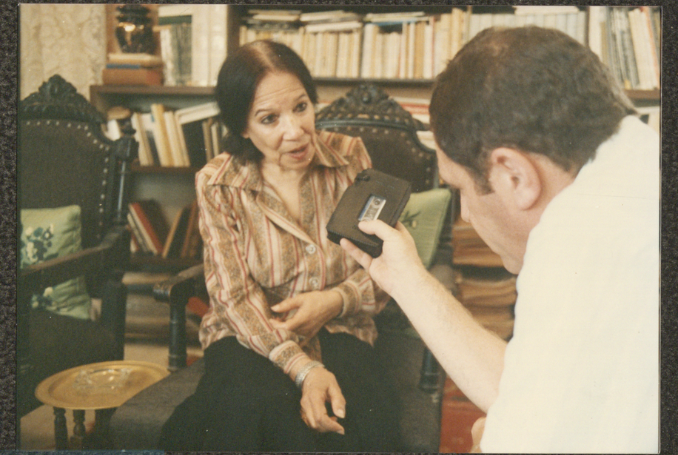
Exactly 22 years ago, on December 12, Fadwa Tuqan left the mansion in which she had once been confined to virtual imprisonment, this time carried out in celebration.
Our story begins and ends in Nablus, one of the most beautiful cities in Palestine. It was on December 12, 2003, during the continuing Second Intifada, that Fadwa Tuqan, one of Palestine’s first female resistance poets, passed away in her hometown at the age of 86. Her final days were spent in an occupied city. As she lay sick in bed, Israeli tanks rumbled past her door. And in the streets, there were Palestinian children whose pockets were filled with stones they had gathered.
Fadwa Tuqan once addressed them in a poem:
When you are grown up, my loved ones,
On that day, you will bear the evil instead of us
And you will play the part, instead of us,
In the story of the battle.
Long is our story,
Long is the tale of battle
And on that day
Oh our dedicated treasure
You will know
When and where the dispersed will meet
And how the tale of dispersal and wretchedness ends.(From Tuqan 1988:626–8; first published in ‘Ala Qimat al-Dunya Wahidan, 1970)
In a grand mansion in the historic streets of Nablus in 1917, the year the Balfour Declaration was issued, a beautiful baby girl was born. They named her Fadwa. The Tuqan family, one of the most prominent families in Palestine, had come from Jordan in the 12th century and settled in Nablus, becoming synonymous with the city itself. Fadwa was the fifth child, with nine siblings in total.
As she grew, the tension caused by the Balfour Declaration became impossible to ignore. Growing up in the shadow of these events, Fadwa reached school age. At that time, there were only two schools for girls in Nablus. At six years old, her father enrolled her in the Fatimiyya School in 1923, the same year as the major Yafa Uprising, a crucial turning point in Palestinian history. Like many of her friends, Fadwa walked to school each day. But when she turned 12, something happened that abruptly ended her schooling.
One morning as she left home, she noticed a boy a couple of years older following her. She ignored him and walked faster. But he didn’t give up. Every day he appeared, following her all the way to school in the morning and back in the afternoon. It went on for days, quiet and shy glances exchanged from a distance, until one day, he handed her a white jasmine flower. White jasmine symbolized purity and innocence.
Just as Fadwa shyly thought of placing the flower between the pages of her book, her older brother Yusuf appeared. He had seen everything. He took Fadwa home and immediately told their father. A harsh punishment awaited her: she would no longer go to school, and she would not leave her room unless necessary. That same year, the 1929 Buraq uprising took place, with tensions rising everywhere. Fadwa, stuck at home, was unbearably bored, spending most of her time in her room.
‘You Turned My Prison into a Flower Garden’
The person who would rescue Fadwa from this suffocating isolation was her poet brother, Ibrahim Tuqan. Later to become of the most important pioneers of Palestinian resistance poetry, Ibrahim was 12 years older than Fadwa and deeply devoted to his little sister. He had studied in Beirut and gained fame as a poet from a young age.
Ibrahim’s resistance poems had already made him a hero among Palestinian youth, especially after the Buraq uprising and the British execution of three young Palestinian men, Muhammad Jamjum, Ata al-Zir, and Fuad Hijazi. The event inspired one of Ibrahim’s most powerful poems.
He had now returned to Nablus and was working as a literature teacher at the renowned Al-Najah School. Ibrahim’s students brought him their poems to read, and he, in turn, brought them home to share with Fadwa in the evenings. During these nightly readings, Fadwa became his greatest helper. She eagerly shared her thoughts, what she liked, what she didn’t, and which lines touched her the most.
One evening, she told her brother, “I too have strong feelings and thoughts inside me that I cannot express.”
And so, Ibrahim began teaching his sister how to write poetry. In the evenings, her room turned into a classroom. But before anything else, he told her to read, to read endlessly. He brought her all the major classics of Arabic literature. She would sit by the window, reading until she was exhausted, then spend hours contemplating what she had read. She had entered an entirely new world. During this period, their father was imprisoned by the British, and Fadwa wrote her very first poem for him.
Months and years passed. In 1936, the Great Palestinian Revolt began, led by the fellahin. Ibrahim became a major figure in this uprising, which spread rapidly across Palestine. Meanwhile, Fadwa corresponded constantly with him after he moved to Jerusalem, sending him her poems. Ibrahim wrote long letters back, critiquing her work, encouraging her, and telling her that he had shared her poems with his friends.
Fadwa’s magnificent relationship with his brother would continue until 1941. In early May of that year, tragic news reached the Tuqan home in Nablus: Ibrahim had died in Jerusalem at the age of just 36. Everyone was devastated, but none as deeply as Fadwa. She would name her first poetry collection, published in 1946, “My Brother Ibrahim.”
And in her later years, when she spoke about her brother, she would say, “He turned my prison into a flower garden. By teaching me poetry, my brother Ibrahim turned my room into a rose garden.”
Fadwa Tuqan’s Early Work
Fadwa was now writing constantly. As a new state was being built on the land stolen from the Palestinian people, this pioneering Palestinian woman poet stepped forward with great courage. She cried out to her enemies: We, the women of Palestine, are here as well and we stand tall before you.
She showed everyone that women who, at the time, were kept away from public life, rarely went out, and were excluded from society, were in fact powerful warriors. Many Palestinian women, expelled from their homes, their houses destroyed, turned into refugees in their own homeland, demonstrated their strength through their dignified stance in the face of everything that was happening. With Palestinian society facing colonization and dispersion, Fadwa played a major role in tearing down the veil that had isolated Palestinian women from society.
After the 1967 Naksa: Becoming a True Resistance Poet
Following the 1948 Nakba, over 800,000 Palestinians were displaced. After the 1967 Arab-Israeli War, the occupation expanded even further. Nablus, the city where Fadwa Tuqan was born and raised, and which had fallen under Jordanian rule after 1948, was now officially under Israeli military occupation. This sharpened Fadwa’s poetry even more.
As Palestine’s fate darkened, the themes of occupation, poverty, oppression, death, and separation became more prominent in her lines. Everything happening in Palestine found new life in the verses of Fadwa Tuqan. She continued to write with deep dedication, and the poem she wrote immediately after the occupation of Nablus, “My Sad City” (June 27, 1967), had a great impact. In it, she compared the Arab nation to a tree: even if its branches were broken, its trunk stood strong, for its roots still clung fiercely to the earth.
In another poem, she described the Allenby Bridge, the only crossing point between Jordan and Palestine. Despite being a small bridge, it had enormous significance. Around it stood four refugee camps. The valley was filled with orange trees and lush fields, but Palestinians were forbidden from touching them. Summers were unbearably hot, making life even more difficult for refugees already living in misery. They lived under harsh Israeli rules and suffered endless humiliation when crossing the bridge. Fadwa saw all this and titled her poem “Waiting at Allenby Bridge.”
Fadwa also became a symbol of how much Israel feared Palestinian poets and writers. Israeli Defense Minister Moshe Dayan once said of her: “This woman’s poems have the effect of 20 guerrilla fighters.”
From the Balfour Declaration to the Second Intifada
By the 1980s, Fadwa’s fame spread far beyond the Arab world. Her poems were translated into English and many other languages. As Palestine’s first female resistance poet, she was already revered across the Arab world, but now she became known globally. Through her, the world began to read about Palestine from the pen of a woman, turning a political struggle into a literary one with extraordinary mastery.
The little girl who once tried to peek outside from the windows of her family’s mansion never married, but she became the mother of Palestine. Fadwa witnessed every major chapter of modern Palestinian history: the Nakba, the creation of Israel, the Deir Yassin Massacre, the 1967 and 1973 wars, the Sabra and Shatila Massacre, Black September, and the First Intifada.
Fadwa saw her beloved Nablus fall under occupation; she saw the orange trees in their garden destroyed, the precious olive trees cut down. And after each rush of pain, she stood up stronger, continuing to write, continuing to tell the world of her people’s suffering. Even when illness severely damaged her eyesight, she never stopped reading or writing.
And so, exactly 22 years ago, on December 12, Fadwa Tuqan left the mansion in which she had once been confined to virtual imprisonment, this time carried out in celebration. Her story, which began in the year of the Balfour Declaration, ended during the Second Intifada. On that day, flags across Palestine were lowered to half-mast for the little girl of Nablus.
If one day your path leads to Nablus and the grave of Fadwa Tuqan, you may wish to leave a white jasmine flower. A flower symbolizing purity and innocence.
– Peren Birsaygılı Mut is a writer, documentary scriptwriter, and publisher from İzmir, whose work focuses on Palestinian literature and history. She is the author of several books, including Among the Olive Trees and The Pen and the Rifle, and is the recipient of the 2023 TYB Special Award and the 2025 Necip Fazıl Idea and Research Award. She contributed this article to the Palestine Chronicle.