
Through each piece she creates, Shireen is not only supporting her family, but also holding on to something essential—her dignity, and her family’s survival.
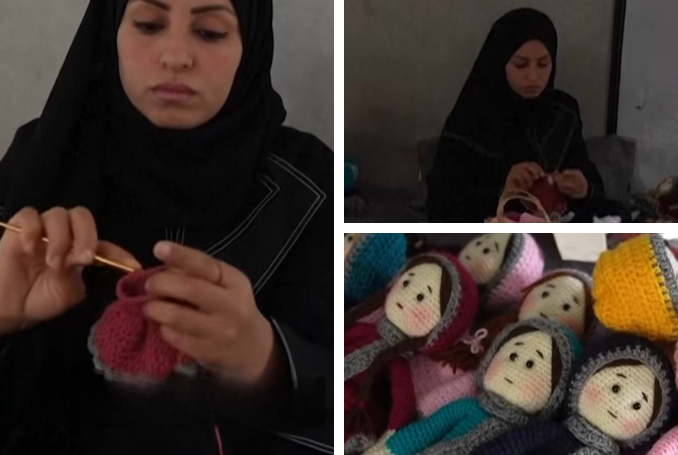
In a small displacement tent in central Gaza, lacking basic living conditions—no electricity and no proper ventilation—36-year-old Shireen Al-Kurdi has managed to open a modest business to support her family, creating a space filled with color and small moments of relief amid loss and displacement.
With a simple needle and crochet threads, Shireen crochets handmade toys—dolls, flowers, sheep, and other small, joyful items that appeal to children.
“Opening this business wasn’t optional; it was a necessity to secure my children’s needs and preserve our dignity after we lost our source of income,” Shireen tells The Palestine Chronicle.
Before the war, the family mainly depended on her husband’s work as a taxi driver for a local company. Yet even that limited source of income was lost as the war began, amid a worsening transportation crisis caused by Israeli airstrikes targeting vehicles, soaring fuel prices, and the lack of spare parts.
“If anyone still has a car, he works on it himself,” Shireen explains. “No one rents his car to anyone.”
Shireen has long been talented in crochet, but she never imagined it would become her profession. Holding a BA in Arabic Language from Al-Quds Open University since 2015, she had always dreamed of working as a teacher. However, due to the long-standing Israeli blockade on Gaza—which has severely limited job opportunities and driven unemployment rates higher—she was never able to work in her field, like many other graduates.
“When jobs were already scarce before the war, how could I find one now, under these conditions?” she reflects.
According to the Palestinian Central Bureau of Statistics, unemployment rates ranged between 45 and 48 percent before the war. Since then, they have surged to at least 80 percent, indicating a near-collapse of economic activity and a deepening struggle for livelihoods.
Faced with this reality, Shireen could not stand aside. Like many women navigating the harshness of daily life, she felt the need to support her husband and take responsibility for sustaining the family.
“Before the war, I used to create crochet items occasionally for my friends and relatives who knew my work, but it was never for money,” she recalls. Now, unexpectedly, it has become their only source of income, placing Shireen in the position of the family’s primary breadwinner.
“At first, I crocheted children’s clothes and sold them at modest prices, especially when clothing was scarce in southern Gaza at the beginning of the war due to the closure of crossings,” she explains. “But the work was neither stable nor effective.”
By September 2025, her project began to take a clearer shape.
My Doll
For over two consecutive years, many children in Gaza have been burdened with responsibilities that have nearly stripped them of their childhood. Alongside displacement, fear, and famine, they face daily struggles—fetching water, chasing meals from charity kitchens, and searching for firewood and basic necessities.
“I wanted to bring some comfort to my children and ease their pain,” Shireen says. “So I decided to make a crocheted toy for each of them.”
“Unexpectedly, the toys impressed everyone around me,” she adds. “People started asking me to make dolls for their children.”
That moment marked the beginning of her small business, which she named “My Doll.”
Shireen designed “My Doll” carefully, keeping in mind the scarcity and high cost of materials. “Threads, beads, and stuffing are expensive and hard to find,” she explains. “If I use too much, the price of the doll becomes too high, and families won’t be able to afford it.”
“My aim is to make this project successful while keeping prices as affordable as possible, so families can still buy toys for their children,” she adds. “If I increase the price, no one will buy.”
Due to the blockade imposed on Gaza since the beginning of the war in 2023, many goods—including children’s toys—have been restricted from entering. A toy that once cost 10 ILS (3 USD) now sells for nearly 60 ILS (20 USD), making it unaffordable for most families struggling to meet basic needs.
Shireen’s motivation is her belief that every child has the right to play.
“These toys are not just for play,” she says. “They are a reminder that children are still children, and they have the right to live their childhood. Children in Gaza deserve toys like any other children in the world.”
“I started this project to feed my children,” she adds. “But it also makes me grateful when I can bring joy to other children and make them smile.”
Greater Effort, Fewer Income
Shireen’s work may appear simple, but it requires significant time and effort, while the financial return remains limited.
“I may spend an entire day crocheting just one toy, yet the return does not match the exhaustion,” she says, adding: “I sell one toy for 30 ILS, while it costs me 25 ILS to make. Still, I cannot complain or give up. It is our only source of income.”
“Sometimes, I push myself to finish two toys in one day, which leaves me completely exhausted.”
Shireen is a mother of five children—the oldest is 15 years old, and the youngest is 4. With growing responsibilities, she rarely finds time to rest.
Living under the conditions imposed by the war, she washes clothes by hand, cleans dishes, cooks on a wood fire, and takes care of her children—all with the same hands she uses to crochet toys.
Despite all her efforts, meeting basic needs remains a struggle. “We can barely afford food and simple necessities, like charging our phones and batteries,” she explains.
“So far, I haven’t been able to replace our torn mattresses or even buy a carpet to cover the floor of the tent,” she adds.
Shireen’s family lost their home in Beit Hanoun, in northern Gaza, at the beginning of the war—along with everything they owned: clothes, furniture, and personal belongings. So they are struggling to start anew.
With all the pressure put on her shoulders, she still has ambitions: to improve her project and have a real crochet factory, to get financial and physical support to get bigger profits, to see her children receive the appropriate education, and to own a house.
Shireen’s experience reflects the broader burden placed on Palestinian women during the war, where survival depends on their ability to adapt and endure while carrying both economic and household responsibilities.
Through each piece she creates, Shireen is not only supporting her family, but also holding on to something essential—her dignity, and her family’s survival.
– Noor Alyacoubi is a Gaza-based writer. She studied English language and literature at al-Azhar university in Gaza City. She is part of the Gaza-based writers’ collective We Are Not Numbers. She contributed this article to The Palestine Chronicle.

Good woman! More power to her. Lots of people would purchase her creations but how could she ship them out? The Israeli Nazis would steal her money. Hopefully ALL of the Israeli Jewish Nazis die, riiiiiiiiight…..
NOW!
……did it work??
ok, i’ll keep trying😉
Until then, hopefully all the good, decent people in Wasrael start to fight their government. It’s time for them to ‘ grow a pair ‘ and stand up for themselves. There are enough of them, they could easily storm the castle, but they’re impotent.
How can we purchase these beautiful dolls, please?
Ask the Nazi Child Killing Zionist regime – Gaza is prison!
Those dolls are beautiful and she has a beautiful soul. Wish my soul was as beautiful.