

Trump declares Iran war objectives nearly achieved, but contradictions over withdrawal, escalation, and global consequences remain unresolved.
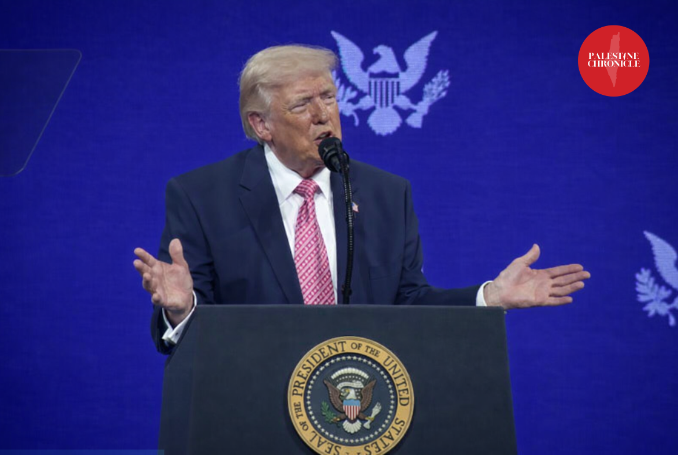
In a primetime address on Wednesday, US President Donald Trump sought to frame the war on Iran as approaching its conclusion, declaring that Washington’s core objectives are “nearing completion.”
The speech, delivered after more than a month of sustained military confrontation, presented a narrative of decisive success. Trump claimed that Iran’s military infrastructure had been significantly degraded, stating that its naval and air forces had been destroyed, while its missile capabilities had been severely weakened.
At the center of his justification remained the longstanding US position regarding Iran’s nuclear program. Trump alleged that Tehran was close to developing a nuclear weapon, framing the war as a necessary intervention to prevent what he described as an intolerable threat.
Yet even as he declared progress, the speech offered no clear timeline for the end of the aggression. Instead, Trump oscillated between projecting imminent victory and preserving the option for continued or renewed military action.
He suggested that the war could end soon, while also indicating that US forces could withdraw quickly but return if needed—an ambiguity that underscores the absence of a clearly defined end state.
The president also attempted to recast the war as a long-term strategic investment, arguing that the outcome would leave the United States safer, stronger, and more prosperous than before.
However, the broader geopolitical implications of the conflict were evident beyond the speech itself. Trump urged countries dependent on Gulf energy supplies to take greater responsibility for securing the Strait of Hormuz, arguing that the United States should not bear that burden alone.
This position reflects a notable shift: from leading global security efforts to effectively redistributing them, even as the conflict continues to disrupt one of the world’s most critical energy corridors.
The immediate aftermath of the speech further complicated the administration’s narrative. Global oil prices rose sharply, reflecting market skepticism over any imminent stabilization of the region and underscoring the continuing volatility of the conflict.
Critics have also pointed to the lack of strategic clarity. Analysts noted that the address did little to explain how the war would actually end, raising concerns that declarations of success may be outpacing realities on the ground.
Top Takeaways
A declaration of victory without a defined endpoint:
Trump’s central message is that the war is nearly won, yet he provides no concrete timeline or mechanism for ending it. The claim that objectives are “nearing completion” coexists with continued military operations and the possibility of renewed strikes, suggesting that what is being presented as closure may, in reality, be an open-ended phase of the conflict.
The nuclear argument remains the core justification:
Throughout the speech, Trump frames the war as necessary to prevent Iran from acquiring nuclear weapons, asserting that Tehran was close to achieving that capability. This narrative continues to serve as the primary rationale for military action, despite ongoing debates over the immediacy and scale of the alleged threat.
A shift from leadership to burden-sharing in global security:
By urging other countries to take responsibility for securing the Strait of Hormuz while signaling that the United States should step back, Trump points to a repositioning of US strategy. Rather than leading international efforts, Washington appears to be redefining its role, expecting others—particularly energy-dependent states—to assume greater risk and responsibility.
War framed as long-term strategic investment:
Trump presents the war as a necessary step toward future stability and strength, linking military action to broader claims about national security and economic resilience. This framing seeks to justify the costs of the conflict by projecting long-term gains.
Market reaction underscores ongoing instability:
The rise in global oil prices following the speech suggests that markets remain unconvinced by claims of imminent resolution. Rather than signaling stability, the address appears to have reinforced expectations of continued disruption, particularly around critical energy routes like the Strait of Hormuz.
The Next Phase
Trump’s April 1 address attempts to define a moment of strategic success, but it ultimately reveals a deeper uncertainty.
The war is described as nearing completion, yet its political, military, and economic consequences continue to unfold.
In this gap between declaration and reality lies the central question: whether this is truly the end of the war—or simply a transition into its next phase.
Trapped by His Own Image: Trump’s Iran War and the Politics of Ego
(The Palestine Chronicle)



Be the first to comment