
UNICEF says severe shortages, disease and exposure to cold are endangering children in displaced communities as aid remains insufficient and supplies stalled at crossings.
The United Nations Children’s Fund (UNICEF) said on Saturday that nearly 9,300 children under the age of five in the Gaza Strip suffered acute malnutrition in October, warning that the onset of winter, combined with food shortages and disease, is deepening an already severe humanitarian crisis.
UNICEF noted that high levels of malnutrition “continue to endanger children’s lives,” and stressed that winter conditions are accelerating the spread of illness and increasing the risk of death among the most vulnerable.
The organization said nutrition screenings showed a persistently high number of cases due to shortages of essential food items and the unaffordability of animal-source foods for most families.
“Despite progress, thousands of children under five remain acutely malnourished in Gaza, while many more lack proper shelter, sanitation and protection against winter,” said UNICEF Executive Director Catherine Russell. “Too many children in Gaza are still facing hunger, illness, and exposure to cold temperatures — conditions that are putting their lives at risk.”
UNICEF added that recent increases in aid have contributed to a slight improvement in market conditions, driving down prices and improving access to food for some families.
High levels of malnutrition continue to endanger children’s lives in the Gaza Strip.
The onset of winter weather is accelerating the spread of disease and increasing the risk of death among the most vulnerable children.
Learn more: https://t.co/x2qe8X56Ll pic.twitter.com/WNwat5BvrB
— UNICEF (@UNICEF) November 28, 2025
However, the organization said that “many essential items remain unavailable or unaffordable,” noting that a household survey conducted in October found that “two in three children under five consumed only two or fewer food groups out of the recommended eight” during the previous week, mostly grains, bread or flour.
According to the statement, winter has intensified the crisis, with thousands of displaced families still living in makeshift shelters without adequate warmth, blankets or protection from the elements. Heavy rainfall has swept floodwaters through populated areas, carrying sewage and waste into displacement sites.
With “poor sanitation, overcrowding and limited access to safe water,” UNICEF warned that disease is spreading rapidly and disproportionately affecting young children. The organization said that “the combination of disease and malnutrition is especially lethal,” and added that cold temperatures significantly increase caloric needs, placing malnourished children at heightened risk of hypothermia.
UNICEF said it has expanded its nutrition response in Gaza, including increasing treatment points for acute malnutrition in Gaza City, where famine was confirmed in August.
‘A Failure of Humanity Itself’: UN Confirms Famine in Gaza for First Time
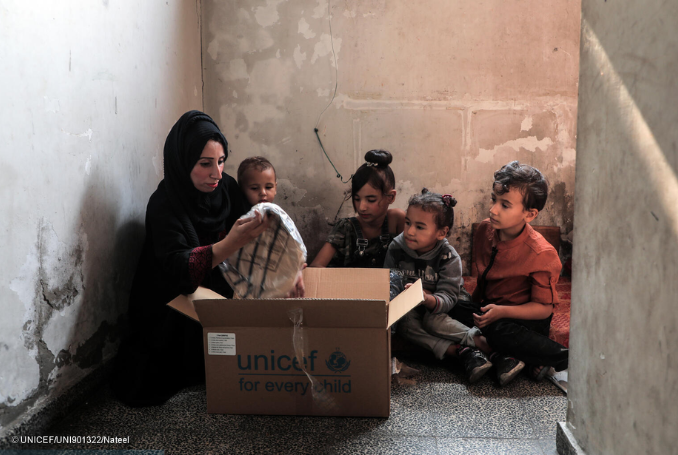
Since the ceasefire, the organization has brought tents, tarpaulins, winter clothing, blankets and mattresses into Gaza, and has distributed winter-related supplies, cash assistance and emergency services to support families and prevent displacement sites from flooding.
However, UNICEF said a significant volume of winter supplies remains stalled at border crossings, and stated that the current level of entry “is not sufficient to meet the scale of humanitarian need.” The organization reiterated its call for the “safe, rapid and unimpeded entry of humanitarian aid into Gaza, in line with international humanitarian law.”
UNICEF urged all parties to simultaneously open all crossings into the Gaza Strip with simplified and expedited clearance procedures and clear prioritisation of humanitarian supplies, to allow aid to move through all feasible supply routes including via Egypt, Israel, Jordan and the West Bank, and to permit the urgent entry at scale of the full range of life-saving and life-sustaining items, including supplies previously restricted or denied — particularly those needed to restore and maintain water and wastewater systems.
The Milk that Never Came: How Famine in Gaza Shatters the First Bond and the Soul of a Nation
Meanwhile, the humanitarian response continues to face operational risks.
According to Jens Laerke, spokesperson for the United Nations Office for the Coordination of Humanitarian Affairs (OCHA), UN staff and facilities have come under fire despite the ceasefire agreement.
He said that an Israeli helicopter “struck a UNRWA schoolyard in Jabaliya on November 24,” and that “gunfire targeted a United Nations Office for Project Services team in Deir al-Balah on November 25.” No injuries were reported.
Laerke stressed that international humanitarian law obliges all parties to protect civilians, humanitarian workers, relief convoys and civilian infrastructure, warning that “these attacks put UN staff and our partner organizations at grave risk and make life-saving work more difficult.”
Local authorities in Gaza say Israel has recorded nearly 500 ceasefire violations since October 10, resulting in hundreds of additional Palestinian casualties.
(The Palestine Chronicle)