
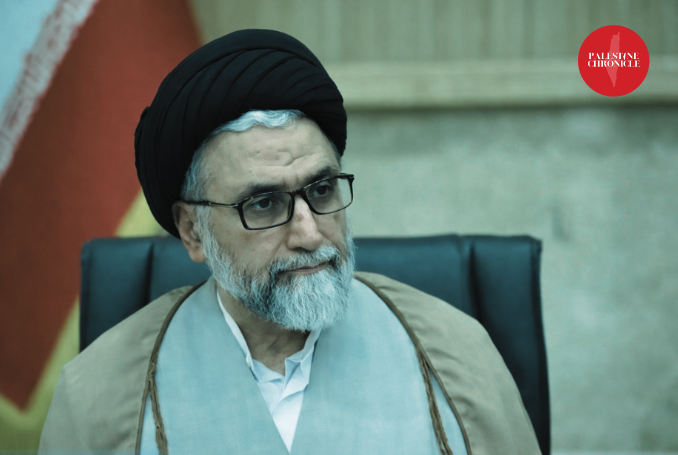

Esmail Khatib, Iran’s intelligence chief, rose through clerical and security ranks to become a central figure in the state apparatus.
Early Formation
Esmail Khatib was born in 1961 into a religious environment that shaped his early intellectual and ideological development.
He pursued religious studies at a young age, joining the hawza system, where he was influenced by leading clerical figures, including Iran’s late Supreme Leader Ali Khamenei and other senior religious authorities.
His early immersion in religious education positioned him within the ideological core of the Islamic Republic, at a time when the country was undergoing profound transformation following the 1979 revolution. This dual grounding in theology and revolutionary politics would later define his career trajectory.
Intelligence Beginnings
Khatib’s entry into Iran’s intelligence world came in the early 1980s, during a formative period for the country’s security institutions.
He joined the intelligence apparatus of the Islamic Revolutionary Guard Corps (IRGC), at a time when Iran was consolidating its internal security structure amid regional and domestic challenges.
This period was crucial in shaping a generation of intelligence officials whose roles extended beyond traditional security functions, embedding them deeply within the political and ideological framework of the state.
Khatib’s early experience in this environment provided him with operational knowledge and institutional connections that would support his steady rise through the ranks.
Institutional Rise
Over the following decades, Khatib advanced through a series of increasingly significant intelligence positions. In 1991, he was appointed head of the General Intelligence Directorate in Qom, a key religious and political center.
He later became head of the office responsible for protecting the Supreme Leader’s institution in Qom, further strengthening his proximity to the highest levels of authority.
His career expanded into the judiciary, where he served, between 2012 and 2019, as head of the Center for Protection and Intelligence of the Judicial Authority. This role reinforced his influence across multiple branches of the state, bridging intelligence and legal oversight.
His progression reflects a pattern typical of senior Iranian officials: movement across interconnected institutions, consolidating influence within the broader security architecture.
Intelligence Minister
In 2021, Khatib was nominated by then-President Ebrahim Raisi to serve as Iran’s Minister of Intelligence, following approval by the Supreme Leader. He received strong parliamentary backing and assumed one of the most sensitive positions within the Iranian government.
As intelligence minister, Khatib oversaw domestic and foreign intelligence operations, playing a central role in safeguarding the state’s internal security and managing external threats.
He remained in office even after significant political changes, including the death of President Raisi in 2024 and the election of Masoud Pezeshkian as president, underscoring his institutional importance and continuity within Iran’s security framework.
Sanctions Controversy
In September 2022, the United States imposed sanctions on him, accusing him of involvement in cyber activities targeting the US and its allies, including an alleged cyberattack on Albania.
Iranian authorities rejected these accusations, framing them as part of broader political pressure against the country’s leadership.
The sanctions highlighted the extent to which Khatib had become a visible figure in the confrontation between Iran and Western powers, particularly in the realm of cyber and intelligence operations.
Assassination
Khatib was assassinated in March 2026 in a strike in Tehran, in what Iranian officials described as part of a coordinated US-Israeli campaign targeting senior leadership figures.
His killing followed closely after the assassination of other high-ranking officials, including Ali Larijani, Secretary of the Supreme National Security Council, and Defense Minister Aziz Nasirzadeh, reflecting a widening pattern of targeted operations.
Reports had also indicated earlier strikes in March that killed several of Khatib’s aides, suggesting that the campaign against Iran’s intelligence leadership had been unfolding in stages.
Strategic Role
Throughout his career, Khatib operated at the intersection of religion, intelligence, and state power. His trajectory illustrates the structure of Iran’s governing system, where clerical authority and security institutions are deeply intertwined.
As intelligence minister, he played a central role in maintaining internal stability and navigating external threats during a period of escalating regional tensions.
His assassination marks not only the loss of a senior official but also a significant moment in the ongoing war, where leadership figures themselves have become primary targets.
‘Deep Mourning’ – Iran Announces Assassination of Intelligence Chief Khatib
(Quds News, Iranian Media, Anadolu, PC)



Be the first to comment