
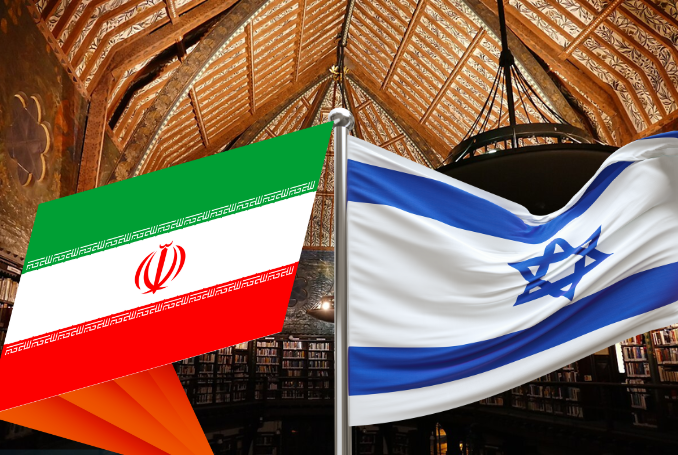

The House voted 265-113 in favor of the motion declaring Israel “a greater threat to regional stability” than Iran.
The Oxford Union, one of the world’s most renowned debating societies, has voted “overwhelmingly” in favor of a motion declaring Israel “a greater threat to regional stability” than Iran.
The debate last Thursday evaluated “threats emanating from both countries”, and key topics included “recent escalations in the Israeli–Palestinian conflict as well as the Iranian nuclear program,” according to a report by The Oxford Student, the university’s student newspaper.
It stated that both houses linked the issue of regional stability in the Middle East to global safety and international concerns.
Oxford Union vote: Israel seen as greater regional threat than Iran
——
The Oxford Union voted 265–113 in favor of the motion that Israel poses a greater threat to Middle Eastern stability than Iran, after a heated debate on 13 November.Speakers backing the motion, including… pic.twitter.com/sMtj7y3LqD
— The Cradle (@TheCradleMedia) November 17, 2025
Speakers for the proposition included Lincoln College’s Alex Webster, Jessica Rowe, former Palestinian Prime Minister and specialist in Middle East politics Mohammad Shtayyeh, and former Iranian Minister of Culture and reformist politician Ata’ollah Mohajerani.
The opposition’s speakers were St. John’s History student Katie Pannick, St. Hugh’s History Masters’ student William Rome, international human rights lawyer and executive director of the UN Watch Hillel Neuer, and Dominick Chilcott, a former British ambassador to Turkiye and Iran.
Israel ‘Biggest Cause of Destabilization’
Speaking for the motion, former Palestinian Prime Minister Mohammad Shtayyeh argued that Israel’s actions constitute the primary source of instability in the Middle East, describing it as “an expansionist colonial state established by colonial powers,” the Anadolu news agency reported.
He went on to call Israel a “pariah state” that “acts above the law,” alleging that it violates UN resolutions and enforces “a colonial regime based on apartheid against the Palestinian people.”
How Zionism and Its Traditional Relationship to Antisemitism is Playing Out Today
“Brutal occupation, crimes and genocide, … Israel is dragging the region into repeated conflicts,” he said, adding that some Israeli lawmakers believe the country’s borders should stretch “from the Nile to the Euphrates.”
“We all should say that Israel is the biggest cause of destabilization in the region,” he concluded.
Other speakers for the proposition included Lincoln College’s Alex Webster, Jessica Rowe, and former Iranian Minister of Culture and reformist politician Ata’ollah Mohajerani, the Oxford Student news report stated.
Opposing the motion were St John’s History student Katie Pannick, St Hugh’s History Masters’ student William Rome, international human rights lawyer and executive director of the UN Watch Hillel Neuer, and Dominick Chilcott, Middle East specialist and former British ambassador to Turkey and Iran.
Iran’s ‘Deeper Threat’
Pannick, who opened the case for the opposition, referred to Iran’s regional allies throughout her speech and deemed it “capable of disruption,” noting its nuclear missile program and the country’s “high appetite for risk,” the Oxford Student news report stated. She argued that Israel tended to act in a more state-centered way, even though it was “imperfect.”
Pannick concluded that “to vote against the motion is to recognize where the deeper threat lies.”
Also opposing the motion, Neuer insisted that Israel is not the destabilizing force in the region and accused Iran of arming groups across the Middle East.
“Regional stability is measured by who starts wars, not by who stops them,” he said. “Israel does not arm terror proxies in five Arab countries – the regime in Iran does that.”
He continued, “The entire Middle East knows this, which is why Arab states quietly depend on Israel for their own survival.”
Neuer cited the Iranian attack on Israel earlier this year involving drones, cruise missiles, and ballistic missiles, arguing that the coordinated response by several Arab states showed their alignment with Israel against Iranian aggression, according to Anadolu.
“You don’t intercept missiles heading toward ‘a threat to regional stability’. You intercept missiles from one,” he stated.
He also claimed that “Iran transformed Hamas into a mini-army. Tehran funded rockets, tunnels, and drone programs, while Hamas diverted aid from civilians to weapons.”
Humanitarian Crisis in Gaza
When Oxford Union President Moosa Harraj introduced the floor speech held by Union members, a proposition speaker shifted the debate’s focus to the humanitarian crisis in Gaza, the Oxford Student report noted, and how it has affected the lives of the civilian population.
“It’s tiring to see that only one side is called terrorist,” the speaker stated, adding that Israel’s actions and disregard of humanitarian principles indicate that “international law has been rendered meaningless” in this context.
Severe Weather Exposes Gaza’s Shelter Shortages – UN Reports Aid Blocked
Shtayyeh then pointed out that Israel is the only nuclear country in the Middle East that does possess nuclear weapons. “Who is acting and who is reacting?” he asked.
He also described “the sufferings of the Palestinian people since 1948 and insisted that the ‘real issue’ is in fact not a student debate but real people’s lives that are lost and destroyed through Israel’s ‘apartheid regime against the Palestinians,’” the Oxford Student report stated.
Shtayyeh’s speech, the report noted, was met with “‘persisting applause” throughout the chamber.
Previous Motion on Israel
The proposition’s final speech was given by Mohajerani, who “compared the Napoleonic wars to Israel’s actions against its neighbouring region,” the report stated. He also focused on the deaths of more than one million Iranians through Israel’s aggression, including that of his own father, it added.
Chilcott closed the debate for the opposition by again focusing on what Iran’s so-called proxy network and connection to organizations such as Hezbollah, the report noted.
These Are the Countries Fueling Israel’s Genocide in Gaza — Including Arab States
It added that he urged the chamber to “look beyond today’s agenda”, and the report continued, “acknowledged the dangers of Iran’s networks if backed by nuclear power.”
The House voted 265-113 in favor of the motion.
The Oxford Union, founded in 1823, has become increasingly scrutinized over its Israel-related debates, Anadolu reported. Last year, it passed another motion accusing Israel of being “an apartheid state responsible for genocide,” by 278 votes to 59.
(PC, Anadolu)