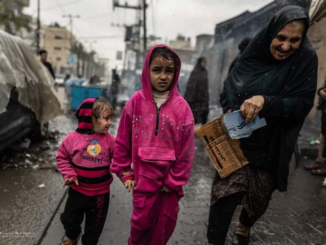
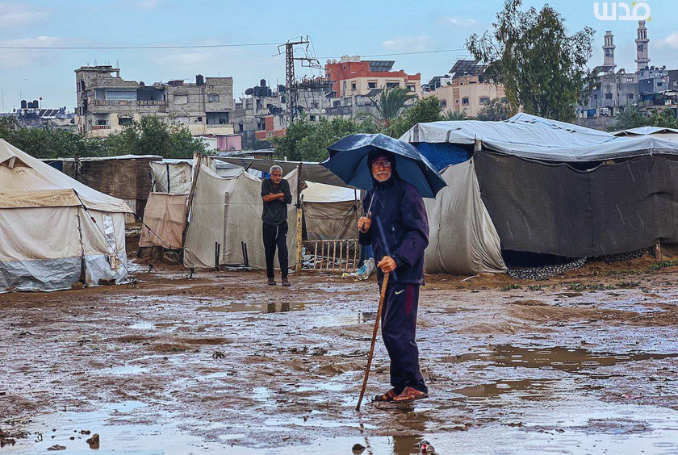

Heavy rainfall has flooded displacement camps in Gaza, worsening already severe humanitarian conditions as aid agencies warn that essential shelter supplies remain blocked from entering the Strip.
The Gaza Civil Defense reported on Saturday that heavy rainfall had flooded dozens of tents sheltering displaced families in the Al-Mawasi area, west of Khan Younis in the southern Gaza Strip.
Emergency crews, the agency said, are responding to dozens of additional tents across the affected camps.
Gaza’s children swallowed by the flood of rainwater, with no tent to shield them from the biting winter cold and no warmth to guard their fragile childhood from a world far too harsh. pic.twitter.com/UlB7OlpMN6
— Eye on Palestine (@EyeonPalestine) November 14, 2025
The development comes as the Palestinian Resistance Movement Hamas called on the guarantors of the ceasefire agreement — the United Nations, the Arab League, and the Organization of Islamic Cooperation — to take immediate action to deliver humanitarian, medical, and shelter relief to the Strip.
Hamas stated that the deteriorating humanitarian conditions underscore the urgent need for shelter and relief supplies, and accused Israel of continuing to obstruct the entry of aid, tents, and mobile housing units.
UN Warns of ‘Humanitarian Catastrophe’ in Gaza – 90% Facing Malnutrition
In a separate statement, Gaza’s Government Media Office warned that the arrival of winter has intensified the crisis for approximately 1.5 million displaced people living in makeshift tents.
Gaza Civil Defense spokesperson Mahmoud Bassal previously told Al Jazeera that thousands of tents were flooded, describing the situation as “catastrophic”. He noted that the Strip requires at least 450,000 tents to adequately shelter displaced residents.
Since early Friday, the Palestinian territories have been impacted by a cold front accompanied by strong winds and heavy rainfall, worsening conditions for more than 1.5 million displaced people living in inadequate shelters.
UN Warning
UN spokesperson Stéphane Dujarric said the organization fears that families across the Strip remain exposed to severe weather conditions. He confirmed that the UN continues efforts to provide relief, but noted that Israel has rejected 23 requests to permit the entry of essential supplies since the ceasefire began.
“Millions of units of shelter supplies remain stuck in Jordan, Egypt, and Israel awaiting approval,” he said.
UNRWA also warned that heavy rainfall is further worsening conditions in displacement areas, with many families seeking shelter in any available structure, including improvised tents. The agency reiterated an urgent need for shelter items and called on authorities to allow UNRWA to distribute supplies already in its possession.
Conditions remain dire as displaced Palestinians continue to face shortages of basic items, limited access to essential goods, and a lack of critical services due to the ongoing Israeli blockade.
LIVE BLOG: Witkoff Plans Meeting with al-Hayya as Gaza Winter Deepens Humanitarian Crisis – Day 771
According to Gaza’s Government Media Office, many displaced families are living in severely damaged tents. As of late September, approximately 93% of tents in the Strip — around 125,000 out of 135,000 — were no longer suitable for habitation.
Over nearly two years of conflict, tens of thousands of tents have been destroyed or damaged by Israeli bombardment or deteriorated due to exposure to extreme heat, rain, and wind.
Even newborn babies flooded with heavy rainwater in Gaza..
The Patient’s Friends Benevolent Society Hospital in Gaza during the rain storm on Friday..
IOF destroyed all infrastructure in Gaza, including rainwater and sewage pipes and pumps.. pic.twitter.com/HmSfsGHt16
— Motasem A Dalloul (@AbujomaaGaza) November 14, 2025
Meanwhile, Israel continues to block the entry of shelter supplies, including tents and mobile housing, despite commitments under the ceasefire agreement that took effect on October 10.
The ceasefire halted Israel’s military campaign, which began on October 8, 2023, and continued for nearly two years. The war resulted in more than 69,000 Palestinian deaths, over 170,000 injuries, and large-scale destruction affecting 90% of civilian infrastructure. Initial economic losses are estimated at approximately $70 billion.
(pC, AJA)