
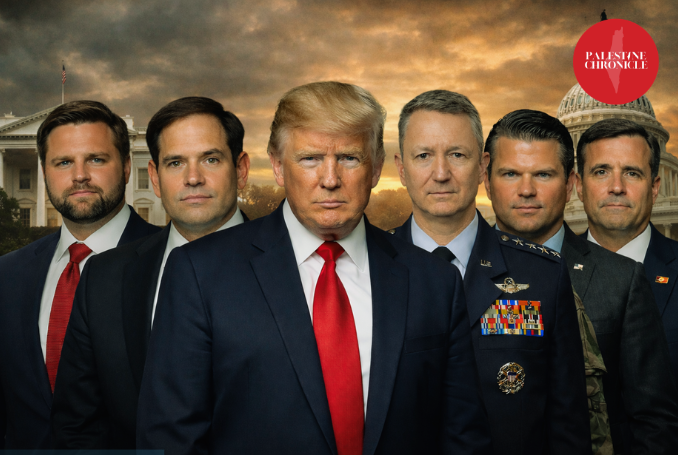

Senior US political and military leaders shaping, authorizing, and defending Washington’s escalating war against Iran.
Below are concise profiles of the senior US political and military officials directing the war on Iran.
Though some had previously warned of the potential fallout of a wider regional conflict, they now stand aligned in presenting the military escalation as an act of self-defense and a matter of national security.
These are among the key figures shaping and sustaining the current campaign.
President — Donald Trump
As President of the United States and Commander-in-Chief, Donald Trump holds ultimate authority over military operations.
Following the launch of coordinated US-Israeli strikes, Trump announced that US forces had hit “hundreds of targets” inside Iran, including facilities linked to the Revolutionary Guard, air defense systems, and naval assets.
“Our objective is to defend the American people by eliminating imminent threats from the Iranian regime,” Trump said in a video message after the strikes began.
Trump also warned that any Iranian retaliation would be met with further US action. “If they strike back, they will face consequences the likes of which they have never seen,” he stated.
He has indicated that military operations would continue until “all of our objectives are achieved,” without specifying a fixed timeline.
As Commander-in-Chief, all operational authorization flows from his office.
Vice President — JD Vance
Vice President JD Vance serves as the second-ranking executive official and a senior advisor in national security discussions.
In remarks addressing US foreign policy, Vance emphasized that adversaries must understand that “the United States will act when its interests are threatened.”
Vance has invoked the phrase “peace through strength” in defending the administration’s actions and has underscored the importance of deterrence. “Weakness invites aggression,” he stated in public comments during a policy forum.
While not directly involved in battlefield command, Vance plays a central role in shaping the administration’s political messaging and reinforcing executive authority during wartime.
Secretary of Defense — Pete Hegseth
Pete Hegseth, as Secretary of Defense, oversees the Department of Defense and is responsible for implementing presidential military directives.
At a Pentagon briefing following the escalation, Hegseth stated, “This is not Iraq. This is not endless war.”
He described the military campaign as “surgical, overwhelming and unapologetic,” emphasizing strikes against Iran’s missile infrastructure and naval capabilities.
“Iran’s stubborn and self-evident nuclear pursuits… were no longer tolerable risks,” Hegseth said.
He also made clear that there was “no fixed timeline” for operations and that the duration of the campaign would be determined by the President.
Hegseth’s office supervises troop deployments, strategic planning, logistics, and regional force posture adjustments across the Middle East.
Chairman of the Joint Chiefs of Staff — Gen. Dan Caine
Gen. Dan Caine serves as the highest-ranking military officer in the United States Armed Forces and principal military advisor to the President and Secretary of Defense.
In a joint briefing at the Pentagon, Caine confirmed the scale and coordination of the initial strikes. He described multiple targets being hit within minutes and detailed the involvement of air and naval assets deployed across the region.
Caine stated that US forces remain prepared for “further contingencies” and emphasized readiness across deployed units.
Although he does not exercise direct operational command, his assessments guide the civilian leadership’s understanding of military risks, capabilities, and escalation thresholds.
Secretary of State — Marco Rubio
Marco Rubio directs US diplomatic strategy in parallel with military operations.
Prior to and following the strikes, Rubio issued warnings to Tehran, stating that Iran should not target US personnel or allied interests. “Any attack on Americans or our partners will be met with a response,” Rubio said.
He has been engaged in briefings with congressional leaders and in consultations with allied governments.
Rubio’s office coordinates diplomatic messaging, manages international reaction, and frames the administration’s actions within broader US foreign policy objectives.
CIA Director — John Ratcliffe
John Ratcliffe heads the Central Intelligence Agency and oversees intelligence collection and analysis related to Iran’s capabilities and internal political conditions.
Before the launch of strikes, Ratcliffe participated in high-level briefings to the President regarding intelligence assessments on Iran’s missile development and nuclear program.
The intelligence community’s findings formed part of the administration’s public justification for the military operation.
Ratcliffe’s role centers on directing intelligence operations and ensuring that threat assessments reach executive decision-makers.
(The Palestine Chronicle)



Big deal…
so what? they kill children and they’re proud of it. They’re all useless.
Despite being “architects” none can articulate goals. But we can see who they are: Trump is Israel’s puppet, Vance is Corporate rep, Hesgeth & Rubio are planning Armageddon, the CIA is the US head of the US/Israel Epstein monster, and Caine is the water-boy.
I expect the worst.