
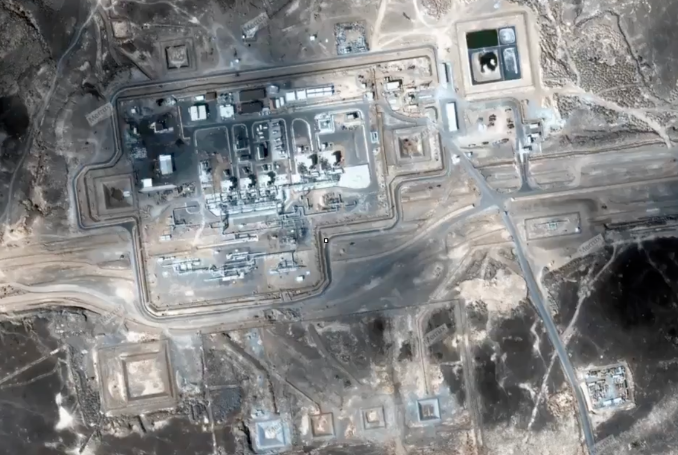

Satellite images showed extensive damage to Saudi Arabia’s East-West pipeline, threatening exports and pushing Brent crude above $108 per barrel.
Key Takeaways
- The Guardian reported that satellite images showed a pumping station on Saudi Arabia’s East-West pipeline charred and badly damaged.
- Oil stocks at the Red Sea port of Yanbu could sustain exports for only five to seven days unless the pipeline resumed operations.
- The pipeline had carried approximately four million barrels daily, equivalent to four percent of global supply, around the Strait of Hormuz.
Images Reveal Extensive Pipeline Damage
Satellite images appeared to show extensive damage to a pumping station on Saudi Arabia’s East-West oil pipeline following drone attacks that forced the kingdom to suspend operations along the vital route.
The Guardian reported that images released on Sunday night showed the facility charred and badly damaged after Friday’s attacks. The images, provided by satellite-imaging company Vantor, showed fire damage at a pumping station in the desert southeast of Medina.
The 1,200-kilometer pipeline transported crude from Saudi Arabia’s eastern oil fields to the Red Sea port of Yanbu, allowing the kingdom to bypass restrictions affecting shipping through the Strait of Hormuz.
Riyadh attributed the drone attack to militias operating from Iraq, but the Iraqi Islamic Resistance rejected the claims.
The full extent of the damage and the time required to restore the pipeline remained unclear. Industry estimates cited by The Guardian ranged from an earlier partial restart to as long as six weeks for repairs.
Saudi Arabia’s East-West Pipeline is Shut: Why Does It Matter?
Export Stocks Could Last Only Days
Saudi oil buyers and traders warned that the kingdom could exhaust oil stocks available for export unless the pipeline resumed operations within days.
According to three industry sources cited by The Guardian, stocks held at Yanbu could maintain current exports for only five to seven days.
Saudi Arabia also held oil stocks at Egypt’s Ain Sukhna port on the Red Sea and Sidi Kerir on the Mediterranean. However, those reserves were not full and would eventually be depleted if the East-West pipeline remained closed.
Saudi Arabia had been transporting approximately four million barrels per day through the pipeline, equivalent to around four percent of global oil supply.
A prolonged shutdown could therefore remove a substantial volume of crude from an already restricted market.
The route had become Saudi Arabia’s principal means of avoiding the disruption in the Strait of Hormuz, through which approximately one-fifth of global oil and gas supplies ordinarily passed.
Iran introduced controls on the waterway after the US and Israel launched their war against Tehran on February 28. Vessels were subsequently required to obtain permission to transit the strait, while Tehran considered introducing service fees.
Brent Crude Climbs above $108
Oil prices rose sharply as traders reacted to the pipeline damage and the possibility of further supply losses.
Brent crude, the international oil benchmark, climbed more than three percent to above $108 per barrel, its highest level since May.
Oil had peaked at approximately $126 per barrel in April before declining over the summer amid expectations of a lasting ceasefire. Prices began rising again after a memorandum of understanding between the US and Iran collapsed and hostilities intensified.
The disruption also affected refined fuel and gas markets. US diesel prices rose above an average of $6 per gallon, while the UK wholesale gas benchmark climbed five percent to its highest level since December 2022.
The increase added to inflationary pressure worldwide as central banks in the US, Britain and Japan prepared to announce interest-rate decisions.
“Oil markets are being subjected to their worst fears all at once – attacks on energy infrastructure, the closure of Hormuz and a breakdown in attempts to restart negotiations,” market analyst Chris Beauchamp told The Guardian.
Ansarallah’s Advance on Al-Mokha, Bab al-Mandeb: All You Need to Know
Ansarallah Expands Position at Bab al-Mandab
The pipeline shutdown came as the Yemeni Armed Forces, affiliated with the Ansarallah movement, expanded their position around the Bab al-Mandab Strait.
Ansarallah captured the strategic island of Perim, also known as Mayyun, strengthening its control over the narrow waterway connecting the Red Sea and the Gulf of Aden.
The movement had also announced a blockade and intensified attacks against Saudi infrastructure and shipping.
These developments placed Saudi Arabia under pressure at both ends of its alternative export route. Iranian controls continued to restrict shipping through Hormuz, while Ansarallah’s advances increased its leverage over maritime traffic entering and leaving the Red Sea.
The capture of Perim also brought Ansarallah closer to Djibouti, where the US operates its largest permanent military base in Africa.
Concerns over energy supplies intensified after a planned meeting between Iran and Gulf Arab states was postponed.
Iranian representatives had been expected to present an agreement reached with Oman concerning the regulation of shipping through the Strait of Hormuz.
Omani Foreign Minister Sayyid Badr Albusaidi announced that the meeting had been postponed “in the interests of consensus.” No new date was immediately announced.
(PC, The Guardian)





Be the first to comment