
By Palestine Chronicle Editors
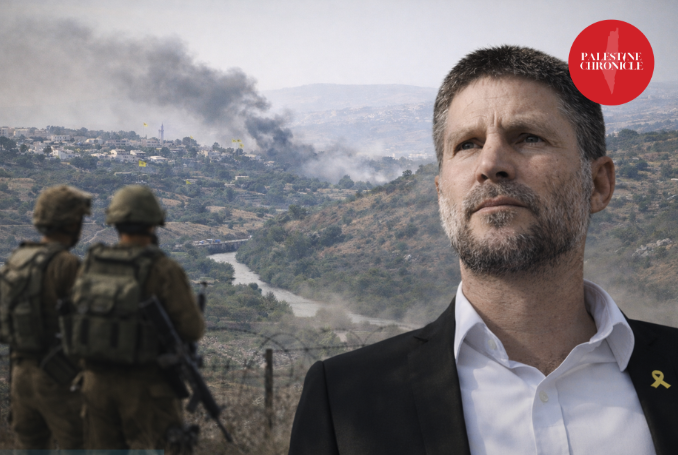
The wounding of Smotrich’s son raises new questions about whether Israel misjudged Hezbollah’s remaining strength near Lebanon’s border.
Key Takeaways
- The son of Israeli Minister Bezalel Smotrich was wounded during clashes near the Lebanon border.
- Israel reports few casualties on the northern front, raising questions about Israeli credibility.
- The ceasefire framework was meant to push Hezbollah north of the Litani River.
- Recent clashes suggest Hezbollah still retains capabilities south of the Litani.
- The incident raises questions about whether Israel miscalculated Hezbollah’s resilience.
A Symbolic Blow
The reported wounding of a son of Israeli Finance Minister Bezalel Smotrich near the Lebanon border may appear militarily minor. Israeli media said his condition was mild and offered few details about the incident itself.
Yet politically, the development carries weight far beyond the battlefield.
Israel’s public broadcaster KAN reported on Friday that Smotrich’s son was injured during clashes along the Lebanon border. The exact circumstances of the injury were not immediately clear, and Israeli authorities released no detailed operational information.
Even so, the symbolism is difficult to ignore.
Smotrich is one of the most extreme figures in Israel’s governing coalition and among the loudest advocates of escalating wars across the region. When the son of such a senior official becomes directly involved in frontline fighting, the conflict ceases to feel distant from Israel’s political elite.
The episode also arrives at a moment when Israel has sought to project confidence regarding its northern front.
For months, Israeli officials and military briefings have suggested that Hezbollah’s military capacity near the border had been severely degraded following repeated Israeli strikes and the enforcement of the post-war ceasefire arrangements.
Events on the ground are beginning to complicate that narrative.
Official Numbers
Israel’s official casualty figures along the Lebanese front remain strikingly low.
Israeli military statements cited in international reporting indicated that only a small number of soldiers have been wounded in recent clashes along the northern border.
If those figures are accurate, the injury of Smotrich’s son appears statistically unusual.
But if the fighting has been heavier than publicly acknowledged, the incident may be one of the few that reached public attention because of the political prominence of the soldier involved.
Israel has historically maintained strict military censorship regarding battlefield casualties and operational setbacks. This is particularly true during periods of intense conflict when maintaining public morale and strategic deterrence is seen as critical.
The ongoing war and genocide in Gaza have demonstrated how tightly controlled information about battlefield losses can be.
This does not necessarily mean official figures are false in the current case. However, it does highlight why casualty numbers alone cannot be taken as a full measure of battlefield realities.
The more significant question lies elsewhere: whether Israel misread Hezbollah’s remaining operational capabilities near the border.
The Litani Framework
Under the ceasefire arrangements that followed previous escalations, Hezbollah fighters were expected to withdraw north of the Litani River.
The logic behind this framework was clear.
The Litani River runs roughly thirty kilometers north of the border between Lebanon and occupied Palestine. For years, Israeli strategy has sought to keep Hezbollah’s heavy military infrastructure away from the immediate frontier.
Under the ceasefire terms, the Lebanese army and UN peacekeepers were expected to deploy in southern Lebanon, while Hezbollah’s forces and weapons would remain largely north of the river.
In theory, this arrangement would significantly reduce Hezbollah’s ability to, from an Israeli viewpoint, threaten Israeli communities and settlers along the border.
Israel reinforced this strategy with repeated airstrikes, surveillance operations, and targeted attacks intended to, supposedly, degrade Hezbollah’s infrastructure across Lebanon. These attacks reached nearly 10,000 violations that have resulted in mass casualties and massive destruction.
Officials in Tel Aviv repeatedly suggested that these measures had weakened the movement’s operational capacity near the frontier.
Yet recent fighting suggests the situation may be more complicated.
IRGC: ‘New Weapons are on the Way’ – Dispatches from the Battlefield – Day 7
South of the River
Israeli media have increasingly acknowledged that Hezbollah’s capabilities near the border appear more intact than expected.
Reports described what some outlets called a “serious security incident” along the northern frontier after anti-tank missiles and other attacks targeted Israeli forces.
At the same time, Hezbollah has continued launching rockets and drones toward Israeli military positions and infrastructure.
Recent operations reportedly targeted Israeli military sites in the Galilee and a defense industry facility associated with Rafael Advanced Defense Systems.
These developments suggest that Hezbollah has retained meaningful operational capacity close to the border, despite the ceasefire framework that was supposed to push its fighters north of the Litani.
In other words, the strategic surprise may not lie north of the river at all.
Instead, it may lie in the fact that Hezbollah appears capable of operating effectively in areas where Israeli planners believed its presence had been substantially reduced.
This raises difficult questions for Israel’s military leadership.
If Hezbollah’s military networks south of the Litani remain resilient, then months of Israeli airstrikes and enforcement operations may have failed to produce the strategic results Israeli officials repeatedly claimed.
Escalating Exchanges
The situation has been further complicated by the broader regional war.
Israel’s escalating military operations across Lebanon have been accompanied by increasingly direct responses from Hezbollah.
Recent clashes reportedly included guided missile strikes on Israeli troop positions, drone attacks on military barracks, and rocket barrages targeting Israeli military infrastructure.
Israeli airstrikes, meanwhile, have struck multiple areas across Lebanon, including southern towns, the Bekaa Valley, and Beirut’s southern suburbs. Hundreds of Lebanese, mostly civilains, have been killed or wounded in the latest escalation.
Lebanese officials have warned that repeated Israeli violations of Lebanese sovereignty cannot continue indefinitely.
Hezbollah’s leadership has also indicated that its patience is limited, suggesting that the confrontation may expand if Israeli attacks persist.
In this context, the northern front is no longer merely a secondary theater connected to Gaza or Iran.
It is increasingly becoming a central arena of the wider regional confrontation.
‘We Hit USS Abraham Lincoln’ – Dispatches from the Battlefield – Day 6
Our Strategic Assessment
Israel may indeed have miscalculated—but perhaps not in the simplistic sense of expecting Hezbollah to disappear as a military force.
The deeper miscalculation may have been believing that Hezbollah could be sufficiently contained through a combination of ceasefire frameworks, international deployments, and repeated airstrikes.
The assumption appears to have been that pushing Hezbollah north of the Litani River would significantly weaken its operational reach along the border.
Yet the latest exchanges suggest that Hezbollah’s networks, logistics, and fighters may remain more deeply embedded in southern Lebanon than Israeli planners anticipated.
This does not necessarily mean Hezbollah is stronger than before the previous wars.
But it does suggest that the movement retains enough resilience to complicate Israeli military planning and challenge claims that the northern front has been stabilized.
The wounding of Smotrich’s son does not by itself prove that Israel is hiding large numbers of casualties, nor does it definitively prove that Hezbollah has regained full operational dominance along the border.
However, the incident highlights a broader reality that Israel’s northern front appears more volatile, contested, and strategically uncertain than Israeli leaders have publicly suggested.
And if Hezbollah’s presence south of the Litani remains stronger than expected, then Israel’s strategy of containment may already be facing its first serious test.
(The Palestine Chronicle)




Aaaawwww…
Muffiiiiiinnnnn.
OH WELL! the Israeli Jewish Nazis deserve a good nosebleed. I hope Iran and/or anybody fighting with them flattens Israel. Raze it. But, give some notice so the innocent ones can leave.
There are no ‘innocents’ in israel.
‘Nosebleed’?? Two eyes for an eye, and a skull for a tooth.