
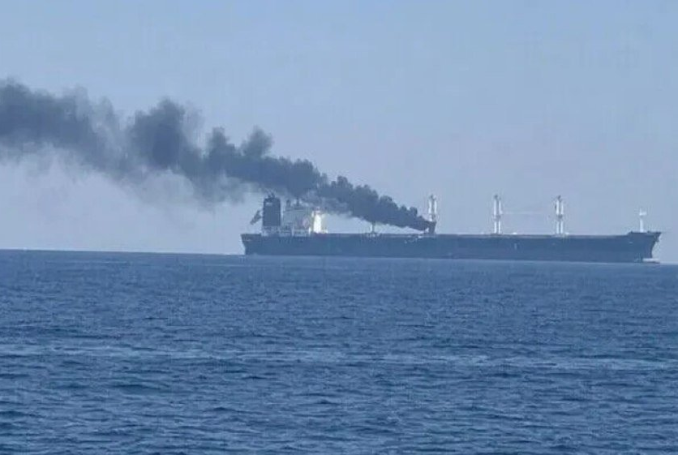

Two tankers were struck off Oman Saturday after a Friday tanker fire that Iran attributed to mines along an unauthorized route.
Key Takeaways
- UKMTO reported two separate tanker strikes near Khasab on Saturday, one hitting a vessel’s stern and another its engine room.
- A tanker also caught fire Friday. Iran attributed that incident to naval mines, while UKMTO reported a strike by an unidentified projectile.
- No casualties were reported in the UKMTO accounts, but the environmental consequences of Saturday’s strikes remained unconfirmed.
Two oil tankers were struck by unidentified projectiles in separate incidents near Oman’s Khasab port on Saturday, the UK Maritime Trade Operations center said, following a tanker fire in the Strait of Hormuz a day earlier.
Both vessels were traveling outbound through the strait when they were hit less than an hour apart. UKMTO reported no casualties in either incident, while the environmental impact remained unconfirmed.
The strikes add to continuing dangers for commercial shipping through the waterway amid the US-Israeli war on Iran and stalled negotiations over navigation. Tehran has repeatedly warned vessels against attempting passage without coordinating with its forces.
🇺🇸🇮🇷 A massive oil tanker catches fire following an attack off the southern coast of the Strait of Hormuz this morning. pic.twitter.com/rxWSgTVKe8
— KOSO (@KosoWrldwide) November 21, 2026
Tankers Hit at Stern and Engine Room
The first Saturday incident occurred at 0500 GMT, approximately 11 nautical miles north of Khasab.
“A Tanker transiting outbound in the Strait of Hormuz has been hit on the stern by an unknown projectile,” UKMTO said in a statement.
A second incident followed at 0550 GMT, 17 nautical miles east of Khasab, where another outbound tanker was struck in its engine room.
UKMTO did not identify the vessels or attribute responsibility for the strikes. It said authorities were investigating and urged ships in the area to exercise caution and report suspicious activity.
On Friday, Iran’s Islamic Revolutionary Guard Corps Navy announced that a tanker had exploded and caught fire after striking naval mines near Khasab while attempting to cross what it described as an unauthorized route.
In a statement carried by Iranian broadcaster IRIB, the force said the vessel had attempted passage with US military support and had violated navigation rules. It said images would be released later and warned that ship movements in the strait and the Gulf were being monitored.
Separately, UKMTO reported that an outbound tanker had been struck on its port bow by an unidentified projectile. The vessel’s company security officer reported a fire aboard the tanker.
Shipping through the strait of Hormuz remains 65% below pre war levels.
Only 263 ships passed through the strait during the week, down from 308 the previous week. 6 tankers were also hit.
Meanwhile, insurance costs for tankers operating in the persian gulf have increased… pic.twitter.com/RXJvTK0NhQ
— Current Report (@Currentreport1) November 21, 2026
Navigation Dispute Persists During War
Iran has repeatedly insisted that vessels coordinate passage through Hormuz with its armed forces, warning that ships entering areas it designates as dangerous risk striking mines and catching fire.
Those warnings contrast with US Central Command’s assertions that the main shipping lanes have been cleared of mines and are safe for transit.
Navigation through the strait has remained a central dispute in efforts to end the war, which began with US and Israeli attacks on Iran on February 28. Tehran responded with attacks on Israel and US military facilities in Arab countries.
Washington and Tehran signed a memorandum of understanding in June and entered negotiations, but talks later stalled over disagreements concerning safe and free navigation through Hormuz.
Fighting between the United States and Iran has flared intermittently since July despite diplomatic efforts. The latest tanker strikes and fire underscore the continuing risks facing vessels attempting to leave the Gulf through the strait.
(PC, AA, Al Mayadeen, UKMTO)




Be the first to comment