
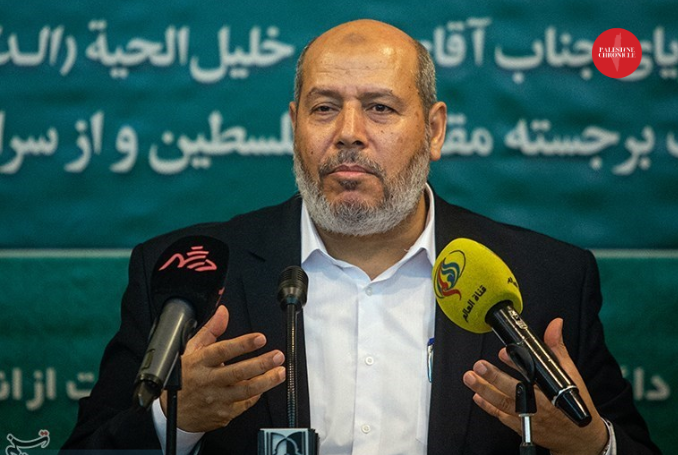

Khalil al-Hayya called for inclusive Palestinian leadership, a unity government and general elections while urging regional action against Israeli expansion.
Key Takeaways
- Al-Hayya called for unified national leadership within an inclusive Palestine Liberation Organization, a unity government in Gaza and the West Bank, and presidential, legislative and Palestinian National Council elections.
- He accused Israel of continuing its military aggression and starvation policy despite the Sharm el-Sheikh agreement, urging Arab and Islamic support for Gaza.
- He warned of displacement and land seizures in the West Bank, threats to Jerusalem and Al-Aqsa, and Israeli expansion across the region.
Hamas leader Khalil al-Hayya has called for the formation of unified Palestinian national leadership within the framework of the Palestine Liberation Organization, bringing together all political forces, alongside a national unity government covering the occupied West Bank and Gaza Strip.
Addressing the 35th Arab National Conference in Beirut, al-Hayya also called for general presidential and legislative elections and elections to the Palestinian National Council, placing political unity and renewed representation at the center of his proposals.
His appeal came alongside warnings that Israel continues its aggression and starvation policy in Gaza despite the Sharm el-Sheikh agreement, while pursuing displacement and land seizures in the West Bank and expanding its military attacks across the region.
On World Children’s Day, nearly 22,000 Children Killed in Gaza, 350 Imprisoned
Palestinian Unity and Gaza’s Survival
Al-Hayya said Gaza’s population “remains steadfast on its land” and committed to its rights despite hunger, military aggression and the absence of basic necessities.
He said Hamas and other Palestinian factions had accepted the Sharm el-Sheikh agreement “to protect Palestinians from genocide and displacement”, but that Israel had continued its attacks and policy of starvation.
Against those conditions, he called on Arab and Islamic countries and communities to provide the support needed to sustain Gaza’s population, strengthen its resilience and secure the necessities for survival.
His proposals for an inclusive PLO leadership, a unity government and general elections addressed the need for a common Palestinian political framework across Gaza and the West Bank.
Al-Hayya warned that Israeli plans in the West Bank seek to drive Palestinians from their communities, seize their land and homes, and uproot them from their properties.
He also pointed to attempts to impose Israeli control over Jerusalem and alter its Palestinian identity. At Al-Aqsa Mosque, he warned that temporal and spatial division—separating access by time and area—had become almost a reality.
Al-Hayya reaffirmed Hamas’ commitment “to resisting the occupation in all its forms”, presenting resistance as a means of “protecting Palestinian rights and recovering land and holy sites”. He said the movement would continue pursuing liberation and return.
He argued that Israel had failed to achieve its objectives of defeating the Palestinian people, displacing them and imposing its will. Operation Al-Aqsa Flood, he added, had created an unprecedented situation for the Palestinian cause and the wider Arab and Islamic world.
‘He Disappeared beneath the Sand’: The Deadly Sewage Pits between Gaza’s Tents
Warning Against Israeli Regional Expansion
Al-Hayya linked the threats facing Palestinians to Israel’s military actions beyond Palestine, pointing to attacks on Lebanon, Syria, Iraq, Yemen and Iran.
He warned that the project of establishing ‘Greater Israel’ had moved beyond ambition into implementation, framing the confrontation as a regional challenge requiring coordinated action.
He praised the Lebanese resistance movement Hezbollah for supporting Palestinians and their resistance during the battle, and called for a more active role for resistance forces across the region.
That effort, he said, should include widening the axis of confrontation and coordinating Arab and Islamic movements against Israeli plans for control and domination.
Three Years into Genocide: Palestine is Global, but Who Still Silences It?
Al-Hayya also urged the formulation of a unified Arab position to build on what he described as the strategic opportunity created by Al-Aqsa Flood. He called for overcoming internal disputes, reviving collective Arab action and preventing Israel from exploiting divisions within the Arab and Islamic world.
Closing his address, he extended greetings to Lebanon and expressed hopes for its unity, stability, recovery and prosperity.
(PC, QNN, Telegram)



Be the first to comment