By Benay Blend
The attack on Chris Smalls was horrendous in itself, in that the Zionist regime singled him out for special treatment because of the color of his skin.
On July 26, 2025, the Israeli occupation forces intercepted and boarded the Handala, a ship that was attempting to breach “Israel’s” long-running blockade of Gaza.
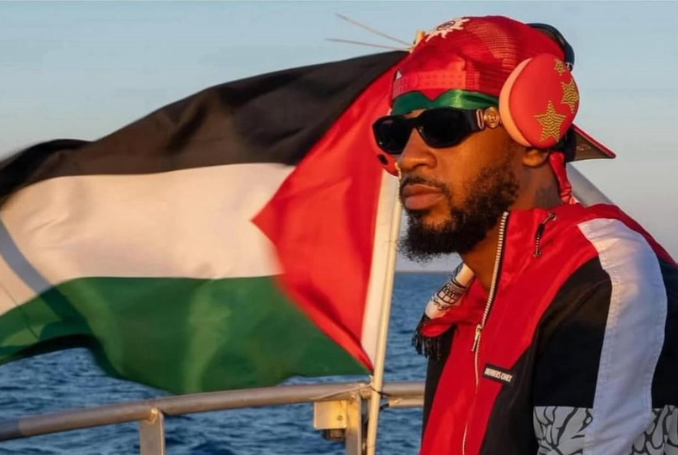
According to the Freedom Flotilla Coalition, a grassroots international collective, IOF soldiers beat and choked the only Black activist on board the ship, Chris Smalls, who is well-known for co-founding the Amazon Labor Union (ALU).
His assault highlights the connection between race and the history of Zionism, an association that forms the core of a recent edited collection entitled Race and the Question of Palestine (2025), edited by Lana Tatour and Ronit Lentin.
“What we are witnessing in Gaza is race at work,” the editors write, namely “the treatment of Palestinians not just as less than human, but also as nonhuman” (p. ix).
“Palestinians, as nonwhite, are treated as statistical and logical figures of suffering, displacement, dispossession, and death,” they continue, “while Israelis, due to their proximity to whiteness, are seen as natural embodiments of life” (p. ix).
In this way, editors Lana Tatour and Ronit Lentin advocate for a racial analysis that centers Palestine within global histories along with current policies of imperialism, colonialism, capitalism, and patriarchy (p. 5).
Accordingly, on their Instagram account, Stop Cop City writes next to a photo of Chris Smalls: “From the streets of Ferguson to the port of Ashdod, the legacy of anti-blackness stretches across borders.”
In this way, they see the attack on the lone Black participant as part of a long history of transnational racism, ranging from the August 2014 shooting of Michael Brown by the police in Ferguson, Missouri, to the beating of the lone Black participant in the quest to bring aid to starving Palestinians.
Moreover, these activists note other ways in which anti-Blackness is global. “From Gaza to Atlanta, the system is the same. Cop City, built on stolen Muscogee land, trains U.S. police with Israeli forces through GILEE.”
There is a long history of mutual support between Black Americans and Palestinians, perhaps because the former see their lives mirrored by the latter. For example, when Angela Davis visited Palestine in 2011, she saw in Hebron worse segregation policies than in Alabama of her youth.
Upon her return, she vowed to globalize the U.S. freedom struggle to include all those fighting against colonialism of their land (Davis, “We Have to Talk About Systemic Change,” Freedom is a Constant Struggle: Ferguson, Palestine, and the Foundations of a Movement, edited by Frank Barat, 2016, p. 45).
More recently, Ta-Nehisi Coates travelled to Palestine, where his impressions mirror those of Davis. In The Message (2024), Coates noted that Hebron resembled the segregated world in which his parents had lived; thus, it was a place where separate and unequal survived (p. 128). In Jerusalem, where Palestinians have “residency” but not citizenship, he experienced anger over massacres that marked his own people’s past, but this time, iniquities were being done in his name as an American citizen (p. 203).
Smalls did not have firsthand experience of racist “Israeli” policies. On July 24, while the ship was nearing Gaza, Rising Up host Sonali Kolhatkar spoke with Chris Smalls about why he joined the 21 activists to bring supplies of baby formula, food and medical aid to Palestinians starved by the Zionist blockade.
As founder of the Amazon Labor Union, Smalls understood how Amazon was guilty of undermining workers’ rights. More than that, however, he claimed that unions, which he feels should be supportive of the Palestinian people, are not doing enough to help.
Moreover, he charged that Amazon “is not just complicit. They are actively participating and actively a part of the military industrial complex that Israel uses to target, surveil, and even kill these innocent Palestinians every day.”
Specifically, Smalls states that AWS Web Services, Amazon, and other corporations have pledged $7.2 billion to “Israel’s” Iron Dome. In this way, he connects the dots between corporate support for the Zionist state and his stance as a labor leader that “enough is enough,” a message that he hopes gets through to other unions.
To make matters worse, as of July 29th, Chris Smalls’ Union President, the Teamsters’ Sean O’Brien, has remained silent on Smalls’ condition. At that time, only the California Faculty Association had issued a statement calling for the release of Smalls as well as other participants held by the IOF.
In late July, 2025, the Palestine Federation of Trade Unions issued a call to members of trade unions and federations around the world asking that global workers denounce the Gaza genocide; pressure respective governments to end weapons sales to the entity as well as impose sanctions on the “settler-colonial and apartheid regime”; honor the call for Boycott, Divestment and Sanctions (BDS); and finally, organize days of rage and global solidarity in factories, workshops, and in public spaces.
Given the violent, racist attack on Smalls by the Zionist regime, now would be an excellent time for labor unions around the world to issue statements in support of this worker who has done so much for the global labor movement.
Smalls’ own Amazon Labor Union (ALU) answered the Call from their Palestinian colleagues. By demanding a permanent ceasefire and a bid to hold the US government complicit in the Gaza genocide through the sale of arms to “Israel,” union members actively support labor’s motto “An Injury to One is an Injury to All.”
As for politicians, so far only Jamaal Bowman, Summer Lee, Rashida Tlaib, and Ilan Omar have spoken out on social media. In their statement of support, Black Alliance for Peace (BAP) calls out “so-called progressives and liberal elites” for their silence.
According to BAP, it is this “complicity of the U.S.’s own Black Misleadership Class, which too often aligns with sustaining pan-European, capitalist, patriarchal interests,” that gives “Israel” the green light for genocide in Gaza as well as the escalating siege and land theft on the West Bank.
“The capture, brutalization, and imprisonment of Smalls by the fascist and racist IDF underscores the urgent need for solidarity between African/Black and Palestinian struggles,” the statement ends, an alliance that would go far in rebuking white supremacist settler colonialism that weaves through both of these violent and genocidal nations.
The attack on Chris Smalls was horrendous in itself, in that the Zionist regime singled him out for special treatment because of the color of his skin.
It also highlights many of the issues that often get overlooked by internationals in the struggle for a free Palestine. As Black Lives Matter (BLM) states, Smalls had joined BLM in April 2025 to protest the rise of police violence towards Black and working class people.
In this way BLM, along with Smalls, echoed Stop Cop City in their condemnation of Israeli training of US forces as well as the two nations exchanging weapons and surveillance systems that are used on Palestinians as well as Black Americans.
Despite wide media coverage of Smalls’ previous labor organizing, Payday Report charged that as of July 29th not a single major media outlet had covered his violent arrest. Protesting for labor rights appears fine as long as it doesn’t delve into corporate complicity in Gaza genocide.
Not only the press, but also what BAP terms the Black Misleadership Class have remained silent regarding the Zionist assault on Smalls.
Finally, as the statement from BAP makes clear, Smalls’ legacy makes clear that
“a vital understanding that the liberation of any domestic working class is inextricably linked to the defeat of U.S.-led Western imperialist domination. This attack on a working-class, anti-imperialist leader further highlights the connection between domestic oppression and Western imperialism, where the U.S. and its allies— including Israel— act with impunity.”
As of July 31st, Chris Smalls is being released from prison, then he will be transported to Jordan followed by Dubai for his final flight to Newark International Airport. There activists are arranging for a welcoming committee replete with “flags, signs, kuffiyehs, and loud love.” Regarding his reception, all is as it should be.
– Benay Blend earned her doctorate in American Studies from the University of New Mexico. Her scholarly works include Douglas Vakoch and Sam Mickey, Eds. (2017), “’Neither Homeland Nor Exile are Words’: ‘Situated Knowledge’ in the Works of Palestinian and Native American Writers”. She contributed this article to The Palestine Chronicle.