
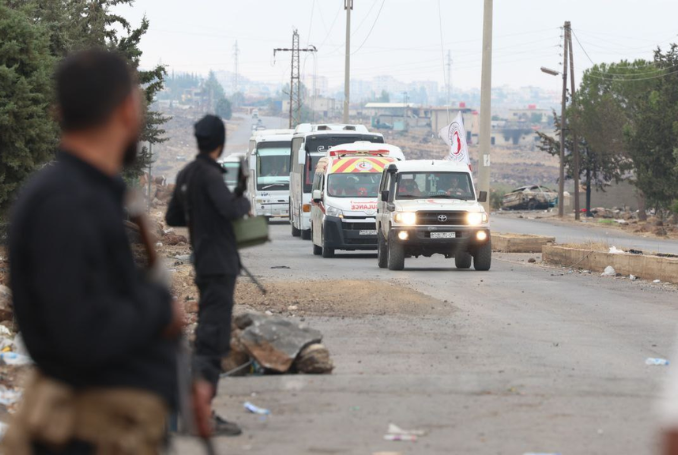
An Israeli agenda has been hatched inside of Syria and the new administration in Damascus is taking every step to accelerate it.
What happened inside the Sweida Province over the last week has demonstrated that the new rulers of Syria simply have no power over the country and rely completely on outside help.
The sectarian bloodshed in southern Syria, culminating in bloody battles between Druze and Bedouin militia forces in Sweida City, revealed the rather shocking truth about the current state of affairs inside the country.
The conflict truly began on July 11, with the kidnapping of a trader from the Druze minority sect who was travelling towards the Syrian Capital. After Bedouin militiamen captured the Druze man, there was also an armed assault on a checkpoint area by Bedouin tribal forces. This eventually led to a breakout of clashes between Druze and Bedouin militias, in addition to the kidnapping of around a dozen Syrian Druze.
Syrian government-aligned security forces were sent into the Sweida province on July 13, in an alleged attempt to de-escalate tensions. Yet local Druze civilians and militias reported that the security forces had sided with the Bedouin tribal forces who share their Sunni Muslim identity.
Before anyone could get to the bottom of what was going on, Bedouin tribal forces began to mobilize across the country, as Druze militants also did the same in the Sweida province. The new Syrian army forces, aligned with the ruling Party of Hayat Tahrir al-Sham (HTS) were then sent in, as the situation descended into what could only be described as a civil war-styled clash.
What was so telling about this situation was that not only did the new Syrian army forces participate in sectarian massacres, some of which were caught on film, but the agreements struck between the government of Syria’s leader, Ahmed al-Shara’a, and Druze militias failed until a third truce was called.
The first alleged ceasefire came about with the retreat of Syrian army forces from Sweida following an Israeli airstrike campaign that killed as many as 700 government-aligned fighters. Israel also bombed Syria’s Ministry of Defence building. Yet, the agreement did not hold more than a few hours before Druze separatist forces, aligned with Sheikh Hikmat al-Hijri, decided to continue fighting and enter Bedouin majority neighbourhoods.
Ahmed al-Shara’a appeared after nearly 48 hours of chaos for only 5 minutes, with a speech that was far from reassuring. We also heard three separate times that he was set to speak imminently, before his extremely short address came.
While Syrians had taken to the streets in their thousands to demand retaliation against Israel, which has been invading and bombing the country since December without any response, al-Shara’a claimed that his government had decided not to be “dragged” to war and instead negotiated an agreement with the Druze minority.
Yet, Israeli airstrikes continued and 41 Bedouin Tribes mobilised to fight Druze militia forces in Sweida. Sectarian violence ultimately claimed the lives of around 1,400 people and the Damascus government was pretty much nowhere to be seen.
Political Theater on Gaza: The Trump-Netanyahu Ceasefire Deal
After another alleged ceasefire failed, there were a few more days of intense fighting by Israeli-backed Druze forces, in addition to independent Druze militias not affiliated with Israel, against Bedouin tribes and elements of the Syrian army.
Out of nowhere, US Envoy Tom Barrack announced a bizarre ceasefire between Israel and Syria, urging all other parties to stop fighting. This was strange for a few reasons, the first of which was that the Syrian authorities had not fired a bullet towards Israeli forces; the only one firing was Israel. The only war was between Druze and Bedouin militias.
Later, as it appeared the Druze were ready to stop fighting after being promised that Sweida City would remain in their hands, the Bedouin Tribes were ultimately convinced to conclude a prisoner swap and reluctantly halted their offensive to capture all of Sweida. Clashes then continued for two days in the countryside, yet the situation somewhat stabilized.
In all of this, the lesson learnt here was that the Syrian government has no control over the country. The Bedouin Tribal forces can manage to mobilise as many as 75,000 fighters, while the combined forces of the Druze could be up to 60,000 fighters per some estimates. On the other hand, the Syrian State forces number no more than 30,000.
Every area of Syria is patrolled by local militias who wield the true power. In nearly 8 months, Ahmed al-Shara’a has failed to unite the country; he dismantled the Syrian army and security forces, instead replacing them with sectarian militia groups who are not equipped to deal with the current state of affairs inside the country. A deal struck previously with the Kurdish-led Syrian Democratic Forces (SDF) has failed to come to fruition also.
Instead, the deeply fragmented country has only devolved into further chaos, with minority groups like the Christians, Alawites, Druze and Shia enduring routine civilian massacres, kidnappings, persecution, exclusion and field executions. Sometimes the sectarian violence comes at the hands of the State’s security forces, other times from unidentified militant groups brandishing ISIS patches.
Breaking Point: How Israel Will Drag Lebanon to Civil War over Normalization
A woman from the Sunni majority in Syria, who lives in Hama, told the Palestine Chronicle that the situation is chaotic. “We were hopeful when the regime fell at first, we thought the country would return to normal and we would have a new government, but instead many people lost their jobs and the extremists do whatever they want, from all sides.”
“I know many religious people here who would pray in the Mosque five times a day, now they only go to the Jummah (Friday prayer), because of the extremists who took over their Mosques”, she said. Continuing on, she added “many people feel like we are lost and don’t know what to do, but it is scary and there are killings every day that people don’t even hear about.”
What Will This Mean?
At the current moment, Syria can be considered a land, but there is clearly no real State to be spoken of. Instead, there is a leadership in Damascus that is speaking on behalf of a country that it doesn’t properly control. This leadership is completely in the hands of the US, EU and to an extent, Turkiye, which lead its decision making.
These outside actors are trying to forge a path forward, but are failing to stabilize the country. While there is an enormous amount of propaganda from all sides about Syria, any fair analysis has to factor in how Ahmed al-Shara’a actually seized power.
It was clear that the offensive from Idlib in late November was only geared towards capturing Aleppo to begin with, yet when Bashar al-Assad’s government began to evaporate the decision was made to capture Damascus.
The seizure of Aleppo had a number of tell-tale signs that the offensive wasn’t aimed at taking over the entire country and that al-Shara’a was not prepared for this. Perhaps the most obvious one was the pro-opposition propaganda set up to support the notion of a resistance force to the government in Damascus.
Hezbollah vs. Israel: Why a New War is on the Horizon – Analysis
At the time, HTS even produced its own military spokesperson who wore a Kuffiyeh over his face and spoke in the exact same style as the spokesman for Hamas’ al-Qassam Brigades, Abu Obeida. This masked militant figurehead soon disappeared from the scene with the capture of the capital.
When we consider that HTS was not prepared to take over the country, it makes a lot of sense why the inexperienced group has proven itself as politically incapable. Another factor here is that they are not independent; they are torn between the interests of the US, EU, Gulf States, Jordan and Israel. Syria has no sovereignty and if the current leadership makes mistakes, they are instantly punished and are threatened with elimination.
So, believing that it will make him safe, Ahmed al-Shara’a has relied on the US and desperate attempts to appease the Israelis at every turn, to keep his government in power. Yet, the Israelis see that he has no real control over the militias across his country, opening the door for them to continue pursuing their long-sought strategy to encourage the rise of a Druze State in the south that will serve as a convenient buffer and ally.
This kind of government in Damascus serves Israel’s agenda. On the one hand, it has disbanded the Syrian Arab Army and Israel has eliminated most of its strategic weapons, meaning it poses no existential threat alone, while on the other hand it refuses to even entertain the idea of resistance and works with Tel Aviv to ensure no threat will be posed to it.
What has emerged from the recent sectarian violence in southern Syria however, has been an uptick in support for Hezbollah and its weapons amongst the vast majority of the Lebanese population. After Lebanon’s Christians and Druze watched the bloodbath inside Syria, it immediately identified the need for Hezbollah to maintain its military capabilities in order to protect their nation.
The way that the Syrian leadership managed the sectarian violence even became too much for its US and European allies, which have started talking about the failure of the government in Damascus to control its own country.
To put this all into its historic context. The CIA helped to overthrow the Syrian government of Shukri al-Quwatli in 1949, which then plunged the country into a period of chaos. Syria didn’t properly begin to recover until the late 1960s and had even merged with Egypt to avoid total collapse.
This time, it will likely take years for the Syrian State to properly re-emerge and there is no chance for it to do so while handing over its sovereignty to the US and EU. Southern Syria, along with the Coastal region and North East, are all integral to the nation’s survival.
In order for there to be economic stability, the coast where the country has access to the Mediterranean is very important and has to be united, which cannot be done without the participation of the huge Alawite minority sect that lives there. North East Syria is the breadbasket of the nation and home to its oil and gas, in order for the area to stabilize there must be unity with the Kurdish minority.
Then we have southern Syria, which includes the Druze minorities enclave of Sweida, which is home to vital water resources. Allowing Israel to ethnically cleanse villages, occupy water resources and strategic locations means the decapitation of the nation itself. Dara’a is where the initial revolt against the Syrian government began, before it spiralled into full scale civil war, this area is now under direct Israeli threat and has been neglected.
If Syria Normalizes Ties with Israel, It Is Complicit in Genocide – Analysis
While sectarian-minded Sunni Nationalists who hate the region’s minorities, claim that Syria’s number one enemy is Iran, the only path towards sovereignty is to work with the Iranian-led Axis of Resistance. There is no other actor on the planet that will back the only action which is going to lead to national unity, direct confrontation with Israel.
The current Syrian administration refuses to take this course, however, having entrenched itself with those who seek to ensure Syria will remain weak and answer only to the United States. Washington learnt from their catastrophic nation-building exercise in Iraq and appears willing to work with Damascus, but will not throw in the resources needed for the complete economic recovery of the country.
Unfortunately, the current Syrian leadership is pursuing a very similar strategy to the transitional administration that took over Sudan following the overthrow of its long-time dictator Omar al-Bashir. In the case of Khartoum, both the Rapid Support Forces (RSF) and Army attempted to collaborate with Israel, leading them to announce they would join the so-called Abraham Accords.
Sudan managed to get their State Sponsors of Terrorism designation lifted, along with US sanctions; it also got sanctions relief and sought out IMF loans in an attempt to transform their nation into a typical pro-West neo-liberal economic rump State. When the rather predictable escalation of violence erupted, Israel initially backed both sides in Sudan’s civil war, before eventually leaning towards the RSF.
According to Axios News, a meeting between Syrian, Israeli and US officials will occur on Thursday to discuss a security solution for southern Syria. Meanwhile, the Israelis will continue to work with Druze separatists, as it is also pursuing a normalisation deal with the HTS-led administration in Damascus.
All of this can be difficult to digest for many Syrians, who hold a range of different opinions on the current state of affairs inside their country. It is important to understand that there is no unified voice amongst the Syrian population. This is why emotions remain high and no matter what someone’s opinions are, no matter how balanced they may try to be, they will be attacked viciously for their actions. These emotions are normal, given the horrors that the Syrian people have endured. The Syrian civil war has not yet ended and accepting that can often prove painful.
(The Palestine Chronicle)
– Robert Inlakesh is a journalist, writer, and documentary filmmaker. He focuses on the Middle East, specializing in Palestine. He contributed this article to The Palestine Chronicle.

You are a traitor to the Palestinians. Assad is worse than Israel and Syria is free now. Fear Allah and stop cursing Islamic rulers and spreading lies. You’ll see when the liberation of Palestine comes from HTS-led Damascus, inshallah