By Reda Zeidan
Between the threat of sea mines and what Tehran calls “smart sovereignty,” Iran is imposing a new reality in the Strait of Hormuz. How is this being done—and what price could Washington pay?
The Strait of Hormuz is no longer merely a geographic waterway. Since late February, it has become a true “guillotine” for the global economy—a testing ground for the limits of power.
Following the US–Israeli aggression against Iran, Tehran shifted from the “diplomacy of threat” to a “strategy of action,” imposing restrictions on enemy shipping in an unprecedented geopolitical escalation. The repercussions were immediate, striking at the heart of global energy flows.
This move was not a temporary reaction, but the practical implementation of long-standing Iranian doctrine. As early as 2011, Admiral Habibollah Sayyari dismissed the complexity of closing the strait as “easier than drinking a glass of water.” By 2018, Revolutionary Guard commander Mohammad Ali Jafari had framed the equation clearly: either everyone uses the Strait—or no one does.
Today, that doctrine has moved from rhetoric to reality, reshaping deterrence dynamics through force.
When Geography Becomes Strategy
With Iran effectively restricting access to adversarial vessels, the Trump administration has found itself confronting what can only be described as a geopolitical nightmare.
What was once an open artery for global trade is now a chokepoint capable of destabilizing energy markets, driving fuel prices upward, and accelerating disruptions across global supply chains.
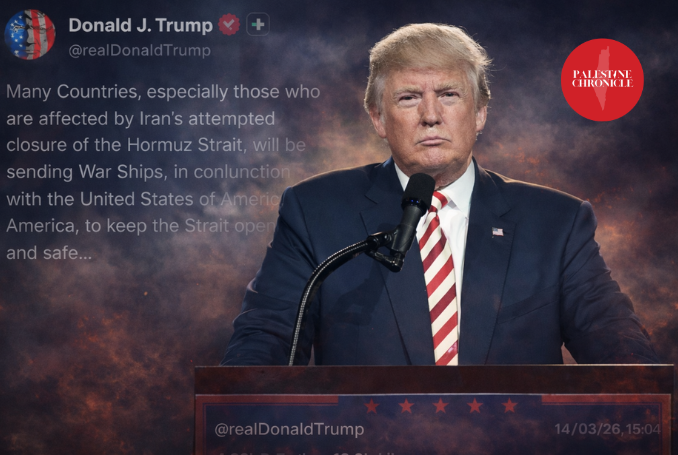
Faced with mounting economic pressure and the erosion of US strategic credibility, Trump has floated the option of forcibly reopening the strait—framing the situation as a direct challenge to American power.
Yet efforts to build a coalition have faltered. NATO allies and European capitals have shown reluctance, wary of the risks of escalation. Trump’s frustration has been evident, but the underlying issue is not political—it is structural.
Military planners recognize a difficult reality: securing navigation by force in a narrow, highly militarized waterway like Hormuz could transform it into a graveyard for naval fleets.
Iran has warned that any attack on its coasts or islands would trigger the mining of access routes. These warnings are reinforced by recent military exercises, including the February maneuver “Smart Control of the Strait of Hormuz,” which simulated rapid-response scenarios against hostile forces.
The Limits of Military Power
Geography remains the defining constraint.
The Strait of Hormuz is narrow and shallow, forcing vessels into predictable routes within range of Iran’s coastal defenses. Tehran has spent decades embedding missile systems, drones, and surveillance infrastructure within mountainous terrain, caves, and tunnels—making detection and neutralization extremely difficult.
As analysts have noted, the environment eliminates reaction time. Engagement windows shrink to minutes, placing even advanced US naval platforms at a disadvantage in what amounts to confined, high-intensity naval combat.
Meanwhile, Iran’s arsenal is not static. It includes mobile missile systems, drones, fast attack craft, and—most critically—naval mines.
The mere suspicion of mines is enough to halt maritime traffic. No navy is willing to risk high-value vessels in potentially mined waters. This factor alone explains much of NATO’s hesitation.
Insurance markets have already reacted. With hundreds of vessels affected and documented strikes on commercial shipping, the promise of military escort provides little reassurance to insurers or operators.
From Sea to Land: A Risky Shift
Faced with the difficulty of securing the strait at sea, Washington appears to be considering a shift toward land-based control.
Reports from within the Pentagon suggest discussions about deploying forces to seize key Iranian islands at the entrance of the Strait—Qeshm, Hormuz, and Larak.
These islands form a strategic network of surveillance and strike capabilities. Qeshm serves as a missile and drone hub, Hormuz controls access points, and Larak provides advanced monitoring capabilities.
Any attempt to seize them would encounter a layered defense combining conventional military forces with asymmetric tactics deployed by the Revolutionary Guard.
Experts warn that such an operation would carry enormous risks. Even limited casualties—such as the capture or killing of US personnel—could trigger major political repercussions.
In this context, what may appear as a tactical maneuver risks escalating into a broader and more dangerous confrontation.
A Strategic Deadlock
The difficulty of reopening the Strait by force is underscored by a stark assessment attributed to former US Defense Secretary Jim Mattis: such an operation would be extraordinarily difficult to sustain.
Maintaining control would require continuous, large-scale surveillance and military presence along an extensive Iranian coastline—placing immense logistical strain on US forces.
The dilemma is clear. Withdrawal risks conceding strategic ground to Iran, while escalation risks prolonged economic and military costs.
‘Open to Friends, Closed to Enemies’
Despite the escalation, Iran has not implemented a full physical closure of the Strait. Instead, it has introduced a model it describes as “smart control.”
Under this framework, the Strait remains open—but conditional.
Iranian officials have stated that passage is available to “non-hostile” vessels, provided they comply with Iranian regulations and coordinate with authorities. Ships linked to the United States, Israel, or military operations are excluded.
This approach shifts control from physical blockade to regulatory dominance.
Iran has formalized this position through diplomatic channels, including communications with the United Nations and the International Maritime Organization. The message is clear: access to the Strait is contingent upon recognition of Iranian authority.
Shipping companies are now required to submit detailed documentation—including cargo, crew lists, and voyage data—to receive clearance.
The effects are already visible. Several countries, particularly in Asia, have successfully negotiated passage under these conditions, highlighting the emergence of a new operational framework.
A New Reality in Hormuz
What is unfolding in the Strait of Hormuz is not a traditional closure, but a transformation.
Iran is redefining control—not by sealing the waterway entirely, but by imposing rules that make access conditional on political alignment and compliance.
The result is a new equation: the flow of global energy is no longer guaranteed by international norms alone, but increasingly shaped by regional power dynamics.
In this evolving landscape, the Strait of Hormuz is no longer just a strategic passage.
It is a lever of geopolitical power.
(This article was originally published in Al Mayadeen. It was translated and published by the Palestine Chronicle)