
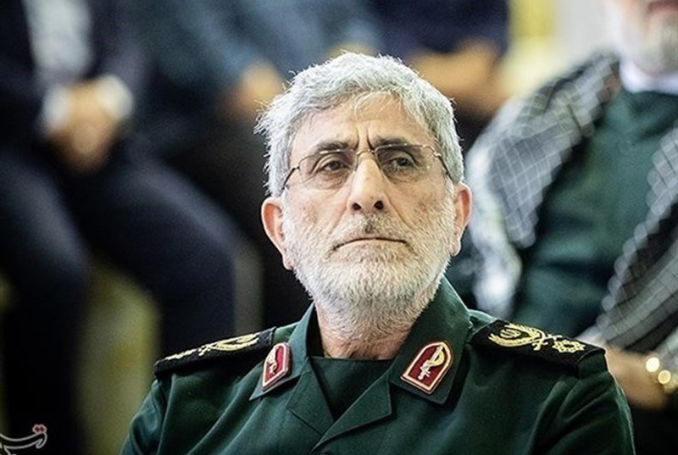

Iranian Quds Force commander Esmail Qaani says a new resistance “security belt” now extends from the Strait of Hormuz to Bab al-Mandab.
Key Developments
- Quds Force commander Esmail Qaani declared that a new resistance security belt now stretches from the Strait of Hormuz to Bab al-Mandab and the Red Sea.
- Qaani warned that continued US and Israeli actions could trigger responses from multiple groups across the Resistance Axis.
- Iranian officials reiterated that attacks on Lebanon, Iran, or allied resistance movements would be met with a stronger and more costly response.
New Regional Security Belt
Iranian Quds Force commander Brig. Gen. Esmail Qaani announced on Monday that a new regional “security belt” now extends from the Strait of Hormuz to Bab al-Mandab and from the Arabian Gulf to the Red Sea.
Speaking through remarks carried by Iran’s official IRNA news agency, Qaani said recent military developments demonstrated growing coordination among groups that form what Tehran describes as the Resistance Front.
“The timely and powerful action of heroic Yemen shows the wisdom of the resistance front. If necessary, others will also join,” he said.
Qaani argued that recent events had confirmed the emergence of a more unified regional front capable of responding collectively to military threats and escalation.
77 Israeli Casualties in 24 Hours as Media Say Iran Changed the Regional Equation
Warning to Washington and Tel Aviv
The Iranian commander warned that future actions by Israel and the United States would provoke responses from allied groups throughout the region.
“The provocations of the Zionist regime and the United States in this region will be met with a reaction from the united resistance front,” he said.
Qaani also suggested that resistance-aligned forces maintain oversight of strategic maritime corridors stretching across the region.
“Borderless fighters are overlooking your transit chokepoints. Continue your aggression and they will seize you by the throat,” he warned.
The Dahiyeh Gamble: How Netanyahu’s Escalation Backfired into an Iranian Victory
Escalation after Beirut Strike
The latest statements follow a sharp escalation triggered by Israel’s strike on Beirut’s southern suburb on Sunday despite an existing ceasefire arrangement in Lebanon.
Iran responded with multiple waves of missile attacks targeting Israeli sites, saying the strikes were retaliation for the attack on Beirut and continued Israeli operations in Lebanon.
Israel subsequently launched several rounds of airstrikes against targets inside Iran, while Tehran answered with additional missile launches.
The exchange marked one of the most serious confrontations since the regional conflict expanded beyond Gaza and Lebanon earlier this year.
Al-Hayya, Araqchi Discuss Gaza as Hamas Praises Iran’s Stance on Resistance Fronts
Iran Warns of Stronger Response
Following the missile exchanges, Iran’s Khatam al-Anbiya Central Headquarters announced a halt to military operations after carrying out what it described as successful strikes against sensitive targets in the occupied Palestinian territories.
The headquarters said Iran’s response had been conducted in support of Lebanon following Israeli attacks on Beirut’s southern suburb and southern Lebanon.
However, Iranian officials stressed that the suspension of operations should not be interpreted as a permanent end to military action.
According to statements carried by Iranian media, Tehran warned that any continuation of Israeli attacks in Lebanon could trigger renewed confrontation and significantly stronger retaliation.
Tasnim News Agency reported that Iran had accepted a ceasefire arrangement under a new conditional formula linking future escalation to Israeli actions in Lebanon.
Iran Says It Delivered ‘Painful Response’ to Israel, Suspends Operations for Now
Broader Coordination
The latest warnings were reinforced by Ebrahim Azizi, chairman of the Iranian parliament’s National Security and Foreign Policy Committee.
Azizi said any attack targeting Iran or the Resistance Axis would face a decisive and costly response, adding that Tehran’s recent military operations were intended not only as retaliation but also as a demonstration of regional deterrence.
Meanwhile, Iranian Parliament Speaker Mohammad Bagher Ghalibaf stated that Tehran would not allow attacks against Lebanon, whether through military escalation, political pressure, or efforts to derail negotiations.
(IRNA, Tasnim, Al Mayadeen, PC)



Be the first to comment