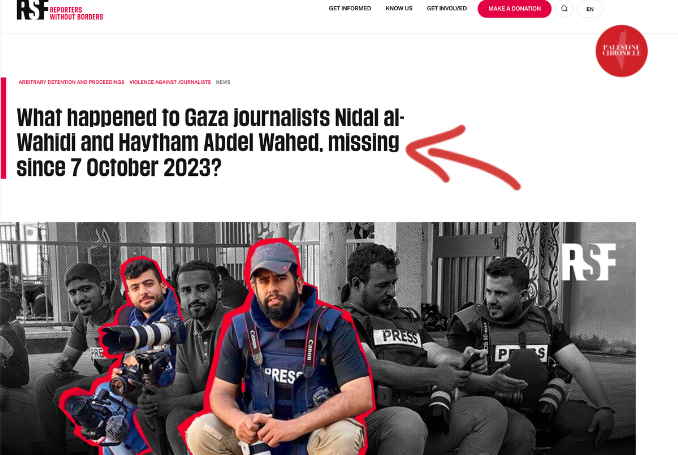

Reporters Without Borders investigates the disappearance of two Palestinian journalists on October 7, 2023, demanding answers from Israeli occupation authorities.
Key Developments
- Reporters Without Borders (RSF) retraces final movements of Nidal al-Wahidi and Haytham Abdel Wahed.
- Israeli army denies holding the two missing journalists in custody.
- Video evidence places both men at the Beit Hanoun (Erez) crossing shortly before Israeli airstrike.
- A photo suggests possible detention of Nidal al-Wahidi.
- Families remain without answers more than two years later.
Disappeared at the Beit Hanoun Crossing
An investigation by Reporters Without Borders (RSF) has raised urgent new questions about the fate of two Palestinian journalists who vanished on 7 October 2023 while covering the unfolding events at Gaza’s northern border.
“They set off for the northern border of the Gaza Strip to cover the Hamas attacks and Israel’s response, and never returned,” RSF states.
The missing journalists — Nidal al-Wahidi, 32, correspondent for Asharq Business and An-Najah News, and 25-year-old Ain Media cameraman Haytham Abdel Wahed — were last seen near the Beit Hanoun (Erez) crossing in northern Gaza.
According to RSF, video footage shows Abdel Wahed “wearing a press vest and holding a camera among a group of journalists and civilians standing in front of the metal gates of the checkpoint.”
Another journalist, Mohammed Zaanoun, told RSF he spotted al-Wahidi roughly 100 meters from the same turnstiles shortly before the area was bombed.
Record 129 Journalists Killed in 2025 – Israel Responsible for Two-Thirds, Says CPJ
Shortly after 10:34 AM, following Israel’s declaration of the ‘Swords of Iron’ war, an Israeli F-16 struck the crossing. Zaanoun described what he witnessed:
“The impact on the tarmac sent bodies flying in several directions,” he said. “What unfolded before my eyes was the targeted bombing of groups of individuals and journalists.”
Was al-Wahidi killed in that strike? RSF notes that someone known to be with him was later found dead. “So, where is his body? No one knows,” Zaanoun said.
Despite searches by family members in overwhelmed hospitals, including the Indonesian Hospital near the crossing, “there was no sign of them,” RSF reports.
More than two years later, the families remain in limbo.
Arrested and Possibly Executed?
RSF’s investigation explores a second possibility: that the journalists were captured inside Israeli territory.
The Israeli organization HaMoked petitioned Israel’s Supreme Court two weeks after the disappearances. On October 31, 2023, Israeli authorities responded that the journalists were not in Israeli custody.
The Israeli army reiterated to RSF on 26 February that the two reporters “are not being held by the IDF (Israeli army – PC), and there is no indication that they were detained by the IDF.”
However, RSF highlights a disturbing photograph that has fueled suspicions of detention.
‘We Returned From Hell’: CPJ Details Torture of Palestinian Journalists in Israel
The image shows around twenty stripped detainees lying face down, hands and feet bound, numbers marked in black on their backs. One detainee bears the number 26. Relatives of Nidal al-Wahidi say they recognize his “build, haircut, the shape of an earlobe, and underwear identifiable by its blue-and-black striped pattern.”
“The image provided does not allow for any possibility of identification,” the Israeli army spokesperson responded.
RSF reports that multiple journalists who covered the early days of Israel’s operations have attested to the credibility of the photograph, suggesting it may have been taken in communities near Gaza, such as Netiv HaAsara or at military facilities in southern Israel.
The possibility that the journalists were transferred to detention facilities such as Sde Teiman — a military camp in the Naqab (Negev) desert described by Israeli human rights organizations as a torture site — has also been raised.
A Name Heard in Prison
RSF’s investigation further recounts testimony from Shady Abu Sedo, a Palestinian journalist released in October 2025 after 18 months in Israeli detention.
He said that in August 2025, while imprisoned in Al-Naqab (Ketziot) prison, he met a detainee who had heard Nidal al-Wahidi’s name during interrogation at the Shikma detention center in Asqalon (Ashkelon).
The witness “said he had heard his name but had not seen him,” Abu Sedo told RSF.
A November 2025 list of 1,468 Palestinians captured since the start of the war, however, did not include either al-Wahidi or Abdel Wahed.
“The occupying forces never disclose the exact number of people arrested, so it is impossible to know with certainty how many of the missing are in prison,” a lawyer told RSF.
A Crime against Truth: Israel’s Slaughter of Journalists Can’t Go Unpunished
‘Multiple Barriers’
RSF concludes that “the multiple barriers imposed by the Israeli authorities have left the relatives and colleagues of Nidal al-Wahidi and Haytham Abdel Wahed trapped in a purgatory between mourning and hope.”
The organization demands that Israeli authorities “disclose the identity of all the journalists held in their prisons, as well as those they are holding hostage.”
RSF also calls for independent access for the international press to the Gaza Strip — access Israel continues to deny — arguing that such access “could help clarify the fate and whereabouts of the only two journalists that went missing on 7 October 2023.”
According to RSF data cited in the investigation, the Israeli army has killed more than 220 Palestinian journalists in Gaza since October 7, 2023. Moreover, at least 20 Palestinian journalists from Gaza and the West Bank are currently being arbitrarily detained by Israeli occupation authorities.
(The Palestine Chronicle)