

New evidence shows the Gaza ceasefire is a mere façade, as Israeli military engineers replace airstrikes with systematic demolitions while 80% of the Strip’s water is contaminated, fueling a catastrophic health crisis.
Despite entering its second month, the Gaza ceasefire agreement has failed to halt the systematic destruction of the Strip, as Israeli forces shift tactics from heavy aerial bombing to deliberate, engineered demolitions, exacerbating a devastating humanitarian crisis fueled by health and infrastructure collapse.
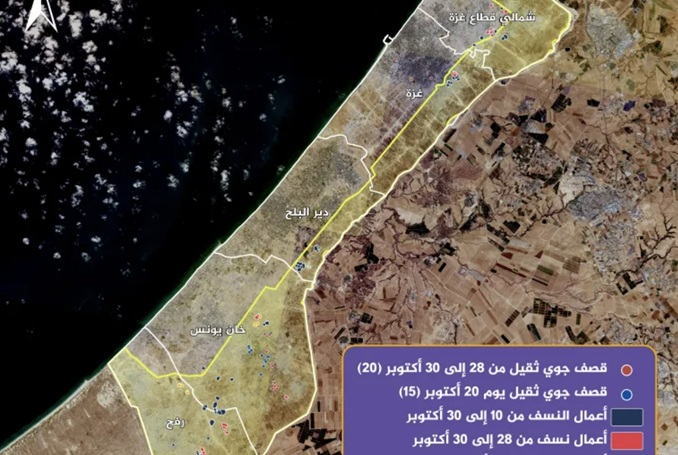
An investigation by Al-Jazeera’s news verification agency “Sened,” based on satellite imagery analysis from October 10 to 30, reveals that the Israeli military did not cease its destructive campaign but rather changed its methodology post-ceasefire.
Engineered Demolitions Surge
Following the agreement’s implementation on October 10, the focus transitioned from heavy airstrikes — which saw a partial reduction — to systematic blasting and engineered demolition, according to the findings.
The data recorded 103 operations of blasting and demolition between October 10 and 30, alongside 35 heavy aerial bombing incidents.
Targeted Geographical Destruction
The majority of these demolitions were concentrated in the Southern Gaza Strip, particularly the eastern area of Khan Yunis.
This systematic destruction was largely confined within the “Yellow Line,” the initial Israeli withdrawal boundary, suggesting a tactical effort to clear and control the designated zone using engineering units rather than air power.
Israeli Airstrikes Hit Beit Lahia and Gaza City amid Ongoing Ceasefire Breaches
Infrastructure Leveling
Israeli occupation forces were observed conducting extensive land leveling and destruction of agricultural greenhouses, and demolishing buildings opposite the European Hospital, confirming that military engineers, rather than the air force, are now the primary tool of destruction.
Pre-Truce Intensity
The investigation also links intense military action to political timelines.
A sharp spike in heavy aerial bombing was recorded in Northern Gaza immediately preceding the ceasefire announcement (October 8–10), achieving field gains before the agreement was finalized.
The systematic destruction is compounded by ongoing security breaches that violate the spirit and letter of the truce:
Naval and Aerial Attacks
Israeli warships have reportedly opened fire off the coasts of Rafah and Khan Yunis. Furthermore, an airstrike was carried out near the Education area in northern Beit Lahia, and multiple residential buildings were demolished using explosives east of Khan Yunis.
Obstruction of Aid and Reconstruction
Israeli occupation forces continue their campaign against the UN Relief and Works Agency (UNRWA), obstructing its vital operations and blocking attempts to rebuild refugee camps and restore essential services.
Ecocide as a Tool of Settler-Colonialism and Genocide: The People Charge Israel in Barcelona
The persistent military actions and infrastructure targeting have pushed Gaza’s public health and utilities to the brink of total collapse:
Water Contamination Epidemic
The Palestinian Red Crescent Society warns that 80% of Gaza’s water supply is completely contaminated. This contamination has triggered a health catastrophe, with over 70,000 cases of hepatitis recorded since the start of the genocide.
Mass Trauma and Disability
The Gaza Ministry of Health has confirmed a staggering 6,000 amputation cases requiring immediate and long-term rehabilitation, with children comprising 25% and women 12.7% of the total.
My Father’s Cancer Battle in Gaza: When Survival Depends on Crossing a Closed Gate
Total Power Grid Failure
The entire Strip remains without electricity. The Director of Public Relations and Media at the Gaza Electricity Distribution Company estimates that the war has destroyed over 80% of the distribution networks, resulting in preliminary infrastructure losses of approximately $728 million.
The continuation of these aggressive, systematic operations and the resulting humanitarian disaster underscore the deep fragility of the American-backed ceasefire, threatening its complete collapse amidst international warnings against the division of the Gaza Strip and reports of US plans to establish a major military base in the region.
(PC, AJA)



