

By Romana Rubeo 
Dan Kovalik, President Petro’s attorney, breaks down Washington’s political attack via sanctions, exposing the imperialist effort to crush Colombia’s pro-Gaza leadership and undermine the revolutionary solidarity of nations like Venezuela.
Colombia has taken one of the strongest governmental positions in the world against the genocide in Gaza, a stance that has rippled across the Global South and directly challenged Western hegemony.
Colombian President Gustavo Petro’s government has not only cut diplomatic ties with Israel and backed South Africa’s case at the International Court of Justice (ICJ), but also called for the UN General Assembly to invoke a Uniting for Peace resolution to bypass the US veto power.
In direct response to this unprecedented moral leadership, Washington moved swiftly, imposing sanctions on Petro and his family and initiating political pressure campaigns.
The move, officially related to counternarcotics, is widely viewed as a clear act of political retaliation aimed at isolating a key revolutionary leader on the world stage.
In this exclusive FloodGate interview, Ramzy Baroud spoke with Daniel Kovalik, the labor and human rights lawyer who serves as President Petro’s attorney in the United States.
Kovalik, who previously served as counsel for Colombian plaintiffs against US corporations for alleged human rights violations, offers a clear-eyed analysis of the legal fight ahead, the political stakes, and what this confrontation reveals about the growing role of Latin America in the global struggle for Palestinian rights and the contours of a new international alignment.
Petro’s Moral Commitment Defies Political Realpolitik
Kovalik argued that Petro’s strong position on Palestine is a rare act of genuine political altruism, contrasting sharply with the self-interest that governs most state behavior. Petro’s principled stand has come at a high personal and national cost, making his commitment all the more profound.
The lawyer affirmed that President Petro “is acting in a more moral, altruistic way”.
His support for the Palestinians “is based on nothing but morality, right? I mean, he gets nothing out of this. In fact, he gets nothing but a headache. He gets nothing but sanctions. He gets nothing but threats, war, but he’s doing it anyway”.
US Sanctions are Retaliation
The US sanctions, officially imposed under the guise of counter-narcotics policy, are viewed as a transparent effort to silence and isolate the Colombian president for his opposition to US-backed Israeli policy.
The timing of the sanctions, which also targeted Petro’s wife and son, suggests a direct connection to his vocal challenge to US hegemony.
The action came very shortly after Petro’s impassioned speech at the UN General Assembly, where he “talked about the need for a military force to protect Gaza”.
Kovalik explained that Petro “is a revolutionary himself. He supports revolutionaries. He supports the right to self-determination like those amongst the Palestinians”.
The timing of his designation on the OFAC blacklist “made it very clear that that speech got him into very hot water with the Trump administration”, and the move against his family is clearly an attempt “to try to quiet him and isolate him on the issue of Palestine”.
The Mantle of Global South Solidarity
The discussion underscored that the true wellspring of action on Palestine lies in the Global South, a political tradition rooted in anti-colonial and anti-imperialist struggle.
Latin America, in particular, is positioned at the forefront of this movement, with nations like Venezuela offering unwavering support, inspired by the region’s long revolutionary history.
Kovalik tied Petro’s stance to the region’s revolutionary past, noting the President’s symbolic act of calling for the sword of Bolívar—the liberator who fought Spanish colonialism—to be brought out at his inauguration.
This legacy is why nations like Venezuela remain “very supportive of the Palestinians,” alongside Cuba and Nicaragua.
While the US has “weakened greatly” states like Venezuela with sanctions in an attempt to “finish off” the ‘pink tide’ of progressive leadership, Kovalik points out that the real driver of US interest remains resources: “Venezuela has more oil reserves than any country in the world”.
Venezuela is Not an Easy Target
Kovalik rejected the idea that Venezuela can be toppled through a quick intervention.
“If the US invaded Venezuela, it would be another Vietnam,” he explained
The numbers matter: “Eight million Venezuelans have joined militias to defend the country. The US doesn’t have anything close to that.”
If Washington uses force, he warned, it will not be a ground war: “It won’t be a full invasion. It would be airstrikes, hoping the military carries out a coup.”
The outcome, however, is not guaranteed, and the cost would be enormous.
According to Kovalic, threats to Venezuela and Washington’s sanctions on Petro are part of a larger geopolitical campaign to reimpose US dominance in the hemisphere.
“The US wants to finish off what was known as the Pink Tide. They smell blood in the water,” he said, adding, “The US still sees the region as theirs. They think they have the exclusive right to control Latin America.”
Colombia’s Petro: From Liberation at Home to Solidarity with Gaza
A ‘Torpedo’ against Potential Peace Initiatives
A major setback to the international legal effort, including Colombia’s initiative, was the recent UN Security Council resolution, which the interview described as a profound betrayal of international law.
US-backed Resolution 2803, which was voted on by the UN Security Council on November 17, is effectively a colonial plan that undermines any hope for a unified global effort to force a ceasefire.
The resolution was described by a Russian UN ambassador as an “old-time colonial plan”.
Kovalik warned that the plan is to put Palestinians in what amounts to a “smaller concentration camp than they were to begin with” with little to “no infrastructure”.
Crucially, the passing of the resolution “may effectively prevent a Uniting for Peace resolution”—the very mechanism Colombia advocated for to bypass the US veto. This act is now “almost like a torpedo to prevent real meaningful action”.
The few Arab states that supported the resolution were dismissed as “completely obsequious, vassal states of the West that should be ashamed of themselves”.
‘Enough Words’ – Colombian President Calls for Army ‘to Defend Palestine’
Colombia’s Break with Israel
President Petro’s decision to cut ties with Israel is not merely a reaction to the Gaza genocide, but also an acknowledgement of Israel’s historical role in supporting the most violent, anti-democratic elements in Colombia.
According to Kovalic, for Colombia, standing with Palestine is also an act of national self-defense against a long-time destructive foreign influence.
Kovalik explained that before Petro, Colombia and Israel were “very close”, with Israel responsible for “a lot of military training in Colombia” and “very responsible for training and supporting the death squads, the paramilitary death squads in Colombia”.
The lawyer recounted that the founder of the AUC paramilitaries, Carlos Castaño, stated in his memoir that he “owes his life and his country to Israel”, even though the paramilitary leader was “responsible for killing tens of thousands of innocents in Colombia”. Petro’s move to cut ties was thus a huge and dangerous step.
Indeed, Kovalik confirmed that the sanctions are retaliation for Petro’s actions: “It’s obvious. He spoke at the UN, calling for a military force to protect Gaza — and very shortly after, he was put on the OFAC list. That’s not a coincidence.”
(The Palestine Chronicle)
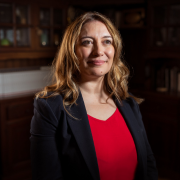
– Romana Rubeo is an Italian writer and the managing editor of The Palestine Chronicle. Her articles appeared in many online newspapers and academic journals. She holds a Master’s Degree in Foreign Languages and Literature and specializes in audio-visual and journalism translation.

Be the first to comment