
Israeli research center tracks 186 Iranian attack waves as Tehran announces new missile strikes and air defenses intercept drones.
Key Takeaways
- Israeli Alma Center reports 186 Iranian attack waves since the start of the war.
- Tel Aviv region remains the most targeted area, accounting for roughly 39 percent of recorded attack waves.
- Iran’s Revolutionary Guard announced the 34th wave of Operation “True Promise 4.”
- Iranian officials say missiles with warheads exceeding one ton were launched against US and Israeli targets.
- Iranian air defenses reported shooting down several Israeli drones, including Hermes-900 and Heron-TP aircraft.
Editorial Note: Israeli and Iranian sources use the term “waves” differently; the figures cited refer to phases or clusters of attacks, not individual missiles.
Attack Wave Data
An Israeli research institute has documented what it describes as an intensifying pattern of Iranian missile and drone strikes since the start of the war involving Iran, Israel and the United States.
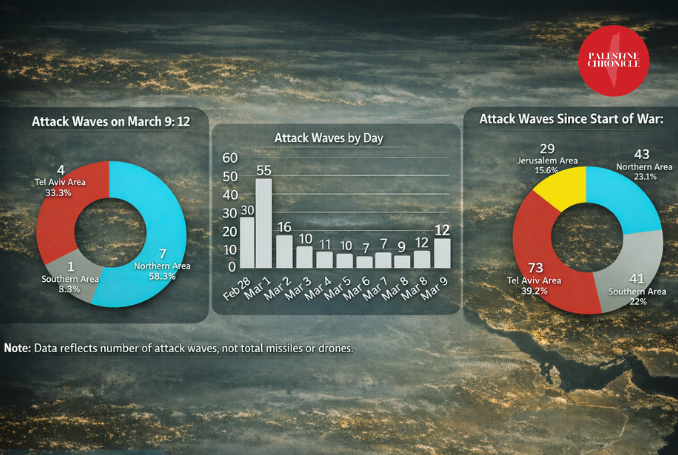
According to a report released by the Alma Research and Education Center, an Israeli security think tank, a total of 186 Iranian “attack waves” have been recorded against Israel since the outbreak of the conflict on February 28.
The figures, cited by Israeli media and reported by Al Mayadeen, provide one of the most detailed numerical breakdowns of Iranian strikes during the ongoing aggression against Iran.
The Alma Center uses the term “attack wave” to describe a cluster of missile or drone launches detected during a specific strike period. The term does not necessarily correspond to the number of individual missiles fired.
The report states that March 9, the 11th day of the war, saw 12 separate Iranian attack waves targeting Israel.
Most of those attacks were directed toward the northern region, which experienced seven waves, accounting for 58.3 percent of the day’s recorded strikes.
The Tel Aviv and central region was hit by four waves, representing 33.3 percent, while the southern region experienced one attack wave, or 8.3 percent.
Researchers at the Alma Center said the data suggests a noticeable change in targeting patterns.
After several days during which central Israel had been the primary target, the report indicates a shift toward increased missile launches against northern areas.
According to the analysis, this shift may be linked to Iranian statements regarding attempts to strike oil facilities inside Israel.
Looking at the broader timeline of the conflict, the Alma report notes that the first two days of the war—February 28 and March 1—were the most intense in terms of the number of attacks.
Beginning on March 2, however, the number of attack waves appeared to stabilize.
The report states that in recent days, the daily number of attacks has fluctuated between 10 and 12 attacks per day.
Across the entire conflict so far, the Tel Aviv region remains the primary target.
According to the Alma data:
- 73 attack waves targeted the Tel Aviv area (39.2 percent of all recorded strikes).
- The southern region experienced 41 waves (22 percent).
- The northern region recorded 43 waves (23.1 percent).
- The Jerusalem area experienced 29 waves (15.6 percent).
The report stresses that these figures refer specifically to waves of attacks detected, rather than the total number of missiles or drones launched.
On casualties, the Alma Center reported that 14 Israelis have been killed inside Israel since the beginning of the war, while 2,339 others have been injured to varying degrees.
Within the past 24 hours, two people were reportedly killed in the Tel Aviv area, while around 200 others were injured following Iranian missile strikes.
Israeli reports cited by Al Mayadeen indicated that one of the missiles used in the attack carried a warhead that separated into multiple sub-munitions while in the air, resulting in several impact points.
The report also stated that more than 3,000 Israelis were forced to leave their homes after missiles or fragments from interception systems fell in populated areas.
Cities where Iranian strikes reportedly caused casualties or damage include Tel Aviv, Bnei Brak, Ramat Gan, Petah Tikva, Beit Shemesh, and Beersheba.
IRGC Wave 34
Meanwhile, Iran’s Islamic Revolutionary Guard Corps (IRGC) announced the launch of the 34th phase of its retaliatory campaign known as Operation “True Promise 4.”
According to statements, the new wave involved precision missiles equipped with warheads exceeding one ton.
The missiles were reportedly fired toward US and Israeli military bases in response to the ongoing war.
In a separate statement, the IRGC said the latest strikes targeted US troop gatherings at Al Dhafra and Al Jafra bases using missiles and drones operated by Iran’s aerospace forces.
The Guard also claimed that military facilities in northern occupied Palestine, including Ramat David Airbase, were struck.
Iranian officials said the attacks marked a new stage in the confrontation with the “American and Zionist aggressors.”
The IRGC warned that Iran possesses a target bank “ten times larger” than the number of objectives currently being struck, suggesting further escalation remains possible.
Drones Shot Down
Iranian officials also reported several interceptions of Israeli unmanned aircraft over Iranian territory.
According to statements by the IRGC public relations office, Iranian air defenses shot down multiple drones in different regions of the country.
Among the aircraft reportedly intercepted were:
- Two Hermes-900 drones over the cities of Borujerd in Lorestan province and Sirvan in Kermanshah province.
- Two Heron-TP drones, one near Tehran and another in Markazi province in central Iran.
Iran’s armed forces also said their missile and drone units continue to play an “effective and influential role” in striking enemy positions.
In remarks reported by Al Mayadeen, Brigadier General Abolfazl Shekarchi, spokesperson for Iran’s Armed Forces General Staff, accused the United States of launching a “brutal aggression” against Iran in order to defend Israel.
Shekarchi said Washington had attempted to justify the war by claiming to protect the Iranian people.
“When Trump found his army trapped before the capable Iranian armed forces,” Shekarchi said, “he bombed the very people he claimed to defend.”
Iranian officials maintain that their military responses will continue as long as the war persists.
LIVE BLOG – Trump Threatens Iran Over Hormuz as Tehran Vows to Decide War’s End – Day 11
(The Palestine Chronicle)



Be the first to comment