
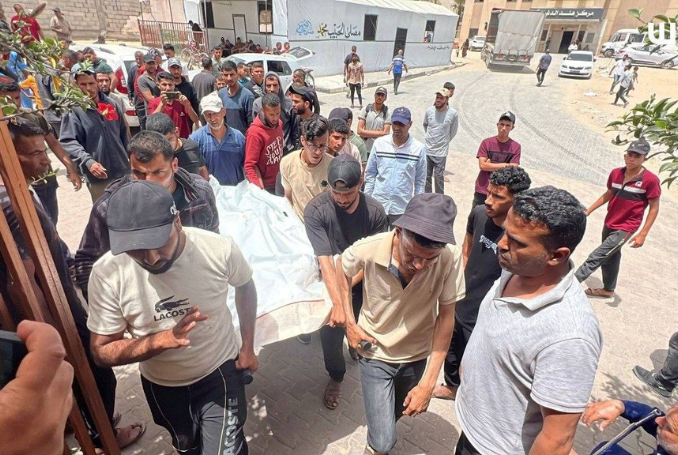
By Jamil Khader
Levy accurately describes the destruction of Palestinian society but does not fully theorize the political and economic logic driving that destruction.
In his recent Haaretz op-ed, “Israel’s Solution to the Gaza Problem,” Gideon Levy argues that Israel’s actions in Gaza reveal the existence of a coherent postwar strategy rather than the absence of one. According to Levy, the destruction of Gaza is not simply a military campaign aimed at defeating Hamas. Instead, it is part of a broader project to dismantle Palestinian society itself.
Having devastated Gaza’s infrastructure and social institutions, Israel is now moving toward what Levy describes as the next phase of its plan: reducing Palestinians to a fragmented population of the disabled, injured, hungry, homeless, unemployed, and socially disorganized. Once Gaza’s society has been sufficiently destroyed, Levy argues, the conditions will be created for the final objective—mass expulsion.
Levy’s intervention is important because it rejects the familiar claim that Israel lacks a political vision for Gaza. On the contrary, he argues that Israel’s refusal to permit governance by Hamas, the Palestinian Authority, or any alternative Palestinian institution reveals its actual objective. Israel does not seek a different government in Gaza; it seeks the destruction of governance itself.
The systematic targeting of teachers, doctors, engineers, civil servants, journalists, and social workers is therefore not accidental. It is part of a deliberate effort to eliminate the institutional foundations necessary for collective life. No society can function without the people who reproduce its social, educational, medical, and administrative infrastructure. Their elimination transforms Gaza into a space of chaos and dependency, making displacement easier to achieve.
While Levy’s analysis is compelling, it remains limited by its humanitarian and sociological framing. He accurately describes the destruction of Palestinian society but does not fully theorize the political and economic logic driving that destruction. Most significantly, he continues to reproduce the assumption embedded in the title itself: that Gaza constitutes a “problem” requiring a “solution.” The question that remains unasked is why Gaza appears as a problem in the first place.
From a settler-colonial perspective, Gaza is not a problem because of Hamas, terrorism, or failed governance. Gaza is a problem because Palestinians continue to exist. The continued presence of Palestinians on the land interrupts the demographic, territorial, and ideological aspirations of Ziofascist sovereignty. What appears as a security problem is, at a deeper level, a colonial contradiction. The obstacle confronting Ziofascist settler-colonialism is not merely armed resistance but the persistence of an indigenous population that refuses elimination.
Levy also treats the destruction of society primarily as a preparatory stage for future expulsion. Yet a necro-imperial analysis suggests that social destruction is not merely instrumental. It is itself a political objective. Hospitals, universities, schools, ministries, archives, cultural centers, and municipal institutions are not simply collateral targets in a military campaign. They are the infrastructures through which a people reproduces itself as a collective political subject. Their destruction aims not only at territorial control but at the dissolution of Palestinian social existence itself.
This distinction is crucial because it shifts attention from expulsion to the production of surplus humanity. Levy observes that Israel has systematically targeted the professionals and institutions that sustain social life. However, he does not fully recognize that this process creates a population rendered economically, politically, and socially superfluous. The elimination of doctors, teachers, engineers, and administrators is not merely the destruction of services; it is the destruction of the mechanisms through which society reproduces itself across generations. What emerges is a population increasingly confined to biological survival while stripped of the institutional capacities necessary for collective autonomy and political self-determination.
Such a population occupies what may be called a necro-imperial death-world. Here the objective is no longer simply the administration of life but the management of populations whose lives have been rendered disposable. Rather than integrating these populations into a political order, necro-imperial governance seeks to contain, fragment, monitor, and administer them at the threshold of social death. Gaza’s devastation, therefore, exceeds the framework of military occupation or even ethnic cleansing. What is being produced is a population that survives biologically while being systematically deprived of the conditions necessary for collective social and political reproduction.
This broader framework also reveals a dimension largely absent from Levy’s account: political economy. The devastation of Gaza is not simply a national project pursued by Israel alone. Gaza increasingly functions as a laboratory for surveillance technologies, military experimentation, humanitarian management, and population control. The methods refined there circulate through global networks of security capitalism, military contracting, border enforcement, and humanitarian governance. Gaza is therefore not merely a site of destruction. It is also a site of accumulation.
The devastation of Gaza generates markets alongside death. Technologies tested on Palestinians become exportable security products. Systems of surveillance, targeting, biometric monitoring, and population management are transformed into commodities marketed to states and corporations around the world. The same processes that render Palestinians disposable simultaneously create new opportunities for profit. Gaza thus emerges not only as a space of elimination but as a frontier of necro-imperial accumulation, where the production of surplus humanity and the production of value become mutually reinforcing processes.
Yet recognizing the barbaric violence of this project should not lead us to overestimate its success. Here, Levy’s analysis risks reproducing a familiar colonial assumption: that the destruction of institutions necessarily produces the destruction of society itself. While he correctly identifies Israel’s systematic assault on the infrastructures of collective life, Gaza continues to reveal the limits of colonial power.
In a recent reflection, Gazan physician Dr. Ezzideen (@ezzingaza) describes walking through a society suspended between celebration and mourning. Weddings continue. Children still play. Families still gather. Yet beneath every moment of joy lies an absence—a son, daughter, brother, or parent killed in the genocide. Gaza, he writes, exists in two realities simultaneously: a visible world of everyday life and an invisible city of grief. Every celebration contains an absent guest; every smile carries a name. What emerges from his account is not a narrative of resilience in the conventional sense, but a portrait of a society that continues to reproduce memory, care, and collective life amid catastrophic loss.
Dr. Ezzideen’s reflections expose a contradiction at the heart of necro-imperial Ziofascist settler colonialism. The destruction of infrastructure, institutions, and leadership may produce what necro-imperial power intends—a population rendered precarious, impoverished, and disposable. Yet it cannot fully eliminate the social relations through which Palestinians continue to constitute themselves as a people. Gaza is therefore not only a site where surplus humanity is produced; it is also a site where that reduction is continually resisted.
This persistence should not be romanticized. Palestinians continue to live, mourn, love, and imagine a future under conditions that no people should endure. Yet their continued reproduction of social life reveals something fundamental about colonial power itself: its incompleteness. Necro-imperial Ziofascist settler colonialism may destroy institutions, manufacture surplus populations, and transform entire territories into death-worlds.
What it cannot fully eradicate is the capacity of human beings to create forms of meaning, solidarity, and world-making amid devastation. Gaza thus reveals not only the violence of colonial power but also the limits of its ability to achieve the finality it seeks.

– Professor Jamil Khader is Dean of Research at Bethlehem University, Professor of English, and Editor at The Bethlehem University Journal. He contributed this article to The Palestine Chronicle.




This gideon levy is a tiresome jew, a chomsky type of cunning colonialist, dedicated to sowing despair. He cannot see israel collapsing under its own unparalleled evil, he will never see how hated israel now is, everywhere.