
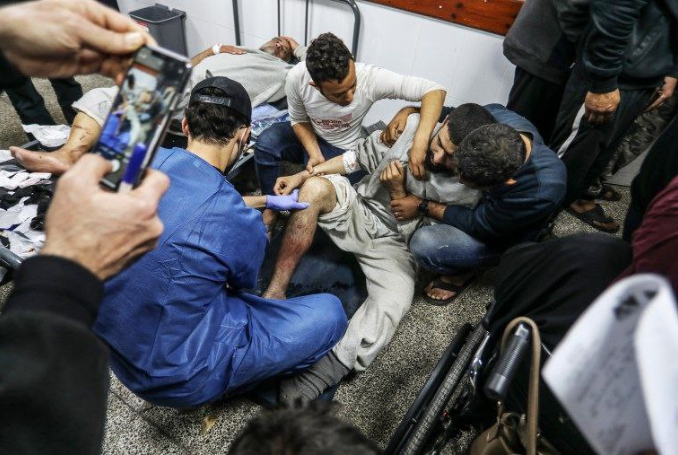
“All the basis for diseases to develop in a constricted environment with very limited access to prevention, to detection and response are all indicating that outbreaks can really spread out of control and very rapidly,” a WHO official said.
The World Health Organization (WHO) warned on Thursday that disease outbreaks in the Gaza Strip may be spreading largely undetected due to the near-total collapse of surveillance and laboratory systems, the Anadolu news agency reported.
Teresa Zakaria, WHO’s unit head for humanitarian and disaster action, said the living conditions in the enclave are so severe that “we can’t even describe it anymore,” the report stated.
🚨 WHO warns vast majority of illnesses in Gaza may be unreported due to limited access
💢 Disease outbreaks likely far worse than detected as surveillance and laboratory capacity collapse
💢 UN health agency cautions near-total breakdown hinders accurate public health picture… pic.twitter.com/PnzT3KWNcq
— Anadolu English (@anadoluagency) December 11, 2025
Zakaria added that “all the basis for diseases to develop in a constricted environment with very limited access to prevention, to detection and response are all indicating that outbreaks can really spread out of control and very rapidly.”
Her remarks came during an Association of Accredited Correspondents at the United Nations (ACANU) media briefing in Geneva.
Lack of Labs
Zakaria said humanitarian access and diagnostic capacities remain “very limited,” making early detection and response nearly impossible.
“What is very important here to highlight is that we are probably missing the vast majority of diseases that are spreading in the territory at the moment just because we have not been able to detect them,” she said.
Medicines, Medical Supplies in Gaza Reaching ‘Catastrophic Levels’
WHO cannot quantify how many outbreaks are occurring or their intensity because “labs aren’t present to actually allow us… to detect them, the various pathogens that are circulating.”
She reiterated calls for “unhindered access for humanitarian supplies… to revive the health system and be able to detect these diseases.”
Concern over Waterborne Diseases
Heavy Winter rains this week have caused buildings already damaged by Israeli bombardment to collapse. Many destroyed buildings are serving as shelter for scores of families forcibly displaced during Israel’s two-year military assault on the enclave.
Speaking from Gaza, Jonathan Crix of the UN Children’s Fund (UNICEF) told UN News of the challenges that children and families are enduring in makeshift tents.
With heavy rains and cold winds, winters in Gaza are worsening unbearable living conditions for children and families.
Join @UNICEFpalestine‘s Rawan Eleyan as she meets displaced families and outlines UNICEF’s response. pic.twitter.com/OQcesk124s
— UNICEF (@UNICEF) December 11, 2025
“Everything was completely damp…the mattresses were wet; the children’s clothes were wet. It’s extremely difficult to live in those conditions,” Crix stated.
The report said he warned of a surge in acute watery diarrhoea and fears of further disease outbreaks.
“With the very poor hygiene conditions and very limited sanitation system available, we are extremely concerned to see the spreading of waterborne diseases.”
Rise in Maternal Deaths, Miscarriages
On Thursday, the UN said that Gaza’s health system for mothers and newborns has been “decimated,” with Israeli attacks destroying almost all hospitals and cutting off medical supplies, according to a UN News report. This has caused sharp rises in maternal deaths, miscarriages and newborn fatalities amid mass displacement and hunger, the report noted.
It said that according to the UN human rights office (OHCHR), 94 per cent of Gaza’s hospitals have been damaged or destroyed, leaving pregnant women and newborns without essential care.
UNFPA: Gaza’s Health System Near Collapse as Women Bear Burden of Survival
“The Israeli blockade has also prevented the entry of objects indispensable to the survival of civilians, including medical supplies and nutrients required to sustain pregnancies and ensure safe childbirth,” the Office said.
By late 2024, women in Gaza were three times more likely to die in childbirth and three times more likely to miscarry compared with pre-war levels, while newborn deaths also increased, OHCHR reported.
Threat of Injuries, Sepsis
Dr. Ambereen Sleemi, a gynecologist who volunteered in Gaza, told OHCHR: “As we did our rounds, bombs were going off in the background…Sometimes quadcopters would come in and try to shoot nurses or literally chase them through the hospital corridors,” the report stated.
The doctor said pregnant women arrived with gunshot wounds, including to the abdomen.
In Gaza, displaced Palestinians face a deepening catastrophe. Rainwater floods their fragile tents, leaving families cold, soaked, and without safe shelter. With the siege continuing and no real ceasefire, many more infants and children will die of cold and disease.#GazaGenocide pic.twitter.com/N7RJeH5Vcj
— Seyed Mohammad Marandi (@s_m_marandi) December 12, 2025
“Many women were simply too injured to survive. If their injuries did not claim their lives, then sepsis often did, as there were not enough medical supplies or antibiotics,” she stated.
Since a ceasefire agreement took effect in Gaza on October 10 under US President Donald Trump’s 20-point plan, Israel has killed 383 more Palestinians and injured over 1,000, according to Gaza’s Ministry of Health.
The total death toll since Israel’s genocidal assault began just over two years ago has risen to 70,373, with 171,079 injured.
(PC, Anadolu, UN News)



