
By Romana Rubeo 
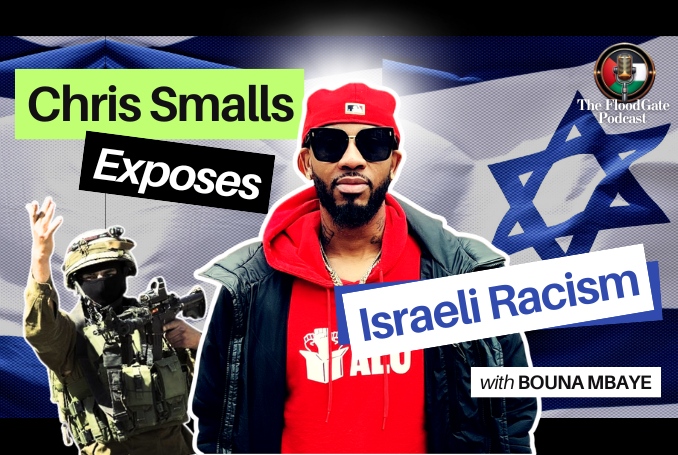
In an exclusive FloodGate interview, Amazon Labor Union leader Chris Smalls shares why he joined the Handala boat, linking the fight of US workers with Palestinian liberation.
Amazon Labor Union president Chris Smalls joined the FloodGate podcast in an exclusive interview with Bouna Mbaye to discuss why he joined the Handala boat.
Smalls connected the struggle of American workers with the fight for Palestinian liberation, exposing Israeli racism, corporate complicity, and the global movement for justice.
This groundbreaking conversation dives into solidarity, resistance, labor rights, and decolonization.
Below are five major takeaways from the discussion.
Solidarity is Indivisible
For Chris Smalls, solidarity cannot be selective. He described how, after speaking out for Palestine, he lost tens of thousands of social media followers and numerous professional opportunities.
Yet he insisted that true commitment to justice means refusing to exclude Palestinians from the struggle.
“People would DM me saying, I supported you when you were taking on Amazon but this is not it. This is where I draw the line. My response was: screw you. If you didn’t understand the struggles and the connections of this fight, then obviously you’re not for the people and you’re not somebody I want to align myself with.”
Smalls compared the backlash to the skepticism he faced when organizing Amazon workers:
“The same way when I took on Amazon, people doubted us, thought I should give it up. I couldn’t. That’s the same feeling I had when I started talking about Palestine. So I decided to double down and go harder.”
He frames the Palestinian struggle as fundamentally connected to the working-class movement:
“This is absolutely a working-class issue. The most important way powerful entities thrive is to divide people, keep us fighting amongst each other, and distract from Palestine. I refuse to let that happen.”
Why He Joined the Handala Boat
Smalls’ decision to join the Handala flotilla happened almost overnight. Inspired by activists like Greta Thunberg and Yasmine, he reached out to Huwaida Arraf of the Freedom Flotilla Coalition. Within 24 hours, he was flying to Italy.
“I didn’t hesitate. I only had one conversation with my children. I told them, I love you, and everything I’m doing is for your future, for the planet, for humanity. I didn’t want to scare them, but I had to be honest that I was going into a dangerous situation.”
For Smalls, the mission was not only about delivering aid but about directly confronting Israel’s illegal blockade of Gaza.
“We shouldn’t have to risk our lives to deliver a small amount of food that can’t feed anybody. The flotilla’s pledge from the beginning is to break the siege. The point is to end the conditions that make humanitarian aid necessary in the first place,” he explained.
He tied his decision to broader struggles at home:
“As an American labor leader, this was important to spread awareness, but also to apply pressure on labor unions that have been complicit in shipping arms to Israel. And as a Black man, I wanted my community to understand that this is our fight too.”
Experiencing Israeli Racism Firsthand
Smalls was the only Black passenger aboard the Handala, and he believes this shaped the brutal treatment he received after Israeli forces seized the boat.
“In 37 years in America, I’ve never experienced the amount of hatred, racism, and bigotry that I experienced in just a few days in Israeli custody. They threw me to the ground, put their knees in my back, twisted my arms, slammed me against the wall, and used my own chains to choke me,” he recounted.
He described a system designed to humiliate and intimidate: “They lied to us every day — told me to get dressed saying I was going home, knowing I wasn’t. They weaponized food, set it in front of us and took it away. They raided our cells, made us strip naked for no reason. It was psychological warfare.”
The difference in treatment was stark:
“All the white prisoners were deported through Tel Aviv airport. Me and my Arab brother from Tunis, the only people of color, were released last and dumped at the Jordanian border. That’s no coincidence.”
Calling Out US Labor Unions and Politicians
As a labor organizer, Smalls does not shy away from criticizing the complicity of American labor institutions in Israel’s war on Gaza. “I will continue calling out all of these US international unions and coalitions who’ve passed zero resolutions and continue shipping arms to Israel every 15 hours for the last 22 months. They are actively participating in genocide and crossing the picket line of the working class.”
He reserved sharp words for progressive politicians as well:
“Bernie Sanders, AOC, they praised me when I took on Amazon. But now they’re traveling the country with their ‘fight the oligarchy’ tour while telling crowds that Israel has a right to defend itself. That’s unacceptable. That’s complicity.”
For Smalls, the silence and obstruction of labor leadership betray the very principles unions are supposed to uphold: “They like to say ‘an injury to one is an injury to all.’ Well, apparently not if you’re Palestinian. They’ve shown us where they stand. And I’m going to continue to call them out for their silence and their active participation in genocide.”
Building a Global Movement for Justice
Smalls insisted that defeating bipartisan support for Israel in the United States will require bold new approaches — including building alternatives to the two-party system.
“The definition of insanity is doing the same thing and expecting different results. We will be insane if we continue to vote within this two-party system. My goal is to hold people accountable while building an alternative — a US Labor Party that represents everybody,” he said.
He also emphasized that collective action, even when it seems small, has transformative power: “We didn’t have money to take on Amazon, a trillion-dollar company. But we beat them because we brought people together. The same thing applies here. No amount of money or evil in the world can match the power of people when we come together.”
And for those afraid or discouraged, his message was clear:
“Your actions are never meaningless. Whether it’s protests, encampments, flotillas, or just sharing on social media — everybody has a role to play. Direct action always gets the goods.”
(The Palestine Chronicle)
– Romana Rubeo is an Italian writer and the managing editor of The Palestine Chronicle. Her articles appeared in many online newspapers and academic journals. She holds a Master’s Degree in Foreign Languages and Literature and specializes in audio-visual and journalism translation.

Be the first to comment