
The UK government reportedly presented secret or confidential evidence to the Court to justify its decision.
A three-day judicial review challenge of the UK government’s decision to ban the Palestine Action Direct Action (PADIA) campaign concluded in London’s High Court this week.
During the hearing, the government presented confidential evidence to justify its decision, while the court heard arguments from the UN Special Rapporteur on Human Rights and Counter-Terrorism and the PADIA’s legal team, Al-Jazeera Arabic report.
Sally Rooney Warns She May Halt UK Publishing over Palestine Action Ban
The proscription, categorizing Palestine Action as a terrorist group, took effect in July. The ban makes it a criminal offence under the Terrorism Act 2000 to express support for the organization. Membership of, or inviting support for, the organization carries a maximum sentence of 14 years in prison.
Huda Amouri, co-founder of PADIA, filed a lawsuit against the Home Office challenging the ban, which places the organization in the same category as al-Qaeda, Hezbollah, and the Irish Republican Army (IRA).
The Home Office stated that PADIA had engaged in an extensive campaign that resulted in significant intentional damage, including to UK national security infrastructure, as well as intimidation, violence, and serious injuries.
The ban followed a series of incidents culminating in the storming of the Royal Air Force (RAF) Brize Norton in June, when members of the movement damaged two aircraft.
‘Civil Disobedience Protest’ Movement
Legal representatives for Ammori told the Court that Palestine Action was “a direct action and civil disobedience protest movement,” which targeted premises said to be connected to the supply of weaponry from the UK to Israel, according to a statement issued by her counsel.
UK police have arrested an 85 year old woman in Manchester for a peaceful protest after she held a sign reading “I oppose genocide. I support Palestine action” and refused to put it away.
She was detained under section 13 of the Terrorism Act, with officers claiming she was… pic.twitter.com/rSNScTyOyt
— Middle East Eye (@MiddleEastEye) December 1, 2025
The statement said the Court was also told about Palestine Action’s now-defunct website, which stated, “Palestine Action is a direct action movement committed to ending global participation in Israel’s genocidal and apartheid regime.”
It continued: “Using disruptive tactics, Palestine Action targets corporate enablers of the Israeli military-industrial complex and seeks to make it impossible for these companies to profit from the oppression of Palestinians”.
The legal challenge to proscribe Palestine Action was brought on four grounds, the statement said.
Four Factors in Challenge
This included that the proscription of Palestine Action “is an unlawful interference “with Articles 10 and/or 11 of the European Convention on Human Rights (ECHR), which are the right to freedom of expression and right to assembly and association.
“Under Article 14 of the ECHR, the enjoyment of these rights must be secured without discrimination,” the statement said.
UK government lawyers have used “secret evidence” in a closed court session to defend the decision to proscribe Palestine Action as a terrorist organisation.
The use of the evidence occurred during the final day of a three-day High Court judicial review in early December 2025,… pic.twitter.com/VGSJoQgZaK
— MintPress News (@MintPressNews) December 3, 2025
It also noted that the ban was decided “without regard to obviously relevant considerations, including that Palestine Action sought to prevent conduct which it (and large sections of the British public) reasonably considered to constitute the aiding and abetting or facilitation of genocide and other serious violations of international law.”
In addition, the decision was made “without following the Secretary of State’s published policy,” and “in violation of the requirements of natural justice by failing to afford Ms Ammori (as Palestine Action’s co-founder) the opportunity to make representations in advance of the decision.”
UN Special Rapporteur Submission
The High Court also heard submissions for Professor Ben Saul, the UN Special Rapporteur on counter-terrorism and human rights. This included a statement from five UN Special Rapporteurs expressing concern at the “unjustified labelling of a political protest movement as ‘terrorist”, the statement noted.
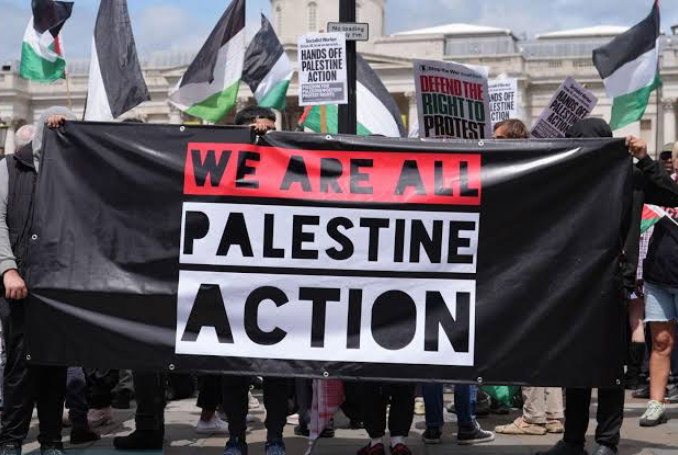
The court also heard that by November 6, 2025, over 2,000 people had been arrested for holding placards declaring support for Palestine Action. According to The Guardian, the case is likely to determine whether those arrested will face criminal trial.
My mandate as UN Special Rapporteur was pleased to intervene this week in the UK High Court judicial review proceeding, challenging the proscription of Palestine Action by the UK Government https://t.co/aNWfKSxNgc pic.twitter.com/6a45VSnSEe
— Prof Ben Saul – UN SR Human Rights & Counterterror (@profbensaul) November 28, 2025
UK-based Palestine Action was founded in July 2020 and gained prominence for protests targeting Israeli defense companies and their British affiliates. Its activities intensified during Israel’s genocidal assault on Gaza, which began in October 2023.
A key target in its campaign has been the British factories of Israeli weapons manufacturer Elbit Systems.
According to the Defend Our Right charity, cited by Al-Jazeera Arabic, 254 people had been charged with supporting a terrorist organization, as of November 20. Most of them face up to six months in prison under anti-terrorism legislation, the report noted.
Ongoing Israeli Killings in Gaza
Starting on October 7, 2023, the Israeli military, with American support, launched a genocidal war against the people of Gaza. This campaign has so far resulted in the deaths of over 70,000 Palestinians, with more than 170,000 wounded. The vast majority of the population has been displaced, and the destruction of infrastructure is unprecedented since World War II. Thousands of people are still missing.
Woman Killed, Homes Razed as Israel Expands Strikes inside Gaza’s Yellow Line
In addition to the military assault, the Israeli blockade has caused a man-made famine, leading to the deaths of hundreds of Palestinians—mostly children—with hundreds of thousands more at risk.
Despite widespread international condemnation, little has been done to hold Israel accountable. The nation is currently under investigation for genocide by the International Court of Justice, while accused war criminals, including Prime Minister Benjamin Netanyahu, are officially wanted by the International Criminal Court.
(PC, AJA)