
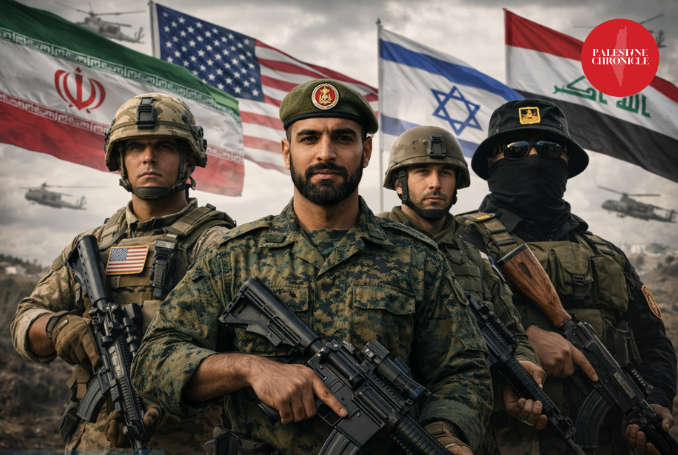

Iran signals full drone and missile readiness as US deploys carrier, refueling jets, and weighs strike options. Meanwhile, Iraqi Hezbollah issues a statement.
Key Developments
- Iran declares “full readiness” across drones, missiles, and air defense systems.
- USS Gerald R. Ford arrives near Israel amid expanding US deployments.
- Dozens of US refueling aircraft and stealth fighters land in Israel.
- Iraqi faction Kataib Hezbollah warns of a possible “long war.”
- US authorizes departure of non-essential embassy staff from Israel.
- Iran urges Washington to drop “excessive demands” after Geneva talks.
- Haaretz reports US buildup cost exceeds $1 billion in six weeks.
- Viral claims about carrier malfunctions delaying a strike are debunked.
Iranian Military Readiness
Iranian officials have moved beyond general deterrent rhetoric, offering detailed assertions of operational preparedness across multiple domains.
Brigadier General Sirus Amanollahi, deputy commander of Iran’s ground forces, stated that the army is “fully prepared to confront any hostile movements,” underscoring readiness in drones, missile forces and air defense systems. He emphasized that Iranian units are capable of executing defensive missions “against any hostile movements” and defending national territory under battlefield conditions.
Amanollahi pointed to extensive exercises and operational lessons drawn from last year’s 12-day war as having significantly elevated readiness levels. According to his remarks, accumulated combat experience has been integrated into updated deployment protocols, unit coordination, and rapid-response frameworks.
He further stressed that Iranian ground forces can deploy to “any point witnessing hostile movements” within a short timeframe upon orders from the commander-in-chief. Equipment modernization, he added, is ongoing and aligned with evolving battlefield requirements, suggesting adaptation to anticipated air and missile-based scenarios.
Tehran has consistently framed US and Israeli threats as pretexts for intervention and regime change. Iranian officials have warned that even a limited strike would not go unanswered. In previous statements cited in recent reporting, Tehran signaled that US military bases in the region could become targets in the event of aggression.
Simultaneously, Iranian political leadership has linked military readiness to negotiation leverage. Tehran maintains that sanctions relief must accompany any nuclear restrictions and rejects demands to halt uranium enrichment entirely, transfer enriched material abroad, and dismantle its ballistic missile program.
US Force Deployment
On Friday, Israeli Channel 12 reported that the USS Gerald R. Ford, described as the world’s largest aircraft carrier, arrived on Israeli shores. The arrival followed the landing of approximately 20 US refueling aircraft in Israel the previous night.
The Times of Israel, citing analysts tracking open-source flight data, reported that six additional KC-46 refueling aircraft are expected at Ben Gurion Airport. Earlier in the week, 11 F-22 stealth fighter jets reportedly arrived at Ovda Air Base, accompanied by logistical support aircraft and aircrews.
Additional deployments reportedly include F-35s, F-15s and F-16s heading to the region, alongside dozens of refueling aircraft and hundreds of cargo flights.
CNN reported that Admiral Brad Cooper, commander of US Central Command, briefed President Donald Trump on potential military options.
Vice President J.D. Vance told The Washington Post that options include “military strikes” or diplomatic resolution, stating:
“I don’t know what President Trump will decide regarding Iran. I think we all prefer the diplomatic option.”
Iraqi Faction Mobilization
The Iraqi dimension adds a potentially decisive regional layer to the current escalation.
Kataib Hezbollah issued a statement calling on its fighters to raise readiness levels for what it described as a possible “long war.” The group warned the United States of “heavy losses” should confrontation begin and urged all fighters to prepare for a war of attrition that “may be long-term.”
An unnamed Iraqi faction leader told Agence France-Presse that participation in any upcoming confrontation is “highly possible,” emphasizing: “We consider Iran a strategic depth for us, and harming this depth threatens us directly.”
This framing positions Iran not merely as an ally but as a core security buffer for Iraqi armed factions. The language suggests that US action against Iran could be interpreted as an immediate threat to Iraqi groups aligned with Tehran.
AFP reporting indicated that Iraqi factions, which did not directly intervene during last June’s confrontation between Israel and Iran, may adopt a less restrained stance if US strikes are perceived as comprehensive or regime-targeting rather than limited.
Such statements introduce uncertainty into Washington’s planning calculus. While US military options may be designed as discrete, time-bound strikes, Iraqi armed groups appear to be signaling that the scope and declared objectives of any attack would determine their response.
The possibility of attacks on US bases in Iraq—whether through rockets, drones or other means—expands the operational theater beyond a direct US-Iran exchange.
‘Until the Last Drop of Blood’ – Iran Warns as US Tankers Head to Israel
Diplomatic Track
Parallel to military escalation, indirect negotiations between Tehran and Washington continue.
Talks resumed in Oman on February 6 after being suspended following Israeli and US attacks in June 2025. A second round took place in Geneva on February 18, with a third round concluding Thursday.
Iranian Foreign Minister Abbas Araghchi said the latest round witnessed “further progress” and ended with “mutual understanding.” However, on Friday he urged Washington to abandon what he described as “excessive demands.”
In a phone call with Egyptian Foreign Minister Badr Abdelatty, Araghchi stated that success requires “seriousness and realism from the other side and avoiding any uncalculated steps and excessive demands,” according to Iran’s Foreign Ministry.
Egypt reaffirmed support for diplomatic efforts and emphasized the need to continue negotiations while avoiding military escalation and its “grave consequences.”
CNN reported that Omani Foreign Minister Badr al-Busaidi is expected to meet Vice President Vance in Washington to discuss efforts to reach a nuclear agreement and avert a potential US strike.
The United States continues to demand that Iran halt uranium enrichment, transfer enriched uranium abroad, and abandon its ballistic missile program. Washington has also signaled that military action remains an option if negotiations fail.
Tehran, meanwhile, insists that sanctions relief must accompany any nuclear concessions and views demands related to its missile program as excessive and unrelated to nuclear compliance.
Iran Signals Deal ‘Within Reach’ – Geneva Nuclear Talks Enter Longest Round Yet
Financial Pressures
The Israeli newspaper Haaretz reported that six weeks of heightened US-Israeli readiness have cost the United States more than $1 billion.
Operating a single aircraft carrier costs roughly $10 million per day, according to the report. The USS Gerald R. Ford, carrying approximately 5,000 personnel, incurs additional costs due to increased flight hours and exercises.
The report suggested that such financial commitments could make it politically difficult for President Trump to withdraw forces without achieving a “tangible achievement,” either military or diplomatic.
Embassy Departures
Meanwhile, the US embassy in Jerusalem announced that Washington has authorized the departure of non-essential staff and their families due to unspecified “security risks.”
The measure allows voluntary departure but does not constitute mandatory evacuation. It follows a separate US decision requiring certain embassy staff in Beirut to leave.
Several countries have issued travel advisories concerning Iran amid escalating tensions.
Iran, Palestine and the Future of the Next Century: The Final Strategic Test
Our Strategic Assessment
The convergence of Iranian readiness declarations, US force deployments, and Iraqi faction mobilization creates a multi-layered escalation environment.
Iran’s emphasis on drones, missiles and rapid deployment underscores a strategy of deterrence through capability signaling. The public articulation of readiness suggests Tehran seeks to raise the cost threshold for any strike while maintaining negotiating leverage.
The Iraqi factor significantly complicates the strategic equation. By framing Iran as “strategic depth,” Iraqi armed factions are effectively signaling that US action against Tehran may trigger retaliatory measures across Iraqi territory. This introduces the possibility of a geographically expanded conflict, even if initial US strikes are narrowly defined.
Diplomatically, the continuation of the Geneva talks indicates that both sides remain engaged. However, the core dispute—over enrichment, missile capabilities, and sanctions relief—remains unresolved. Iran’s characterization of US demands as “excessive” and Washington’s insistence on comprehensive constraints reflect a persistent structural gap.
The simultaneous advancement of military preparedness and diplomatic engagement suggests that both sides are attempting to maximize leverage before any decisive move.
The coming phase will likely hinge on whether the current buildup functions as coercive pressure within negotiations or crosses into kinetic confrontation shaped not only by Washington and Tehran, but also by armed actors in Iraq and across the region.
(PC, Anadolu, Iranian Media, Al-Mayadeen, AJA, Israeli Media, US Media)


As of 19:32 hours NZ time, aka 7-32pm, the Jerusalem Post at 8:21am has declared that the IDF is attacking Iran. Khaleej Times gives 10:19am as the time they published their report. I don’t know to what degree, but the doofus currently mismanaging Israel’s defense Israel Katz has said it’s a “pre-emptive strike” a la Pearl Harbor, which among other things, means that the Iranians are entitled to defend themselves. We are watching a re-run of the Suez Crisis, with Iran standing in for Egypt, and the US standing in for Britain and France.