
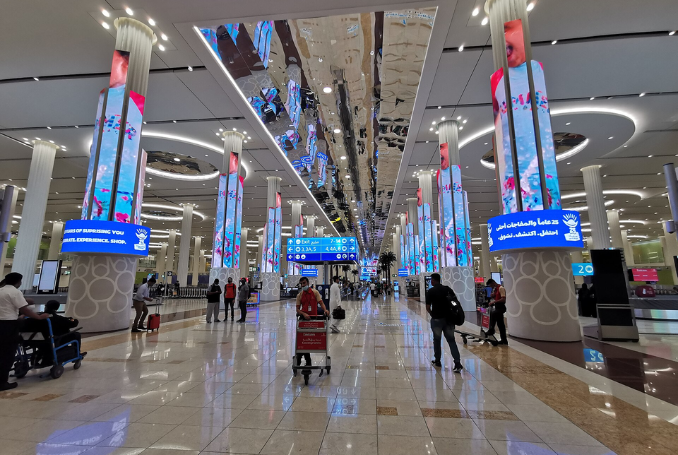

Residents are fleeing the Gulf as war disrupts airspace, cancels thousands of flights, and rattles global aviation markets.
Key Developments
- More than 11,000 flights have been cancelled since Saturday, affecting over one million passengers.
- Dubai residents driving to Oman and Saudi Arabia to secure outbound flights.
- Private jet bookings jump 40 percent as demand outstrips aircraft supply.
- Airline stocks fall sharply following regional escalation.
- Businesses shift to remote operations amid safety concerns.
Residents Seek Exit Routes
As Israeli and US strikes on Iran triggered retaliatory attacks across the Gulf, thousands of residents in Dubai and Abu Dhabi began seeking ways to leave the region.
According to a report published in the Financial Times on Monday, Dubai residents have been driving to neighbouring Oman or even Saudi Arabia “to try to secure seats on the limited number of flights out of the region.”
Muscat in Oman emerged as what EnterJet founder Charles Robinson described as “the only really viable option” to handle “the array of immediate UAE departure requests.”
The Endgame in the War on Iran: Scenarios and What Comes Next — Analysis
Others reportedly drove up to 10 hours to Riyadh. Robinson noted that “there’s activity starting in Dammam as well, which is useful for those in Bahrain and Qatar.”
According to the reports, hotels in Oman are filled with Gulf-based expatriates, including families who crossed the border shortly after airspace closures began.
Private Jet Demand Surges
With commercial operations suspended, the report says that private aviation operators reported a sharp rise in demand.
FT cited EnterJet as saying that bookings had jumped 40 percent since Saturday. Robinson told the Financial Times: “We have more demand than aircraft that are available to offer in the region at the moment.”
FT Luxe Jets reportedly chartered an Airbus A320 from Muscat to Istanbul and planned additional departures later in the week. “Half of Dubai is booking,” said Luxe Jets director Alexander Graham.
Landing slots in Muscat have become competitive, and aircraft availability remains limited.
‘Not Iraq,’ They Said – The US War on Iran Is Already Unraveling — Analysis
According to the report, prices have surged. One operator charged £20,000 per seat for a jet leaving Oman for Milan. A charter from Oman to Paris was selling for €215,000 for a 13-seat aircraft — nearly double standard rates.
A Dubai-based Russian businessman told the Financial Times he offered twice the normal price for a private jet from Dubai to Moscow but was told “no exceptions could be made at this time.”
Raffaella Meledandri, founder of private jet operator Air-Dynamic, said customers would need to “be patient” as operations resume gradually from Muscat.
Over One Million Passengers Affected
According to aviation data group Cirium, more than 11,000 flights have been cancelled since Saturday, including roughly 4,000 on Monday alone. More than one million passengers have been affected.
Airports in Dubai and Abu Dhabi, closed since Saturday, began limited reopening late Monday, with a small number of repatriation flights expected.
Qatar Airways and Etihad Airways said scheduled flights remain suspended until at least Tuesday.
The European Union’s aviation safety agency has warned civil aircraft not to fly across the entire region, complicating efforts to restore normal operations.
What Happens If the War on Iran Drags On for a Month? – Analysis
Financial Markets React
According to the report, shares in major European airline groups fell sharply on the first trading day after the escalation.
International Airlines Group fell just over 5 percent. Air France-KLM ended nearly 9 percent lower. Lufthansa shed close to 5 percent.
Although most European carriers have aircraft based in their home markets, disruption to Gulf routes and connecting traffic has affected investor sentiment.
Businesses across the region have advised employees to work remotely.
“We will work remotely as a measure of caution to limit employee exposure to the threat of falling debris,” said John Hensel, director of Dubai-based Demeter Tactical Investments, according to the Financial Times.
A senior executive at a global hedge fund with operations in Dubai told the Financial Times: “We have been exploring how to evacuate people but it’s not easy.”
(PC, FT)