
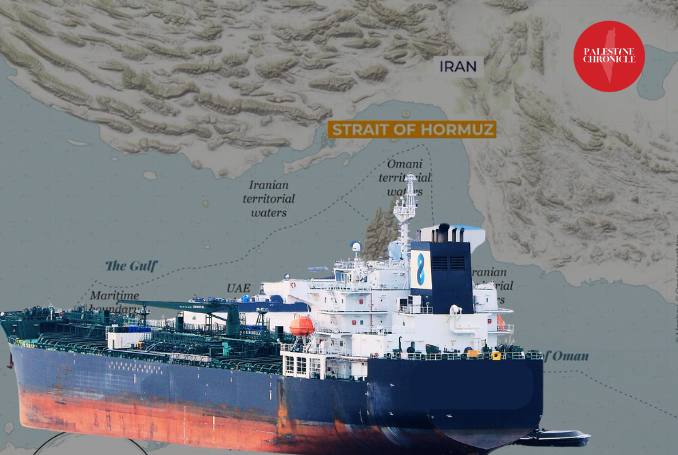

Iran’s Revolutionary Guard says it struck a US oil tanker and tightened control over the Strait of Hormuz.
Key Developments
- IRGC says it targeted a US oil tanker in the northern Gulf.
- Iran reiterates that the Strait of Hormuz is under its control during wartime.
- Iranian Foreign Minister Abbas Araqchi threatens the US over the sinking of the frigate Dena.
- Iran says it struck Israeli targets using Arash drones.
- Analysts warn that prolonged disruption in Hormuz could trigger a European energy crisis.
IRGC Claims Attack on US Tanker
Iran’s Islamic Revolutionary Guard Corps (IRGC) said Thursday that it had targeted an American oil tanker in the northern Gulf waters at dawn.
According to a statement from the Guard’s public relations office, the vessel was struck and is “burning now.”
The IRGC also reiterated that navigation through the Strait of Hormuz falls under Iranian authority during wartime.
The statement said that maritime traffic regulations in the strait “are under Iran’s control in times of war,” adding that all vessels must comply.
The Guard warned that ships belonging to the United States, Israel, European countries and their allies must not attempt to cross the strategic waterway.
Iran’s Islamic Revolutionary Guard Corps (IRGC) announced on Thursday that its naval forces struck a US oil tanker in the northern Persian Gulf, while warning that vessels linked to the United States, Israel, and allied countries could be targeted during wartime navigation…
— The Palestine Chronicle (@PalestineChron) March 5, 2026
It said Iranian forces would monitor and target any vessel attempting to pass through the strait illegally.
The statement came one day after Iranian officials declared that the Revolutionary Guard had taken full control of the Strait of Hormuz, one of the most critical chokepoints in global oil trade.
Iranian officials warned that “not a single drop of oil will be allowed to leave the region,” suggesting that oil prices could surge dramatically if the situation escalates further.
Iran Threatens US after Frigate ‘Dena’ Incident
Iranian Foreign Minister Abbas Araqchi also issued a sharp warning to Washington following reports that the Iranian frigate Dena had been struck at sea.
“The US has perpetrated an atrocity at sea, 2,000 miles away from Iran’s shores,” Araqchi wrote on the X platform.
He said the frigate, which he described as “a guest of India’s Navy,” was carrying nearly 130 sailors and had been hit in international waters without warning.
“Mark my words: The US will come to bitterly regret the precedent it has set,” he added.
Separately, Iranian military statements said the Iranian navy targeted fuel storage tanks at Ramat David Airbase in northern Israel overnight using Arash drones.
Possible Supply Shock
The escalating tensions around the Strait of Hormuz have raised serious concerns about global energy markets.
Oxford Economics warned that continued disruptions could severely affect European gas supplies.
The U.S. has perpetrated an atrocity at sea, 2,000 miles away from Iran's shores.
Frigate Dena, a guest of India's Navy carrying almost 130 sailors, was struck in international waters without warning.
Mark my words: The U.S. will come to bitterly regret precedent it has set. pic.twitter.com/cxYiI9BLUk
— Seyed Abbas Araghchi (@araghchi) March 5, 2026
According to the organization, if the closure of the Strait persists, European gas reserves could fall below 20% by the end of the summer, making it extremely difficult to reach the EU’s winter storage target of 80%.
Analysts warned that each additional week of disruption reduces Europe’s ability to replenish its reserves and could push the continent closer to an industrial crisis scenario.
Gas contracts in the British market have already surged to 158 pence per thermal unit, representing an increase of more than 44%.
ANZ Bank analysts said the disruptions are occurring at a particularly sensitive moment, with European energy stocks already at unusually low levels for this time of year.
The report also highlighted structural constraints in global supply, noting that US liquefied natural gas facilities are already operating near maximum capacity, limiting Washington’s ability to increase exports to Europe.
Countries most exposed to the crisis include Italy, which relies heavily on Qatari liquefied natural gas, and Germany, whose energy-intensive industrial sector depends on a stable supply.
Eastern European states may also face domestic instability if energy prices surge ahead of upcoming elections.
The Strait of Hormuz is the passage for roughly one-fifth of the world’s oil trade, making any prolonged disruption a potential trigger for global economic shock.
(PC, Al Mayadeen, Tasnim News agency)


Be the first to comment