
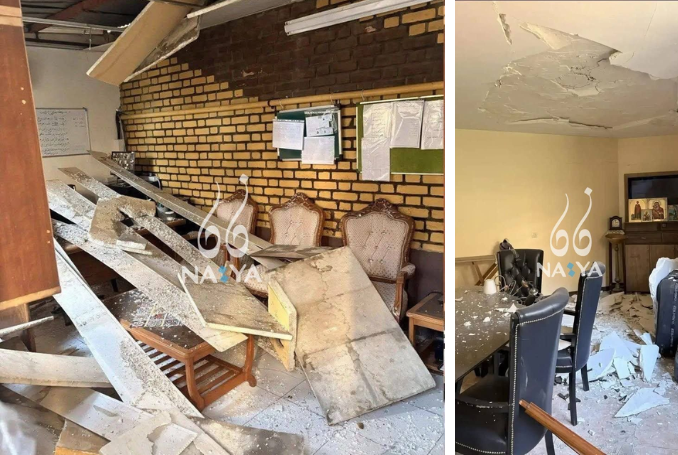

Airstrikes near a Russian Orthodox church in Tehran cause structural damage, prompting Moscow’s condemnation and concern over cultural site protection.
Serious Damage
A Russian Orthodox church in Tehran sustained structural damage following US-Israeli airstrikes carried out on Wednesday, April 1, according to Russian officials and media reports.
Russia’s Foreign Ministry said the attack struck near St. Nicholas Orthodox Church, damaging parts of the main building along with auxiliary facilities.
“We strongly condemn any damage to religious sites,” Foreign Ministry spokesperson Maria Zakharova said, describing the incident as a “flagrant violation” of the rights of believers.
She added they were “shocked by reports of serious damage and significant material losses,” noting that the strike occurred in close proximity to the church complex.
The Russian Embassy in Tehran confirmed that no casualties were reported, though images circulating in the media showed shattered windows, debris inside the structure, and visible damage to surrounding buildings.
The strike reportedly targeted an area near the former US Embassy compound, located only meters from the church.
US-Israeli strikes today damaged the St. Nicholas Russian Orthodox Cathedral in Tehran, including broken doors, windows, and an almshouse, during an attack near the former US Embassy compound. pic.twitter.com/CaGxTQhL81
— National Chronicle (@NCNewsOnX) April 1, 2026
‘Place of Strength’
Russian authorities stressed that the church is not only a place of worship but also a protected cultural and historical landmark.
Zakharova said the church is administered by the Russian Orthodox Church and is listed as part of Iran’s national cultural heritage.
She described it as a religious center that has long served the Russian community in Iran, functioning as a “place of strength and spiritual connection” for the diaspora.
Moscow called on the international community to take note of the strike, warning that attacks near religious and heritage sites raise concerns under international norms governing armed conflict.
St. Nicholas Orthodox Church
St. Nicholas Orthodox Church was built in the early 1940s and officially opened in 1945, designed by Russian architect Nikolai Markov.
The church was constructed through donations from Russian émigrés who had fled the Bolshevik Revolution and settled in Iran, particularly in Tehran.
It was built on what is now Mofatteh Street, an area historically associated with the Russian community in the Iranian capital.
The complex also included a charitable facility and care center, reflecting the needs of an émigré population that included elderly and displaced individuals.
The church was consecrated in April 1945 and initially operated under the Russian Orthodox Church Outside Russia before later being integrated into the Moscow Patriarchate.
The broader Russian Orthodox presence in Iran dates back several centuries, with early parishes established as far back as the Safavid period.
By 1917, around 50 Russian Orthodox churches existed across Iran, though many were lost in the years following the Russian Revolution.
The re-establishment of a Russian Orthodox church in Tehran in the 1940s marked a revival of that presence, centered around St. Nicholas.
After a period of decline in the 1980s, the church was restored to active use and placed under the Moscow Patriarchate in 1995.
🚨⚡️Maria Zakharova: Moscow strongly condemns the targeting of St. Nicholas Cathedral in Tehran and calls for a serious international response. pic.twitter.com/qE7XVzIH7O
— RussiaNews 🇷🇺 (@mog_russEN) April 3, 2026
Architectural Significance
The church is recognized as a cultural heritage site in Iran and is considered one of the most significant Russian religious buildings in the country.
Its architecture reflects traditional Russian ecclesiastical design adapted to the Iranian urban environment, with distinctive domes and structural elements characteristic of Orthodox churches.
The building’s historical value is tied both to its architectural design and to its role in preserving the identity of a long-standing expatriate community.
Strikes on Civilian, Cultural Sites
The damage to St. Nicholas Church comes amid widespread reports of airstrikes affecting civilian, cultural, and religious sites across Iran.
Iranian authorities and humanitarian groups say thousands of civilian structures have been impacted since the start of the campaign, including residential buildings, schools, medical facilities, and places of worship.
Data released by the Iranian Red Crescent indicated that at least 6,600 civilian units were targeted in the early weeks of the strikes, including more than 5,500 residential buildings, dozens of schools, and medical centers.
Separate reporting has documented strikes on schools and infrastructure, including an attack on a girls’ school that killed scores of students, as well as damage to bridges, industrial facilities, and cultural landmarks.
(PC, Iranian media, Russian media)



Be the first to comment