

Seventeen Palestinians killed as Gaza toll rises, while aid deliveries remain far below targets despite ceasefire framework.
Key Developments
- 17 Palestinians killed, 32 injured amid ongoing Israeli attacks.
- Death toll since ceasefire reaches 809, total exceeds 72,500.
- Aid deliveries remain far below agreed levels, worsening humanitarian crisis.
Rising Death Toll amid Continued Attacks
The Gaza Ministry of Health announced on Saturday, April 25, that 17 Palestinians were killed, including 13 over the past 24 hours, while 32 others were injured over the previous 48 hours as Israeli attacks continued across the Gaza Strip, Quds News Network reported.
In its daily statistical report, the ministry said a number of victims remain trapped under rubble or lying in the streets, as ambulance and civil defense teams are unable to reach them due to ongoing bombardment and dangerous field conditions.
This, the ministry warned, means the actual death toll is likely higher than currently reported.
The ministry added that since the ceasefire came into effect on October 11, 2025, at least 809 Palestinians have been killed and 2,267 injured, alongside 761 reported recoveries, reflecting what it described as continued deadly violations of the agreement.
The toll since October 7, 2023, has now risen to 72,585 killed and 172,370 wounded, underscoring the scale of destruction and the prolonged strain on Gaza’s already devastated health system.
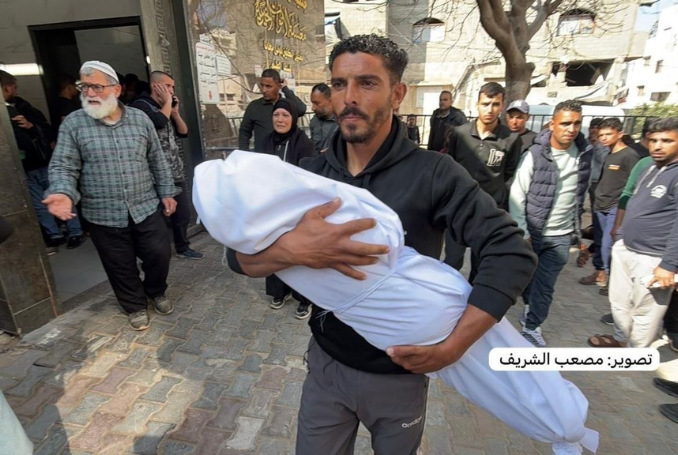
A heartbreaking farewell to the slain young girl Naya Al-Tanani, who succumbed to her wounds last night after being critically injured in an Israeli airstrike in the northern Gaza Strip two days earlier. Her mother and sibling were killed in the attack. pic.twitter.com/9BsD9wCF50
— Quds News Network (@QudsNen) April 25, 2026
Bloody Friday
At Nasser Medical Complex, medical sources confirmed that five Palestinians were killed on Friday after an Israeli drone strike targeted a police vehicle in the Mawasi area of Khan Younis, in what local authorities described as a renewed targeting of civilian and security structures.
In northern Gaza, two members of the Al-Tanani family, a mother and her child, were killed when Israeli artillery shelled their home near Kamal Adwan Hospital. Several others were injured and transported for treatment as shelling continued in the area surrounding the hospital.
Meanwhile, in the Sheikh Radwan neighborhood of Gaza City, two Palestinians were killed and others seriously injured after an airstrike targeted a police patrol near the Bahloul intersection.
Gaza’s Ministry of Interior and National Security confirmed that the strike killed two police officers, identified as Captain Imran Omar Al-Lad’a and Lieutenant Ahmed Ibrahim Al-Qassas, and left two others critically wounded.
Humanitarian Crisis Deepens
The latest figures come as humanitarian conditions in Gaza continue to deteriorate sharply, with shortages of medical supplies, disrupted rescue operations, and thousands still missing under rubble across the Strip.
At the same time, data reported by the Financial Times shows that deliveries of food and essential goods into Gaza have fallen significantly below levels outlined in the ceasefire arrangements.
According to humanitarian data cited in the report, an average of just 60 UN-coordinated aid trucks entered Gaza daily between the start of the US-Israeli war on Iran in late February and the ceasefire on April 8. This marked a sharp decline from the pre-war February average of 95 trucks per day.
Under the terms of the October ceasefire framework, Israel was expected to allow 4,200 aid trucks per week into Gaza. However, deliveries fell to below 1,500 trucks over a two-week period before the Iran ceasefire, according to data from the US-led Civil-Military Coordination Center.
Although aid volumes rose to around 3,100 trucks in the week following the ceasefire, they still remain well below agreed targets.
A tragic farewell to the slain young girl Naya Al-Tanani, who was killed last night in an Israeli strike in the northern Gaza Strip. pic.twitter.com/5nY3vi39qR
— Quds News Network (@QudsNen) April 25, 2026
Restrictions and Access Limitations
Humanitarian officials attribute the reduced flow of aid to Israeli restrictions, including the closure or limited operation of key crossings during the escalation with Iran.
A source familiar with coordination efforts said movement inside Israel was heavily restricted during the conflict, limiting aid distribution.
While crossings such as Kerem Shalom and Zikim have since partially reopened, access remains inconsistent and subject to restrictions.
An Israeli security official cited by the Financial Times claimed that there is “no shortage of food in Gaza,” stating that up to 600 trucks per day are currently entering through crossings.
However, humanitarian organizations dispute this assessment.
Olga Cherevko said that the issue is not only the number of trucks, but the types of goods being allowed in.
“What matters more than the number of trucks is the things that are not being allowed in,” she said, highlighting restrictions on critical items such as medical supplies, construction materials, and equipment needed to clear rubble.
Living Conditions Remain Catastrophic
The worsening aid situation is having a direct impact on Gaza’s 2.1 million residents, most of whom remain displaced and dependent on external assistance.
Large parts of the Strip remain in ruins following months of Israeli bombardment, with residents living in tents or damaged structures.
Officials also warned of secondary health risks, including the spread of disease due to sewage overflow and uncollected waste, compounded by delays in approving the entry of essential sanitation materials.
Meanwhile, reconstruction efforts remain stalled, with a joint assessment by international institutions estimating that Gaza would require approximately $71 billion to rebuild.
Despite the formal ceasefire agreement, continued attacks and restrictions on humanitarian access indicate that conditions on the ground remain highly unstable.
(PC, QNN, Financial Times)



Be the first to comment