
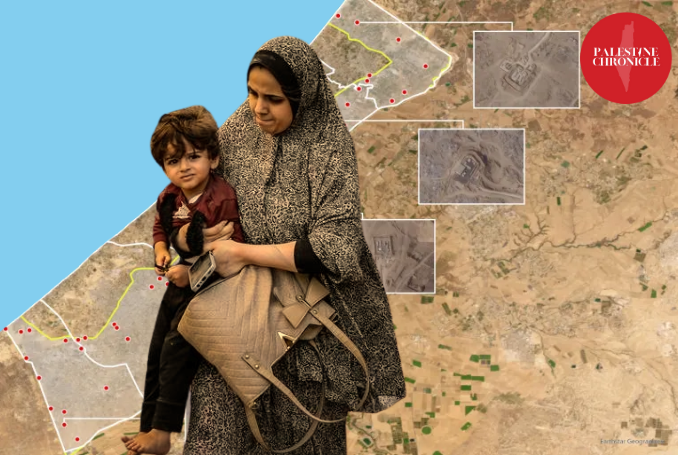

New Israeli military maps quietly expand Gaza restricted zones, confining Palestinians deeper into shrinking territory under Israeli control.
Key Developments
- New Israeli maps place thousands more displaced Palestinians inside expanded restricted zones in Gaza.
- Restricted areas now cover nearly two-thirds of Gaza’s territory, according to Reuters analysis.
- Aid groups received updated maps in mid-March, but Israel did not release them publicly.
Israel Quietly Expands Restricted Areas in Gaza
New maps quietly distributed by the Israeli military to humanitarian organizations have expanded restricted zones inside Gaza, placing thousands of displaced Palestinians within areas where Israeli forces may operate and open fire, according to a report by Reuters.
The maps, sent to aid groups in mid-March, introduce an enlarged restricted area marked by an orange line beyond the so-called Yellow Line, which demarcates territory occupied by Israeli troops following the October ceasefire.
According to the analysis, the newly marked areas encompass an additional 11 percent of Gaza’s territory, bringing the total area effectively controlled or restricted by Israel to nearly two-thirds of the Strip.
The Israeli military has not publicly released the maps.
According to Reuters, aid workers and displaced Palestinians say the constantly shifting lines have created confusion and fear among civilians already living in overcrowded camps and bombed-out neighborhoods.
“People don’t know what is what,” displaced resident Rani Ashour, who lives near Gaza City between the two lines, told Reuters.
“The line is here today, you sleep, and you wake up, and you find it has passed you,” he added.
Palestinians living in these areas fear they could be considered military targets simply for remaining inside zones whose boundaries continue to change.
Living under the Yellow Line: Life, Water, and Displacement in Northern Gaza
Aid Access Restricted
Israel claims the area between the orange and yellow lines is a restricted coordination zone intended to facilitate humanitarian operations.
The Israeli military agency COGAT said international organizations must coordinate movements with the military inside the area “while safeguarding personnel in a complex operational environment.”
However, aid workers say the restrictions have severely hindered humanitarian access.
Ashour said humanitarian groups are increasingly reluctant to enter the area, leaving residents without sufficient water and aid.
The uncertainty surrounding the boundaries has also raised concerns among humanitarian organizations operating in Gaza.
Aid Workers Killed near the Lines
According to Reuters, at least three Palestinians working with international aid agencies have been killed by Israeli attacks in the area between the two lines since mid-March.
The victims included two workers affiliated with UNICEF and one with the World Health Organization.
In both incidents, the Israeli military said it identified threats near the Yellow Line and opened fire.
UNICEF and WHO did not immediately comment on whether their personnel had coordinated movements with Israeli authorities.
Control Expands Beyond Ceasefire Terms
Israeli officials have described areas seized in Gaza, southern Lebanon, and Syria as “buffer zones” intended to prevent future attacks following October 7, 2023.
Israeli Prime Minister Benjamin Netanyahu said on March 31 that “more than half of the Strip’s territory” was under Israeli control.
Reuters reported that the latest maps appear to show the Yellow Line itself being moved deeper into Gaza, effectively absorbing previously restricted areas and replacing them with even larger zones marked by the orange line.
According to Reuters, the Israeli military declined to confirm whether the Yellow Line had shifted.
Mass Confinement and Displacement Concerns
Palestinian analysts and humanitarian officials warn that the expanding zones are confining Gaza’s population into an increasingly narrow coastal strip.
Jad Isaac, director general of the Applied Research Institute-Jerusalem, told Reuters that Israel now effectively controls at least 64 percent of Gaza.
“They want to put as many Palestinians as possible in the smallest area,” Isaac said, adding that the policy could push Palestinians out due to the “absence of any viability or sustainability in what’s left of Gaza.”
Israeli ministers, including Bezalel Smotrich, have repeatedly called for Palestinians to leave Gaza, intensifying fears of long-term displacement.
Behind the Yellow Line, Reuters reported that Israeli occupation forces have forced civilians out and bulldozed much of the remaining infrastructure.
At the same time, development discussions involving the United States and the UAE have reportedly focused on future plans for territory now under Israeli control.
Amjad al-Shawa, head of the Palestinian NGOs Network in Gaza, said the shifting boundaries have created chaos for civilians.
“Residents do not know where the lines begin or end,” he said, adding: “One day, the boundary is in one location, and the next day it shifts without warning.”
Since the October ceasefire, local medics say Israeli fire has killed more than 800 Palestinians in Gaza, many of them near the Yellow Line.
The area is densely populated with displaced persons camps and families sheltering in damaged buildings.
During the same period, four Israeli soldiers have reportedly been killed.
(PC, Reuters)





The leader of Isreal…is pure evil. How can the world sit by and watch the genocide.
Millions are protesting…but those who could stop it… U.S.A DO NOTHING.