
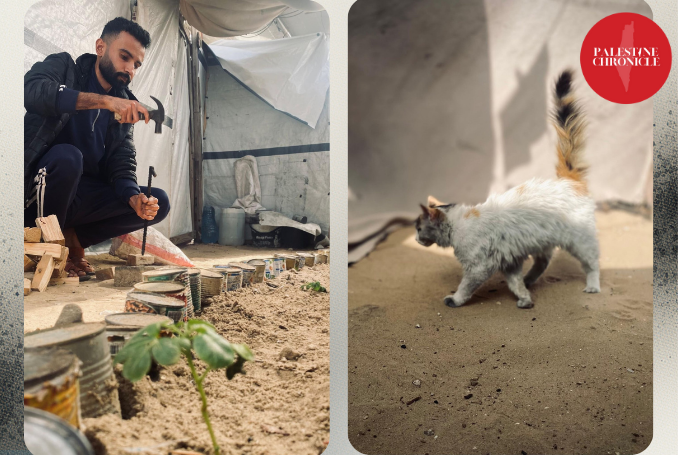
We are not living life—we are bargaining with it, day after day, for its bare minimum. And we survive not because we are stronger, but because surrender is a luxury we cannot afford.
I never imagined that I would live in a tent—that worn-out fabric would become my roof, the cold ground my bed, and the open sky a constant witness to our fractures. My home in Gaza was destroyed, a home that was never just walls, but a living archive of memory. Overnight, I was transformed from a homeowner into a displaced person, reduced to carrying my life in a few bags and plastic sacks, measuring my days by how much patience I had left to spend.
A tent offers only the bare minimum required to remain alive. It does not protect you from the cold of night, nor shield you from the heat of day. It grants no privacy and no safety. And yet, we try to live inside it—not because we love it, but because life, even when stripped to its narrowest margins, insists on continuing. We cling to the little food aid we obtain with great difficulty and at unbearable cost. We cook cautiously, fearing for the food more than for ourselves, because losing it means another cycle of hunger, waiting, and humiliation.
But another battle was draining us quietly and relentlessly: rats.
The rats of the camp were not passing intruders; they were permanent residents. They knew the tents well and understood that what lay inside them was everything we owned. They gnawed through bags, spoiled food, and stole what barely sustained us.
Every morning, we woke to their traces, a cruel reminder that even the most basic survival was no longer secure. We tried every traditional and improvised method to get rid of them, but their instinct to survive proved stronger—until we found ourselves helpless before a handful of rats.
Daily Thirst amid Tents and Ruins: A ‘Rough and Sandy Path’ for Gaza’s Displaced
Lychee: The Quiet Guardian of the Tent
One morning, I woke up to an unfamiliar weight on my body. I opened my eyes to find a white mass of fur curled on top of me, like a ball of yarn.
A cat.
How and when did she arrive? I hadn’t felt her. And what was this calm with which she slept on me, as though I had belonged to her for years? She didn’t flinch or run away. She simply opened her eyes and stretched her paws, like a child waking safely in a cradle.
And from that moment, the story began. Not a calculated plan, but an instinctive intervention by nature itself.
The cat entered our tent just as we did: without guarantees, without certainty. She was thin and quiet, watching everything with cautious eyes. My mother loved her immediately; as always, she saw more than what was visible. She named her Lychee.
The name was not incidental.
Lychee was the name of a fruit my martyred sister used to bring home before the war—when markets still carried color and days still carried taste. My mother chose the name because the cat’s pale color resembled the fruit, as if memory had refused to die and instead found a new body. Naming her was not an indulgence; it was an act of resistance against erasure.
Lychee was no ordinary cat. She was a hunter by instinct—patient, alert, strategic. Soon, the rats began to disappear, and a fragile calm returned to our tent. When her belly began to swell, we realized she was pregnant.
Winter in Gaza: A New War Devours the Tents of the Displaced
We prepared a cardboard box lined with fabric, a makeshift cradle in a place without shelter. Then Lychee gave birth to four kittens—four lives born inside a tent, just like us, without warmth or security, yet unmistakably determined to live.
What followed was even more remarkable than their birth.
Lychee practiced the motherhood of survival. She trained her kittens to hunt, observed them closely, corrected them, and taught them patience and precision. Watching her, I saw Gaza’s mothers—women who cannot afford their children the luxury of a long childhood, and who therefore teach them early how to face a world built on cruelty.
Over time, the cats’ presence extended beyond our tent to neighboring ones, and then to the entire camp. The rats disappeared, or at least retreated. People noticed. Everyone began feeding the cats, as if caring for them restored a sense of collective responsibility that the war had tried to destroy.
If someone found a rat—or even its trace—they rushed to us: “Bring Lychee. Or one of her kittens:” as if calling paramedics, or a rescue unit.
In a place stripped of order, Lychee and her kittens reintroduced balance.
They guarded our food. They guarded the tent against invisible chaos. They gave the tent warmth despite its cold, softness despite its harshness, and a sense of safety in a space surrounded by fear from every direction.
A Day Measured in Water, Fire, and Waiting
Years ago, I watched The Hunger Games, where hunger becomes a plot device, suffering a spectacle, and survival a competition. Back then, hunger, thirst, and fear were ideas confined to a screen—turned off when the film ended.
Beneath the Plastic Sheets: A Day in the Life of Gaza’s Displaced
Today, those ideas have stepped out of fiction and settled into my daily life. They are no longer metaphors, but rules governing existence, a rhythm that dictates day and night. In the films, survival is a prize.
Here, in the tent, survival is unceasing labor: racing thirst to water, negotiating with fire so it does not consume us, waiting for food without collapsing, thinking carefully before deciding to shower—just to shower—as if cleanliness were a privilege that required justification.
There are no heroes here, no villains with clear faces—only people whose nerves are slowly unraveling, yet who are expected to adapt, as though endurance itself excuses cruelty.
Morning in the tent does not begin with light. It begins with thirst.
At 5 AM, I wake before hope does, carrying empty containers into the darkness, where exhausted people stand in a single line, shadows stripped of names. We wait for the water tanker, counting minutes as if they are being carved out of our lives.
I return carrying weight—not to rest, but to begin another battle: firewood. Collecting it, buying it, sorting it, bargaining with it. I have learned wood the way one learns people: this one smokes too much, that one burns too fast, another demands patience. Flames sting the skin, smoke steals breath, and eyes burn—not only from grief, but because we are forced to befriend fire to cook food that resembles patience more than nourishment.
Then comes washing water—arriving at a strict time, staying briefly, then vanishing. We line up again, knowing it will not be enough. Waiting becomes competition. Containers fill quickly. Hands tremble at the fear of a sudden cutoff. Scarcity is shared, just like exhaustion.
Then comes the communal kitchen. One must line up hours in advance for a chance—not a guarantee—to receive a small plate that neither satisfies nor nourishes. Bodies press together. Breath grows heavy. We wait without promises, afraid of returning empty-handed, carrying disappointment heavier than hunger.
Bathing, too, has changed. It is no longer routine, but a decision requiring courage. Little water, usually cold, and a space that protects neither body nor dignity. I wash quickly, counting drops like currency. In those moments, I do not feel clean—I feel exposed, as though vulnerability itself is being returned to me, naked.
This is how a day passes in the tent. Nothing is incidental. Every detail comes at a cost.
Every hour is a test: every act, a silent struggle.
We are not living life—we are bargaining with it, day after day, for its bare minimum. And we survive not because we are stronger, but because surrender is a luxury we cannot afford.
(The Palestine Chronicle)
– Abdulrahman Abunada is a Gaza-based media professional working in photography, graphic design, and video production. He holds a Bachelor’s degree in Journalism and Media and a postgraduate diploma in Digital and Graphic Design from the Islamic University of Gaza, and has contributed visual and documentary work to media outlets and independent platforms, with a focus on visual storytelling and social narratives. He contributed this article to the Palestine Chronicle.
A BRILLIANT WRITER… HE COULD BE A GREAT POET!…. Another reason why Palestine MUST be FREED!! … Palestinians MUST be able to display their MANY Talents to the World, talents israel has tried to murder for nearly 80 years!!! … a niece of mine was in AL-QUDS for a few months helping Palestinian families there, and when she returned she brought me a spoon-holder that was hand-painted by a Palestinian woman artist in a co-operative…it is white ceramic and adorned with a painted leafy-vine that looks almost 3-dimensional…It is absolutely beautiful…..And I love to hear the HAMAS Military sing ” aid from heavens “…SO MUCH TALENT LIVING PROUD AND STRONG IN THE PALESTINIAN PEOPLE
The israelite’s sadistic cruelty is unmatched in the history of the World.