
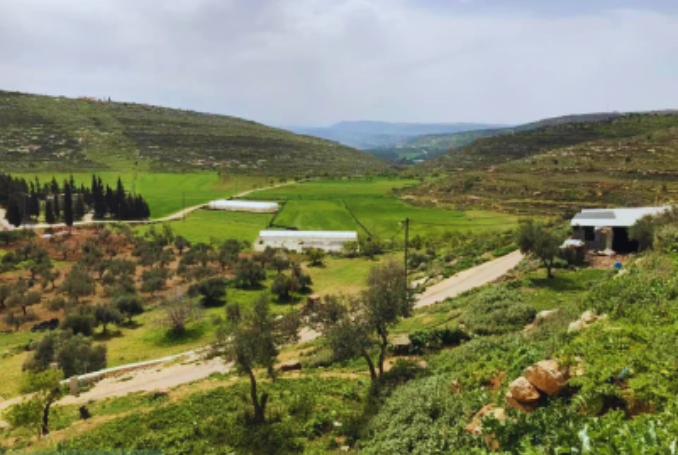
Once sustained by land, livestock, and communal life, Yanoun’s families describe to the Palestine Chronicle how years of settler pressure and military backing culminated in their expulsion.
Fawzi belongs to one of the ten families that lived in Yanoun before the village was forcibly emptied. Speaking about his years there, he recalled a life defined by stability and self-reliance—now violently taken from them.
“We used to cultivate the land around us, which stayed green throughout the year,” he told The Palestine Chronicle.
“We planted whatever we wanted and lived off it. We gave to the land, and it gave back to us. We grazed our livestock safely and slept in our courtyards because of the area’s tranquility. We didn’t feel like we were living under occupation.”
After the year 2000, illegal Israeli Jewish settlers intensified their pressure on Yanoun, a fertile Palestinian community surrounded by farmland and natural springs. The village’s agricultural richness made it a clear target within a broader system of settlement expansion and land seizure.
The Water War in Al-Auja: How Illegal Settlers are Strangling Jericho’s Lifeline
Harassment became systematic. Illegal settlers assaulted residents, chased them from their fields, and stormed their homes, invoking claims over the Maqam Nabi Nun—a local shrine long known to Palestinians—which some Jewish traditions identify as the tomb of Joshua, son of Nun.
Although illegal settlers designated the site as a Jewish holy place, Palestinians have lived continuously in Yanoun for centuries. Similar religious claims have repeatedly been used across the occupied West Bank to justify settlement expansion and the confiscation of Palestinian land.
“They would storm the area weekly to harass us and try to force us out,” Fawzi said. “But we refused to leave our land and our homes. We resisted.”
The attacks escalated sharply after the start of the genocidal war on Gaza, in October 2023. Armed settlers increasingly entered Yanoun under the protection of the Israeli army, which not only enabled the assaults but also directly enforced the displacement.
‘A Beating No Child Could Endure’: Israel Intensifies Arrests across West Bank
“The intensity of the attacks didn’t make us consider leaving, even though they destroyed our homes, the village school, and confiscated our belongings,” Fawzi said. “When they realized we would not leave, they gathered two weeks ago and gave us a deadline to evacuate.”
Residents refused. Shortly afterward, Israeli forces entered the village and forcibly expelled them at gunpoint—methods that mirror those used by settler militias during the Nakba of 1948.
“We left filled with anguish and pain,” Fawzi said. “Everything we had built was scattered before our eyes like a mirage. Now we are searching for shelter after living with dignity in Yanoun. We ask the people of Aqraba and neighboring villages to host us until we find somewhere to live—while our hearts remain in Yanoun.”
The Death Penalty Law: Another Tragedy for Palestinian Prisoners
Under Siege
Khirbet Yanoun, a small Palestinian agricultural community, has endured years of sustained pressure, primarily from surrounding settlements that have steadily expanded onto its land. What has unfolded there reflects a broader pattern in which settlement activity systematically empties rural Palestinian communities of their inhabitants.
Youssef Diriya, a member of the Settlement Resistance Committee in Aqraba, told the Palestine Chronicle that after 2000, international activists began living in Yanoun to help protect residents from displacement, as settlers were already working methodically to force Palestinians out.
Meanwhile, settler violence intensified over time. In one attack, an elderly resident lost his hearing. Conditions deteriorated further after the war on Gaza began, as settlers occupied homes and expelled families, Diriya said.
‘Emerging from the Jaws of Death’ – Settler Violence Ravages Palestine’s Olive Harvest
“Since the start of the war, the people of Yanoun have been living under siege,” he told The Palestine Chronicle. “A gate surrounds the village. No one is allowed to enter—not even residents who live elsewhere. Medicine and animal feed are banned, and residents were given a deadline to leave.”
The assault on Yanoun coincided with similar attacks on villages such as Fasayil, Tana, and Al-Auja—areas rich in water resources. These lands have been seized under fabricated claims that settlers’ ancestors once lived there, despite continuous Palestinian presence dating back to before the Ottoman era.
Five families remained in Yanoun until the final stage of the assault, enduring relentless attacks by settlers and the Israeli army. Isolated, besieged, and cut off from basic necessities, they were left without any viable means of survival.
“If a son grows up, he is forbidden from building a home and is forced to leave Yanoun,” Diriya said. “Construction and renovation are prohibited. Another part of Yanoun lies in Area B, where more than 13 families live, yet they face the same restrictions. They are even barred from praying in the village mosque and from expanding their homes—just as happened to their neighbors in Upper Yanoun.”
‘They Hit First, Then Burn’: Settlers Wage Daily War on Palestinian Villages
Yanoun, which spans 16,000 dunams, has now been entirely confiscated, with four illegal Jewish settlements established on its land. Aqraba, whose total land area exceeds 100,000 dunams, has lost more than 90 percent of its territory, with 18 settlements and outposts imposed on it.
(The Palestine Chronicle)
– Fayha’ Shalash is a Ramallah-based Palestinian journalist. She graduated from Birzeit University in 2008 and she has been working as a reporter and broadcaster ever since. Her articles appeared in several online publications. She contributed this article to The Palestine Chronicle.

Since the Ashkenazi seem to be a combination of three strands – the original Rhineland converts from before the fall of the Roman Empire, the Roman convert population who migrated to the Rhineland after Charlemagne wanted to modernize his empire, and the refugees from the fall of the Khazar Empire – and most Israeli settlers appear to be Ashkenazi, their ancestors could not have ever lived in Yanoun however long ago. This is like converting to Hare Krishna and arriving in India claiming that because I’m worshiping a popular Hindu deity, I have automatic citizenship rights in India exceeding those of Indians. Please translate into Arabic, Aramaic, Hebrew, Hindi, etc, if it helps.