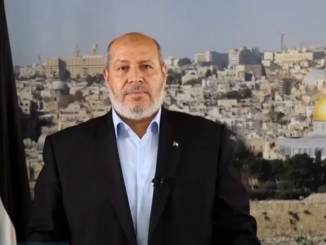
Analysts say Khalil al-Hayya’s election underscores Hamas’ institutional resilience while preserving its political direction amid Israel’s ongoing genocide in Gaza.
Key Takeaways
- Analysts say Khalil al-Hayya’s election demonstrates Hamas’ ability to maintain its institutional structure despite wartime losses.
- The selection reinforces Gaza’s central role in the movement’s leadership.
- Al-Hayya is expected to maintain Hamas’ existing political and negotiating approach.
- The new leader faces major challenges, including ceasefire talks, Gaza’s future and rebuilding the movement’s leadership.
Hamas’ election of Khalil al-Hayya as head of its political bureau represents more than a routine leadership transition. According to Palestinian analysts, the move sends multiple political and organizational messages at a time when the movement continues to confront unprecedented military pressure following Israel’s ongoing genocide in Gaza.
The movement announced Monday that al-Hayya had been elected to succeed Yahya al-Sinwar, who was killed by Israeli occupation forces in October 2024.
Hamas said the election involved representatives from Gaza, the occupied West Bank, Israeli prisons and the movement’s external leadership, describing the process as a demonstration that its institutional mechanisms continue to function despite the ongoing war and the loss of several senior leaders.
Institutional Resilience
Political analyst Ahmad al-Tannani argued that the election primarily demonstrates Hamas’ ability to preserve its internal organizational structure despite the extensive losses it has suffered during the war.
Speaking to Quds News Network, al-Tannani said the movement has shown it remains capable of renewing its leadership through established institutional procedures despite the killings of former political bureau chief Ismail Haniyeh, Yahya al-Sinwar and other senior political and military figures.
He noted that the election required more than one round after al-Hayya reportedly failed to secure the necessary majority in the initial vote, describing the process as evidence that Hamas continued to follow its internal regulations rather than relying on emergency appointments imposed by wartime circumstances.
According to the analyst, completing such an election while facing continuous military pressure also sends a message that Israel’s campaign has not dismantled Hamas’ governing institutions.
Gaza Remains the Movement’s Center
Al-Tannani also argued that al-Hayya’s election reaffirms Gaza’s central role within Hamas’ leadership structure.
Despite nearly three years of war and repeated Israeli efforts to weaken the movement’s political and military institutions in the Strip, selecting another senior Gaza-based leader signals that the enclave continues to shape Hamas’ strategic decision-making, he said.
The election therefore represents not only a leadership transition but also a political statement that Gaza remains the movement’s principal center of gravity.
Observers likewise see little indication that the appointment marks a change in Hamas’ political orientation.
As al-Sinwar’s deputy and head of Hamas’ negotiating delegation during the genocide, al-Hayya became the movement’s principal political representative in ceasefire negotiations, prisoner exchange talks and contacts with regional mediators.
His election is therefore widely viewed as signaling continuity rather than a departure from Hamas’ recent political approach.
Rebuilding after Heavy Losses
Political analyst Wissam Afifa said the significance of al-Hayya’s election extends beyond filling the leadership vacancy left by al-Sinwar’s death.
Instead, he argued, it marks the beginning of a broader effort to rebuild Hamas’ leadership after the loss of numerous senior political and military figures during the war.
Afifa said Hamas’ long-established consultative, or shura, system has helped preserve organizational cohesion despite repeated assassinations.
However, he noted that the current challenge differs from previous leadership transitions because the movement must now reconstruct decision-making structures after suffering some of the heaviest losses in its history.
A Complex Agenda
According to Afifa, al-Hayya inherits one of the most demanding leadership agendas since Hamas’ founding in 1987.
His immediate responsibilities include overseeing negotiations aimed at ending the genocide, managing prisoner exchange talks, addressing the future governance of Gaza and navigating discussions surrounding post-war arrangements in the enclave.
He must also manage relations with other Palestinian factions, reorganize coordination between Hamas’ internal and external leadership, and respond to rapidly evolving regional and international dynamics.
Afifa added that Hamas’ current leadership model is likely to rely increasingly on collective decision-making among the movement’s different branches.
While that approach may broaden internal legitimacy, he said, it could also complicate rapid decision-making during moments of crisis.
Ultimately, Afifa argued, the success of Hamas’ new leadership will be measured not only by its ability to preserve the movement’s influence in the Palestinian struggle but also by whether it can rebuild its organizational structure, cultivate a new generation of leaders and adapt its long-term strategy to the political realities created by the genocide.
Hamas Elects Khalil al-Hayya as Political Bureau Chief – Who is the Veteran Leader?
(Quds News Network)