
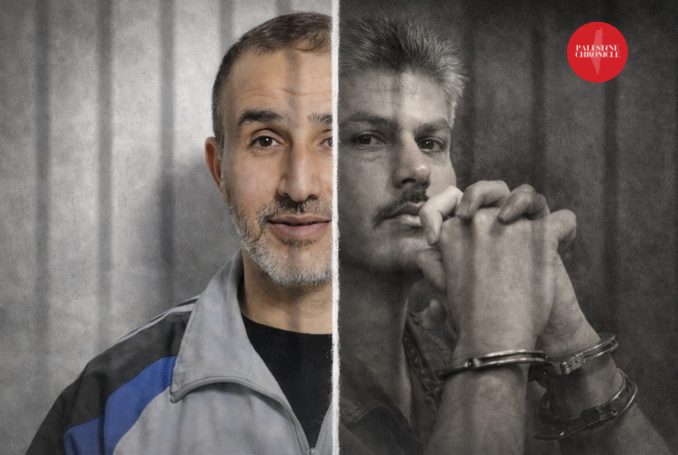
Israel tramples on all humanitarian laws, Ikhlas told us, under the pretext of its national security, causing the deaths of thousands of innocent people.
Ikhlas tries to hide her tears as they flow amidst the dancing and celebrations of Israeli Knesset members following the passage of the law authorizing the execution of Palestinian prisoners.
Ikhlas has been waiting for her husband, Abbas al-Sayed, who is held in an Israeli prison, to return home for the past 24 years. She can hardly believe that she could lose him at any moment as a result of Israel’s decision, which has shaken the homes of Palestinian prisoners and the hearts of their families who are anxiously awaiting their return.
Al-Sayed, from the city of Tulkarm, was arrested in 2002 and sentenced to 35 life terms plus 100 years. He is considered one of the most prominent leaders among Palestinian prisoners, whom Israel has refused to release in any of the past prisoner exchange deals with the Palestinian Resistance movement Hamas.
The controversial law was passed on Tuesday after several readings, with Palestinian observers saying the move was intended to provide a legal veneer, allowing Israel to deflect international criticism.
The law stipulates that the execution of ‘elite’ prisoners from the Gaza Strip will begin 90 days after its enactment, by hanging, with no possibility of appeal.
The families of Palestinian prisoners believe that Israel will retroactively apply the law to the remaining prisoners, claiming their involvement in the killing of Israelis, which would mean the execution of hundreds of them.
‘Like Animals’
For all these years, Ikhlas has lived in hope of her husband’s release. She raised her two children, Abdullah and Mawada, on this hope until they grew up, married, and had children of their own, and they are still waiting for their father’s return.
We tried to speak with her immediately after the decision was issued, but Ikhlas did not answer. Hours later, she contacted us.
“When the decision was confirmed, all my words failed me. I was trapped inside, and all I could do was remain silent, weep, and cry for the prisoners,” she told The Palestine Chronicle, explaining why she had been unable to answer the calls.
Ikhlas believes the law is a charade within the Knesset, designed to protect Israel’s image before the world by claiming it was passed unanimously, despite being an “unjust law from an unjust state,” as she put it.
The timing of the law’s passage came as a shock to some families who had had no information about their loved ones for two and a half years, as Israel has prevented visits. The occupation authorities have also barred lawyers from seeing prisoners since the beginning of the current escalation with Iran.
“The prisoners have been subjected to the most severe forms of torture, oppression, humiliation, and degradation, as if they were animals in iron cages and dark cells with no food or medicine,” Ikhlas told The Palestine Chronicle.
“We now see those who are released as mere skeletons in a world that considers itself civilized, advanced, and democratic,” she added.
Israel tramples on all humanitarian laws, Ikhlas continued, under the pretext of its national security, causing the deaths of thousands of innocent people.
The decision to execute Palestinian prisoners was made long ago, as more than 100 detainees were killed during the war without any accountability.
Al-Sayed was subjected to physical and psychological torture, severe beatings, and attacks by police dogs. His family has accused Israel of attempting to assassinate him in prison due to the severity of the torture he endured over the past two years.
No Red Lines
The law, passed while Palestinian prisoners endure impossible living conditions, only deepens their suffering and torments their families, who have been living in fear for over two years.
Ghufran Zamel, fiancée of prisoner Hassan Salameh from the Gaza Strip, who has been detained since 1996, told The Palestine Chronicle that she is following the ratification of the death penalty law with grave concern, especially since he is serving 48 life sentences.
“Just when we were waiting for his release, we find ourselves facing a new reality filled with fear and anticipation; a real fear that this sentence could turn into an actual execution at any moment,” Ghufran told The Palestine Chronicle.
This fear is no longer exaggerated. Experience has shown that Israel does not hesitate to commit crimes in full view of the world, she added.
“The genocide that occurred in Gaza without any serious international action, and the documented testimonies emerging from inside prisons about torture and violations without accountability, are all dangerous indicators that all red lines have been crossed,” Ghufran said.
“Under an extremist government that sees prisoners as a political bargaining chip and a tool to appease its public, the possibility of this law being implemented is no longer remote; it has become a real threat that haunts us every day. We do not just live waiting for freedom; we live in constant anxiety for the lives of our loved ones, in a reality that offers no guarantees or protection,” she concluded.
Shattered Hopes
The law is intended to apply only to Palestinian prisoners, which has sparked widespread criticism for its discriminatory nature, especially since it is not applied in the same way to Israeli prisoners convicted of murder. This adds to a long list of racist measures.
Sami al-Sa’i, a Palestinian prisoner who was released last June after a year and a half of detention, told The Palestine Chronicle that the reality inside Israeli prisons is extremely harsh and lacks the most basic human necessities.
During his detention, he said he was raped with a sharp object—one of the torture methods prisoners are routinely subjected to—adding that life inside bears no resemblance to anything human.
“The prisoners are hungry and deprived of almost everything. A toothbrush is a dream for them. Clothes, blankets, and mattresses are all things they long for. They are denied visits and medical treatment, and they are subjected to the brutality of dogs and the cruelty of the guards,” Sami told The Palestine Chronicle.
But despite all this, the prisoners were always full of hope, Sami said. When they first heard about the law, they believed it would not affect them because they would soon be released in prisoner exchanges for Israeli prisoners in Gaza.
“But the law was passed, and the prisoners are still in prison. I don’t know how that affected them. May God help them,” he said.
The number of Palestinian prisoners exceeds 9,500, including 73 female prisoners and 350 children.
There are 115 prisoners serving life sentences, after more than 486 were released in the last three prisoner exchange deals with the resistance.
(The Palestine Chronicle)

– Fayha’ Shalash is a Ramallah-based Palestinian journalist. She graduated from Birzeit University in 2008 and she has been working as a reporter and broadcaster ever since. Her articles appeared in several online publications. She contributed this article to The Palestine Chronicle.





The israelites are an astonishingly evil people. Immortal hate for them.
The world needs to abandon the Israeli Jewish Nazis. The Israelis are too weak and needy to take over the government and jail all the leaders. They’ve never fought their own battles. The leaders are scummy people, how did they assume positions of power??