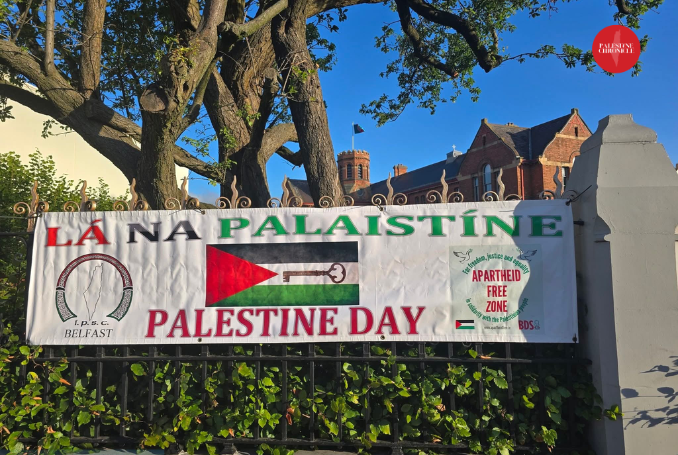

In Belfast, Romana Rubeo challenged Western media portrayals of Palestinian women, arguing that erasing their agency is itself political violence.
Key Takeaways
- Rubeo argued that Western media frequently portrays Palestinian women as victims while systematically removing their political and historical agency.
- She traced Palestinian women’s resistance from the 1936–39 Great Revolt and the Nakba through the First Intifada and today’s genocide.
- Rubeo challenged narrow definitions of resistance, arguing that healing, teaching, documenting, remembering and sustaining communities are themselves political acts.
‘It Strips Them of Political Agency’
Rubeo began by connecting the struggle over Palestine to a broader struggle over language, memory and historical meaning.
“Every colonial project seeks to dominate territory. But it also seeks to dominate meaning,” she said, adding:
“It seeks to determine who is civilized and who is barbaric; who is a victim and who is a threat; whose suffering deserves empathy and whose suffering becomes ordinary, inevitable, even invisible.”
For Rubeo, media bias cannot therefore be understood simply as a matter of incorrect facts or poor reporting. It is also about selection: which aspects of reality are elevated and which are pushed outside the frame.
“Media does not simply tell us what happened. It tells us what matters,” she said. “Which deaths deserve front pages. Which lives deserve biographies. Which voices are credible. Even which emotions are legitimate.”
This process, she argued, is particularly apparent in representations of Palestinian women.
“The issue is not that Palestinian women are completely absent from Western media. They are present. The question is: how are they present?”
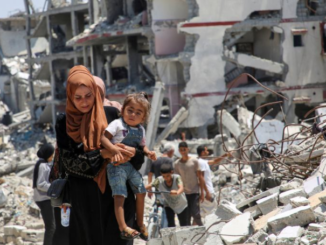
At one extreme, Palestinian women are viewed through the prism of the colonial power, portrayed as threats or subjected to dehumanizing rhetoric. At the other, Rubeo said, they are reduced to “grieving mothers, anonymous widows, displaced civilians, bodies wrapped in white shrouds,” or presented as helpless victims requiring Western liberation.
“What is completely absent is their agency,” she said. “Sure, they cry. They mourn. They bury their children. All this is true. But it is profoundly incomplete.”
Rubeo then posed a series of questions that challenged precisely this erasure.
“Where are the journalists? Where are the doctors? Where are the professors? Where are the lawyers? Where are the artists? Where are the organizers of community kitchens?”
“Where are the women documenting war crimes while simultaneously surviving them?” she continued. “Where are the women preserving the memory of entire families erased from civil registries?”
Media bias, she argued, therefore “does not simply misrepresent Palestinian women. It strips them of political agency.”
Drawing on Edward Said’s critique of Orientalism, Rubeo said that Palestinians, and Palestinian women in particular, continue to be trapped within a framework in which the West determines what they are permitted to represent.
“If Orientalism denies Palestinian women political agency, history restores it,” she said.
From the Great Revolt to Gaza: ‘Resistance is Continuity’
One of the great distortions of contemporary media coverage, according to Rubeo, is its tendency to treat Palestinian women as though their history began with the current genocide.
“One of the great ironies of contemporary media is that it presents Palestinian women as though they suddenly appeared in history on October 7, carrying children through rubble,” she said. “In reality, Palestinian women have stood at the center of the national struggle for nearly a century.”
During the Great Palestinian Revolt of 1936–39, Rubeo noted, women transported weapons, carried messages, sheltered wanted revolutionaries and organized demonstrations. During the Nakba, another role became increasingly important: preserving the collective memory of a society undergoing forced displacement.
“They preserved the names of villages erased from the map, safeguarded land deeds and house keys, transmitted oral history to children born in exile, and ensured that Palestine survived not only as geography, but as memory,” she said.
During the Palestinian struggle for liberation of the 1960s and 1970s, women once again challenged the image of the passive Palestinian woman.
Rubeo cited Leila Khaled as one of the clearest examples, saying: “She challenged one of the central assumptions of Orientalism: that Arab women are passive subjects of history.”
The First Intifada, she continued, offered an even broader illustration of women’s role in sustaining Palestinian resistance: “We often remember iconic images of young boys throwing stones at Israeli tanks. But those images tell only part of the story.”
Behind those images, Rubeo said, were women organizing underground schools, medical relief committees and food distribution during curfews, establishing agricultural cooperatives, supporting prisoners’ families and sustaining communities under occupation.
“The uprising was not sustained by stones alone,” she said. “It was sustained by society. And women were at the very heart of that society.”
That history, Rubeo argued, requires a much broader understanding of resistance itself: “Too often, resistance is imagined exclusively through military imagery: a rifle, a fighter, a battlefield.”
But resistance can also mean teaching, healing, feeding, documenting and remembering — the preservation of society itself under conditions designed to destroy it.
This understanding, she stated, is particularly important during Israel’s genocide in Gaza, where the most ordinary acts of maintaining life have acquired extraordinary political significance.
“A mother baking bread inside a refugee camp is not merely preparing a meal. She is refusing starvation as a mechanism of domination; a teacher holding lessons inside a shelter is not merely educating children. She is refusing the destruction of an entire generation.”
And, she added, “A doctor continuing surgery without electricity is not merely practicing medicine. She is refusing the collapse of society itself.”
Soma, Wafaa and the Refusal to Be Forgotten
For Rubeo, however, the argument was not merely historical or theoretical. It was deeply personal.
“It has faces, voices, temperament,” she said. She recalled Dr. Soma Baroud, a Palestinian physician whose life embodied a form of resistance rarely acknowledged by conventional political narratives.
“Like so many Palestinian doctors throughout this genocide, she has become far more than a clinician. She is simultaneously a healer, a humanitarian, a witness, a chronicler and a moral voice. Because medicine itself has become an act of resistance.”
Every surgery conducted under impossible conditions, every child treated despite shortages, and every patient comforted while Gaza’s medical infrastructure was being systematically destroyed, Rubeo argued, represented “acts of refusing the collapse of human dignity.”
“Soma reminds us that resistance, in Palestine, is also expressed through care. Through healing. Through insisting that life itself remains sacred, even when everything around you is designed to destroy it.”
Rubeo then turned to her friend and Palestine Chronicle contributor Wafaa Aludaini, who was killed in an Israeli attack in Gaza.
Wafaa, she noted, also demolished one of the most entrenched Western stereotypes surrounding Palestinian and Muslim women.
“To many people in the West, Wafaa would have appeared to fit a familiar stereotype. She wore the niqab, and for far too many audiences that image immediately evokes assumptions of silence, passivity and oppression.”
“Nothing could have been further from the truth,” Rubeo said, adding that “Wafaa was one of the strongest, most intelligent and most courageous women I have ever known.”
Rubeo recalled first encountering Aludaini’s work during the Great March of Return, when she reported from Gaza as Israeli snipers targeted Palestinian demonstrators along the separation fence.
“She documented not only the killings and injuries, but also the hopes, the dignity and the humanity of ordinary Palestinians demanding nothing more than their right to return to the homes from which their families had been expelled.”
During the genocide, the editor and journalist remained in contact whenever Gaza’s collapsing communications infrastructure permitted.
“Like every editor working with colleagues in Gaza, I found myself living between WhatsApp notifications,” Rubeo recalled.
“Sometimes there was no electricity. Sometimes there was no internet. Sometimes entire neighborhoods had been forced to flee once again.”
Then, one morning, she opened Facebook and saw Wafaa’s photograph accompanied by two words in Arabic: “Allah yerhamha” — May God have mercy upon her.
“There is something profoundly cruel about discovering the death of someone you love through social media,” Rubeo said.
“International media recorded another statistic. Another journalist killed. I lost my friend. And that difference matters.”
The distinction went directly to the heart of Rubeo’s argument about journalism, memory and power. “Journalism is not simply about recording events. It is about preserving memory.”
“Every article we write becomes part of the historical record. Every testimony we preserve becomes evidence against erasure. Every name we refuse to let disappear challenges those who would reduce an entire people to numbers.”
Rubeo concluded by returning to the central question of media bias.
“Media bias is not simply about inaccurate reporting,” she said. “It is about deciding who enters history. Every colonial project attempts to eliminate a people twice. First physically. Then historically. The first is carried out through bombs. The second through silence.”
For nearly a century, she argued, Palestinian women have resisted both forms of erasure — as organizers, fighters, doctors, journalists, teachers, writers and mothers.
“The forms of resistance have changed. The purpose has not,” Rubeo said. “To ensure that Palestine survives. Not only as territory. But as memory. As history. As culture. As people.”
She ended with the words that encapsulated the central message of the address:
“If there is one thing Palestinian women have taught us over nearly a century of struggle, it is this: Resistance is not only the refusal to die. It is the refusal to be forgotten.”
(The Palestine Chronicle)