
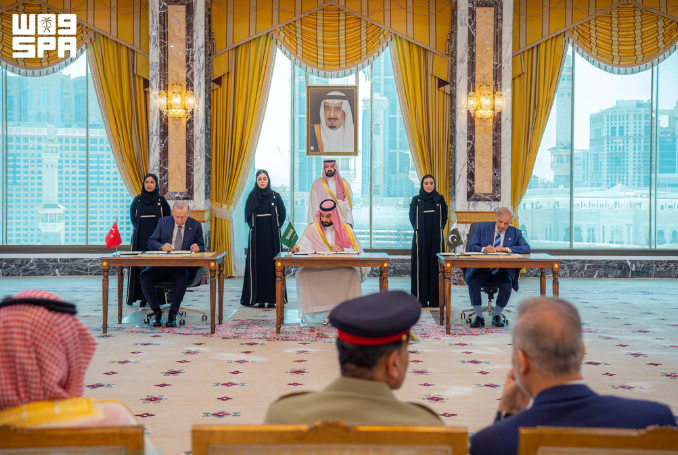

Saudi Arabia, Türkiye and Pakistan signed a collective defense agreement stipulating that an armed attack against one constitutes an attack against all.
Key Developments
- Saudi Arabia, Türkiye and Pakistan signed the Mecca Joint Defense Agreement, establishing collective deterrence based on the principle that an attack on one is an attack on all.
- The three countries said the pact strengthens defense cooperation and interoperability, while Türkiye stressed that it targets no particular country and remains open to others.
- Iranian lawmaker Ebrahim Rezaei responded that a “paper agreement” would not provide Saudi Arabia security, urging Riyadh to change its regional policies.
‘Attack on One is Attack on All’
Saudi Arabia, Türkiye and Pakistan signed the Mecca Joint Defense Agreement on Friday, establishing a trilateral collective-defense framework amid mounting regional tensions and months of military escalation.
The agreement was signed in Mecca following talks involving Saudi Crown Prince Mohammed bin Salman, Turkish President Recep Tayyip Erdogan and Pakistani Prime Minister Shehbaz Sharif.
Under the pact, an armed attack against any one of the three countries will be considered an attack against all three, according to a joint statement.
The three governments said the agreement aims to strengthen collective deterrence, joint security and defense cooperation while contributing to regional security and stability.
According to Saudi officials, the agreement establishes a long-term framework intended to increase military coordination, readiness and integration among the three countries.
WATCH: Türkiye, Saudi Arabia, and Pakistan sign Mecca trilateral Defense Agreement. pic.twitter.com/ffL2jIpXC5
— Clash Report (@clashreport) August 7, 2026
Saudi Foreign Minister Faisal bin Farhan described the agreement as an important milestone in coordinating efforts to confront threats to regional security.
Saudi Defense Minister Khalid bin Salman said it establishes a framework for a long-term defense partnership and strengthens “deterrence, coordination and integration” among Riyadh, Ankara and Islamabad.
Reuters reported that negotiations leading to the agreement had been underway for roughly a year, while Saudi sources cited by Al-Jazeera said technical and political discussions had continued for around two years.
The agreement builds upon longstanding bilateral military relations among the three states. Pakistan has trained Saudi forces for decades, while Türkiye and Saudi Arabia have significantly expanded their defense-industrial cooperation in recent years.
Erdogan: Pact Targets No Country
Erdogan said the agreement is based on the principle of “collective deterrence” and covers security and defense cooperation, joint defense-industry projects and counterterrorism.
The Turkish president said the framework rests on the right to self-defense established under Article 51 of the United Nations Charter.
🇵🇰🇸🇦🇹🇷 Footage posted by the Pakistani PM's office from today's landmark Mecca Summit, in which Pakistan, along with Saudi and Turkey, signed a MAJOR NATO-style pact…
"Guided by the longstanding historical ties among the three States, based on the enduring bonds of brotherhood…
— Mario Nawfal (@MarioNawfal) August 7, 2026
He stressed that the pact is not directed against any particular country and does not constitute the creation of a military axis.
According to Erdogan, the framework will also remain open to other countries seeking to contribute to regional peace, stability and prosperity.
A Turkish official similarly told Reuters that the agreement is purely defensive and does not supersede existing bilateral or multilateral security arrangements involving the three countries.
Pakistan’s Foreign Ministry said the agreement encompasses three principal areas: collective deterrence, collective security and joint defense cooperation.
The signing also highlights the different capabilities each country brings to the arrangement. Türkiye possesses a rapidly expanding defense industry, Pakistan has extensive military capabilities and operational experience, while Saudi Arabia has invested heavily in military procurement and the localization of defense production.
Pakistan also possesses nuclear weapons, although analysts cited by Reuters said they did not expect the Mecca agreement to include a nuclear dimension.
The agreement comes amid a rapidly changing regional security environment following the US-Israeli war against Iran that began on February 28 and subsequent escalation across several regional fronts.
It was also signed amid renewed confrontation between Saudi Arabia and Yemen, including Yemeni Armed Forces operations against Saudi-backed forces and Saudi maritime traffic under Sanaa’s declared “blockade for blockade” strategy.
Turk President Erdogan reached Saudi Arabia to meet Crown Prince Mohammad bin Salmaan and Pakistani PM Shehbaz Sharif pic.twitter.com/teqtWgQPf0
— Azaz Syed (@AzazSyed) August 7, 2026
Iran: ‘Paper Agreement Will Not Bring Security’
The agreement drew a sharp response from Ebrahim Rezaei, spokesperson for the Iranian Parliament’s National Security and Foreign Policy Committee.
“The Saudis should know that a paper agreement will not bring them security, just as years of unilateral subservience to the United States did not provide it,” Rezaei wrote on X.
He urged Riyadh to reconsider its policies rather than seek security guarantees from other states.
“Correct your policies so that you do not have to beg for security from others,” Rezaei said.
(PC, Reuters, Al Mayadeen, AJA)


What are Turkey and Pakistan going to do when US bases in Saudi Arabia attack other countries, inviting direct reprisal on the Saudis?