
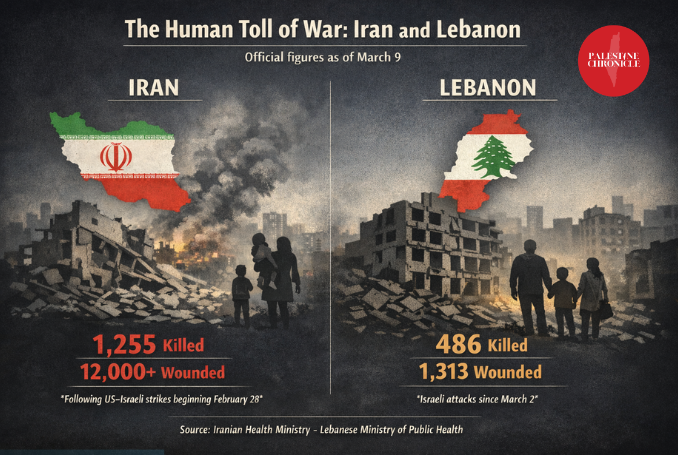

Official Iranian and Lebanese figures reveal rising civilian deaths, injuries, and widespread destruction as the regional war intensifies.
Iran: The Official Toll So Far
As of Monday, March 9, Iranian officials say the death toll from the ongoing US-Israeli assault has reached 1,255, with more than 12,000 people wounded, making Iran the deadliest front in the regional war so far.
The figure was given by Iranian Deputy Health Minister Ali Jafarian, who said most of those killed and wounded were civilians.
According to Jafarian, those killed include 200 children and 11 healthcare workers, with victims ranging in age from eight months to 88 years old.
He said many of those struck were in their homes or at work, underscoring the extent to which civilian areas have borne the brunt of the bombardment.
Iranian official and semi-official reporting has also highlighted the scale of physical destruction across the country. Press TV, citing Iran’s Health Ministry, Foreign Ministry, and Red Crescent reporting, said strikes have hit residential districts, schools, hospitals, emergency facilities, markets, and other non-military sites across several cities, especially Tehran.
Iran: Hospitals, Schools, Homes, Oil Facilities
The damage reported by Iranian authorities goes well beyond casualty figures. Jafarian said 29 clinical facilities have been damaged, 10 of them forced to shut down.
He added that 52 health centres, 18 emergency service locations, and 15 ambulances have also been damaged or destroyed.
Press TV’s March 8 fact sheet, based on Iranian official reporting, said the Red Crescent had documented thousands of strikes on non-military property, including 3,646 residential and non-military units hit and 528 commercial units completely destroyed.
The Iranian news network also said 11 hospitals were affected by missile strikes, three hospitals were rendered fully non-operational, and eight emergency medical bases were damaged.
Iranian reporting also points to repeated attacks on schools and children’s facilities.
Press TV, citing official sources, said schools in Tehran suffered severe damage and listed strikes on educational facilities, including an elementary school in Minab and a kindergarten in Narmak.
The same compilation said medical sites hit included Gandhi Hospital, Khatam al-Anbiya Hospital, Motahari Hospital, the Tehran Trauma and Burn Center, and Ameneh Neonatal Care Center.
A major new line of destruction emerged after Israeli attacks hit oil infrastructure. Jafarian told Al-Jazeera that the bombardment of oil facilities spread toxic smoke over Tehran and warned of respiratory and environmental risks.
The report said strikes hit the Aghdasieh oil warehouse, the Tehran refinery, and the Shahran oil depot, triggering large fires and darkening the capital’s sky.
Lebanon: Death Toll Climbs
After Iran, Lebanon remains the other major civilian front in the war. According to the Lebanese Health Ministry’s Health Emergency Operations Center, Israeli attacks since March 2 have now killed 486 people and wounded 1,313. Anadolu reported the updated toll on Monday evening, citing the ministry directly.
The official Lebanese toll had already risen sharply by Sunday. Reuters, citing Lebanon’s Health Ministry, reported that the dead included at least 83 children and 42 women, underscoring the civilian cost of the widening Israeli assault.
The same report said Israeli bombardment has sent smoke columns over Beirut’s southern suburbs and southern Lebanon as the war entered a second week.
It also noted that strikes hit branches of Al-Qard Al-Hassan in the southern suburbs, while the Israeli military had expanded evacuation orders across south Lebanon, parts of the Bekaa Valley, and Beirut’s southern suburbs.
While Monday’s latest official death toll stands at 486, the pattern of destruction in Lebanon is also becoming clearer. Reuters reported that Israeli strikes have hit Beirut’s southern suburbs, including Dahiya, and large areas of southern Lebanon, while many families have fled under broad evacuation orders.
Lebanese and regional reporting on March 9 also pointed to fresh strikes on Al-Qard Al-Hassan branches in Dahiya and additional casualties in southern Lebanon, as attacks continued to spread between Beirut and the south.
Naharnet reported that the Health Ministry recorded casualties from those Monday strikes as well.
As of March 9, the latest official counts from Tehran and Beirut indicate a widening regional war with a mounting humanitarian cost.
(PC, Iranian Media, Lebanese Media, Official Statements)
Where is President Aoun?? Where is the Lebanese Army?? Hezbollah defends Lebanon!