
By Palestine Chronicle Editors
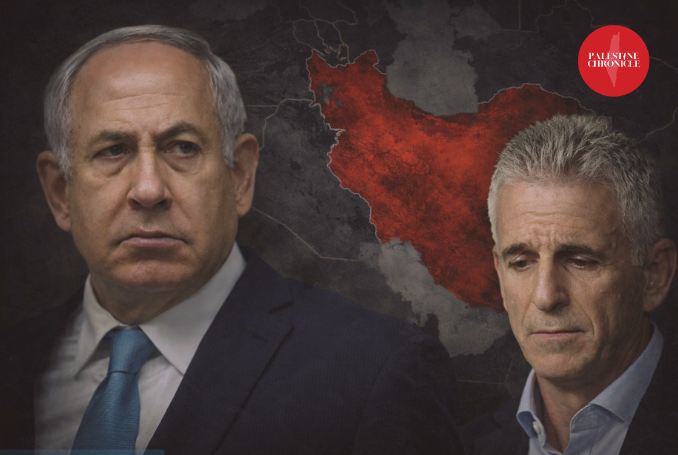
Netanyahu blames Mossad for Iran failures, exposing a war built on illusion, miscalculation, and a familiar pattern of deflection.
Israeli Prime Minister Benjamin Netanyahu is known for blaming others for his own mistakes.
In the case of the Palestinian October 7, 2023 operation, he moved swiftly to shift responsibility onto Israel’s security and intelligence chiefs, claiming that no warning had been given to him regarding Hamas’s intentions. In the now-deleted post, he wrote: “At no time and no stage was a warning given to Prime Minister Netanyahu regarding war intentions of Hamas.”
He later apologized, writing, “I was wrong,” but only after a political uproar. At the time, multiple Israeli and international reports noted that while senior security officials acknowledged failures, Netanyahu himself largely refrained from doing so.
He also blamed others for his failed war on Gaza, which extended for two years and continues in various forms. Yes, the war led to a genocide, but it did not defeat the resistance nor disarm Hamas and other Palestinian fighting groups.
Even as the destruction intensified, Netanyahu avoided genuine accountability, offering at most carefully calibrated statements designed less for introspection than for political preservation.
Later reporting indicated that he resisted calls for a state commission into October 7 and instead backed a process that would allow political actors to shape the inquiry—a move widely seen as an attempt to manage the outcome rather than enable full accountability.
Needless to say, he continues to do everything in his power to obstruct a genuine independent investigation into everything that has gone wrong in his wars.
By late 2025, Reuters reported that Netanyahu had “taken no responsibility” for October 7, while efforts to establish an independent investigation remained contested within Israel’s political system.
Now Netanyahu is starting the blame game again in the case of the war gone awry which he initiated against Iran, jointly with the United States, starting on February 28.
According to a New York Times report, cited by The Times of Israel, Netanyahu embraced a Mossad plan that promised the war could trigger a mass anti-government uprising in Iran and possibly collapse the regime. Mossad chief David Barnea reportedly argued that after Iranian leaders were killed, the agency could “galvanize the Iranian opposition,” ignite unrest, and help bring about regime change.
While the Mossad, under the leadership of David Barnea, certainly contributed to the illusion that a revolt could be engineered in Iran to fit conveniently into the Israeli-American regime-change campaign, Netanyahu cannot plausibly claim innocence.
The same reporting indicates that he discussed the plan while persuading Donald Trump to go to war. In other words, he was not misled from the outside; he was a central political investor in the premise itself.
For years, Netanyahu has sought to destabilize Iran, not only through covert operations but through sustained public messaging aimed at encouraging internal collapse.
During the latest protests preceding the war, and again during the war itself, he repeatedly addressed Iranians directly in language designed to frame Israeli aggression as liberation. On March 10, according to The Times of Israel, he declared: “We are waging a historic war for liberty. This is a once in a lifetime opportunity for you to remove the Ayatollah regime and gain your freedom.”
Days later, he stated that one of the war’s goals was “creating the conditions for the Iranian people to grasp their freedom, to control their destiny.” These were not incidental remarks. They were central to the political narrative he sought to construct.
In fact, the war itself was intended as the final push that would allow protesters, genuine or otherwise, to topple the government.
But it was Netanyahu who fundamentally misread the situation. He conflated protest with collapse, dissent with surrender, and social discontent with a fifth column ready to carry out US-Israeli objectives.
That assumption has now collided with reality.
The Times of Israel reported that “behind the scenes,” Netanyahu “has expressed frustration that Mossad’s promises to foment revolt in Iran have not materialized.” In one early wartime meeting, he reportedly complained that “the plan was not working,” and worried that Trump “could decide to halt the campaign at any moment.”
In short, Netanyahu wagered on regime change from above and revolt from below—and neither materialized.
Indeed, broader reporting suggests that many American officials were never persuaded that this scenario was realistic.
The Times of Israel article, again citing the New York Times, noted that US officials and even some Israeli counterparts viewed the chances of regime change with skepticism. Former Trump administration official Nate Swanson said he had never seen a “serious plan” to cause an Iranian revolt.
His assessment was blunt: many Iranians may oppose the regime, but they are not going to walk into gunfire and bombardment to fulfill someone else’s war script.
Now, as his war on Iran proves increasingly disastrous, Netanyahu is seeking not only an exit strategy with his partners in the Trump administration, but also a political exit strategy for the day after within Israel itself.
The pattern is already familiar.
In the coming days and weeks, especially if the war ends unfavorably for Israel, this pattern is likely to reassert itself: Netanyahu and his media circus turning against domestic opponents and critics, searching for a scapegoat, constructing a narrative, and attempting to secure political survival as the crisis deepens.
Today it is the Mossad. Tomorrow it will be someone else. But the central fact will remain unchanged: Netanyahu did not merely inherit these failures. He engineered them.
This Is How We Know the Iran War Is Failing — And Not for Military Reasons
(The Palestine Chronicle)






Assuming Netanyahu is alive. After March 8, it’s whats left of the Likud party, including Mossad, etc. that’s running the show.