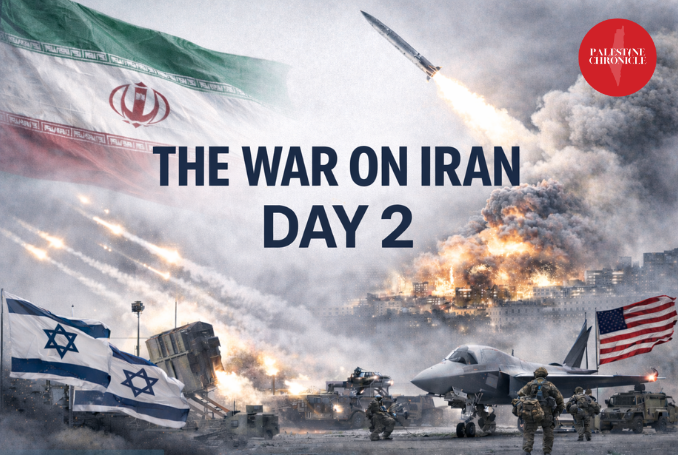
On the second day, assassinations, mass missile exchanges, and regional spillover intensified the US–Israeli war on Iran.
Assassination and Immediate Fallout
Day Two began with confirmation.
Iranian state television announced the killing of Supreme Leader Ayatollah Ali Khamenei in US–Israeli airstrikes on Tehran. The strike reportedly targeted a high-level Defense Council meeting.
Among those killed, according to Iranian and US media:
- Major General Mohammad Pakpour, IRGC Commander.
- Major General Abdolrahim Mousavi, Chief of Staff.
- Brigadier General Aziz Nasirzadeh, Defense Minister.
- Brigadier General Gholam Reza Rezaeian, head of Police Intelligence.
US President Donald Trump confirmed Khamenei’s killing and warned that any further Iranian retaliation would be met with “unprecedented force.”
CBS News cited unnamed US sources claiming that around 40 senior Iranian officials have been killed since the war began.
Iran declared 40 days of national mourning and suspended government work for seven days.
The assassination marked a turning point. Not only militarily. Politically and symbolically.
Institutional Response: Continuity Under Article 111
Within hours, Iran activated Article 111 of its Constitution.
A temporary leadership council was formed. Its task:
- Assume the Supreme Leader’s duties.
- Maintain state continuity.
- Prepare for selection of a new leader by the Assembly of Experts.
Foreign Minister Abbas Araghchi described the killing as a grave violation of international law. He rejected claims that the political system would fracture.
“Absence or death of a leader does not alter the system,” he said.
Iranian officials framed the strike as an attempt at regime destabilization. They insisted it failed.
Tehran’s message was clear: the state remains intact. The chain of command remains operational. The war continues.
Iranian Retaliation: Successive Missile Waves
If Day One was dominated by US–Israeli airpower, Day Two was marked by Iranian missile saturation.
The Islamic Revolutionary Guard Corps announced expanded phases of Operation “True Promise 4.”
According to Iranian and Israeli sources:
- Multiple missile waves targeted central and southern Israel.
- Sirens sounded across Tel Aviv, Jerusalem, Haifa, Ashdod, Ashkelon and Eilat.
- Five missile barrages were launched within less than an hour.
In Beit Shemesh:
- Four buildings collapsed.
- Israeli public broadcasting reported eight fatalities.
- Dozens were injured.
- Search and rescue operations continued.
Israeli emergency services reported hundreds transferred to hospitals since the war began.
Iran also expanded its strikes beyond Israel.
The IRGC claimed it targeted:
- Prince Sultan Air Base in Saudi Arabia.
- American facilities across the Gulf.
- Tel Nof airbase and Israeli defense installations.
Iranian officials stated they are targeting American military presence, not the Gulf states themselves.
Gulf Shockwaves and Regional Spillover
Day Two made one reality unavoidable: the war is no longer confined to Iran and Israel.
Missiles and drones were intercepted over:
- Jordan
- Kuwait
- Bahrain
- The UAE
- Saudi Arabia
In Dubai:
- Explosions were reported.
- Interception debris caused fires at Jebel Ali Port.
- DP World suspended operations.
The UAE Ministry of Defense reported casualties following Iranian strikes. Kuwait’s Health Ministry confirmed injuries and one fatality. Saudi Arabia summoned the Iranian ambassador.
In Bahrain, a hotel in Manama was reportedly targeted, causing material damage.
The UK Defense Secretary said Iranian missiles and drones fell near British troops stationed in Bahrain.
Maritime security became a central concern:
- An oil tanker was targeted near Musandam, Oman.
- Hapag-Lloyd suspended traffic through the Strait of Hormuz.
- Global energy markets reacted sharply.
Iranian officials stated there is currently no intention to close the Strait of Hormuz. But the strategic leverage remains.
Civilian Toll and Human Cost
The civilian impact deepened significantly.
In southern Iran, local officials reported that the death toll from a US–Israeli strike on a girls’ elementary school in Minab has risen dramatically, with figures surpassing 100.
Iran’s envoy at the UN Security Council described the assault as:
- Unjustified aggression
- A violation of the UN Charter
- A deliberate attack on civilian areas
Inside Israel:
- Sirens continued throughout the day.
- Injuries mounted from missile impacts and shelter stampedes.
Across the region:
- Protests erupted in Baghdad near the Green Zone.
- Demonstrations were reported in Shiraz.
- Casualties occurred in Karachi after protesters stormed the US consulate.
The war is now generating social tremors far beyond the battlefield.
Strategic Narratives and Political Stakes
Israeli officials described the confrontation as an “existential battle.”
The US Defense Secretary stated that Washington would:
- Prevent Iran from acquiring nuclear weapons.
- Destroy Iran’s naval capacity if necessary.
Yet strategic clarity remains limited.
The New York Times editorial board criticized Trump’s decision to launch the war without congressional authorization, calling it “reckless” and constitutionally dubious. It warned of echoes of Iraq and Afghanistan.
Washington frames the campaign as preventing nuclear escalation.
Israel frames it as survival.
Tehran frames it as imposed aggression aimed at political submission.
Each side claims deterrence. Each side escalates.
The War After Day Two
By the end of Day Two, several facts stood out.
Iran’s leadership structure did not collapse.
Missile exchanges intensified rather than subsided.
Gulf states were drawn directly into the confrontation.
Airspace closures, evacuations, and emergency diplomatic meetings signaled fear of broader war.
Energy markets reacted. Shipping routes were disrupted. Regional alliances were tested.
The US–Israeli war on Iran has moved beyond a limited strike campaign.
It is now a multi-theater confrontation involving:
- Assassinations
- Sustained missile warfare
- Gulf security
- Maritime chokepoints
- Global energy stability
The second day of war confirms one thing: this is no longer a contained confrontation. It is a regional rupture with global consequences.
(The Palestine Chronicle)