
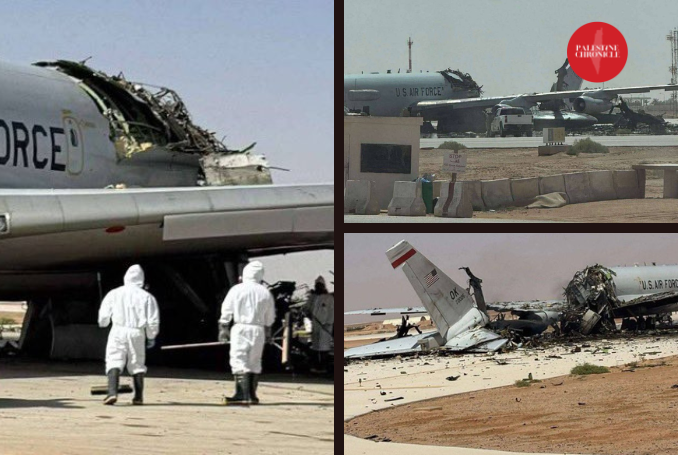
An objective reading of the post-war landscape suggests that Gulf states may come to realize that their long-standing alignment with the United States—and the presence of American military bases on their territory—has not guaranteed their security, but may, in fact, have exposed them to greater risk.
As the sixth week of the war on Iran begins, what had previously been anticipated before the outbreak of war has now become evident to the entire world. The war has not been as swift, decisive, or rapid as the duo of Donald Trump and Benjamin Netanyahu had envisioned.
The initial strike against the Iranian leadership neither led to regime change nor even created a leadership vacuum. The Iranian street did not turn against the government; rather, there was broad mobilization against the aggression.
What began as a war aimed at overthrowing the regime has shifted into a struggle centered on restoring access to the Strait of Hormuz—ironically, a waterway that had been open prior to the war. Instead of achieving a rapid resolution that would consolidate US-Israeli regional and global hegemony, the ongoing war may ultimately be recorded as a turning point in the decline of American power and its regional allies, particularly Israel.
The war has proven not to be a limited confrontation, as initially assumed in Washington and Tel Aviv, but one with wide-ranging regional and global repercussions. Beyond its immediate military dimension, its outcomes will shape the balance of power in the Middle East, influence control over trade and energy routes, and contribute to the reconfiguration of the global order amid intensifying competition between major powers.
In this confrontation, US-Israeli strikes have targeted Iran’s military capabilities, though the extent of the damage remains unclear. However, Iran’s continued ability to strike American and Israeli targets at distances of approximately 2,000 kilometers—using ballistic missiles and drones, some of which have penetrated advanced air defense systems—undermines claims of the near-total destruction of its capabilities.
Similarly, the downing of several American aircraft challenges assertions of full control over Iranian airspace. Iran’s continued ability to influence maritime movement through the Strait of Hormuz also casts doubt on claims regarding the destruction of its naval capabilities.
Iran has demonstrated sustained capacity in missile production, drone warfare, and nuclear infrastructure. Despite narratives of total degradation, its forces continue to exhibit significant defensive and offensive capabilities, as well as operational control, even after more than six weeks of war.
The failure to achieve a rapid resolution appears to be pushing Washington toward deeper involvement. This includes threats of a ground operation targeting Kharg Island—a critical hub for Iranian oil exports—and renewed efforts to reopen the Strait of Hormuz, through which roughly 20 percent of global oil supply passes. These moves suggest an attempt to assert broader strategic control over regional energy flows.
For the United States, Israel, and Iran alike, the war is about shaping the strategic landscape of the post-war order. In the context of US competition with China and Russia—both of which maintain strong economic and military ties with Iran—the confrontation extends beyond the regional level. It is part of a broader struggle over global leadership.
Should the United States fail to defeat Iran, the outcome could accelerate the erosion of American global dominance while strengthening Russia, China, and Iran’s regional position.
For Israel, the primary objective remains the destruction of Iran’s nuclear and missile capabilities, as well as the dismantling of its alliance network across the region—either through regime change or by rendering the Iranian state dysfunctional.
Israeli strategic thinking assumes that the survival of the Iranian regime will allow it to rebuild and further develop its capabilities. Some analysts speculate that future leadership in Iran could revisit existing religious restrictions on nuclear weapons development.
The United States, however, views the conflict through a broader geopolitical lens. Its objective is not merely to neutralize a security threat, but to reshape Iran’s position within the international system—potentially replacing a hostile regime with one aligned with US interests.
This would involve distancing Iran from China and Russia and integrating it into a US-led economic and political order. To this end, Washington appears to be considering a shift from military pressure to comprehensive economic targeting aimed at forcing unconditional concessions.
Yet current indicators do not support these assumptions. Instead, Iran appears prepared for a prolonged war of attrition, with no signs of capitulation.
After six weeks of war, even American and Israeli circles increasingly acknowledge that key objectives have not been met. The Iranian government remains intact, retains control, and faces no credible internal alternative. Iran continues uranium enrichment, missile launches persist, and its influence over the Strait of Hormuz remains significant.
Meanwhile, the conflict is expanding across multiple fronts—including Lebanon, Iraq, Yemen, and the Gulf—while economic and geopolitical consequences intensify. Opposition to the war within the United States is growing, alongside a decline in Trump’s domestic political standing ahead of midterm elections.
The original US-Israeli vision was to secure a decisive strategic shift: replacing the Iranian regime with a cooperative one, weakening ties with Russia and China, and consolidating Israel’s role as a central power within a US-led regional order.
However, Iran’s resilience—military, political, and societal—has thus far obstructed these objectives.
This leaves Washington with two difficult options. The first is to declare victory without achieving fundamental change, withdraw, and leave Israel engaged in a prolonged multi-front war of attrition. The second is deeper escalation, leading to a sustained regional war involving Iran and its allies, continued disruption in the Strait of Hormuz, and escalating global economic consequences.
Both options carry significant costs and fall short of delivering the strategic transformation sought by the United States.
Globally, the perception of American power may be weakened, potentially emboldening China in East Asia and encouraging Russia to expand its ambitions in Ukraine.
Regionally, Israel’s standing could decline, while Gulf states may reassess their reliance on the United States and their alignment with Israel, particularly in light of a war that has exposed their vulnerabilities.
A failed war on Iran could therefore mark a turning point: diminishing prospects for normalization with Israel and reinforcing the perception that US and Israeli policies contribute to regional instability.
In such a scenario, Gulf states may increasingly question the strategic value of hosting American military bases, recognizing that such arrangements have drawn them into conflicts rather than ensured their security.
This could open the door to a broader regional realignment, including the possibility of a quieter strategic dialogue among regional powers—such as Iran, Türkiye, Saudi Arabia, and Egypt—aimed at establishing new frameworks for stability beyond American dominance.
(This article was originally published in Al Mayadeen. It was translated and edited by the Palestine Chronicle)


Be the first to comment