Inspired by the Russell-Sartre Tribunal, a civil society-led process begins in Sarajevo to document and challenge Israel’s crimes in Gaza.
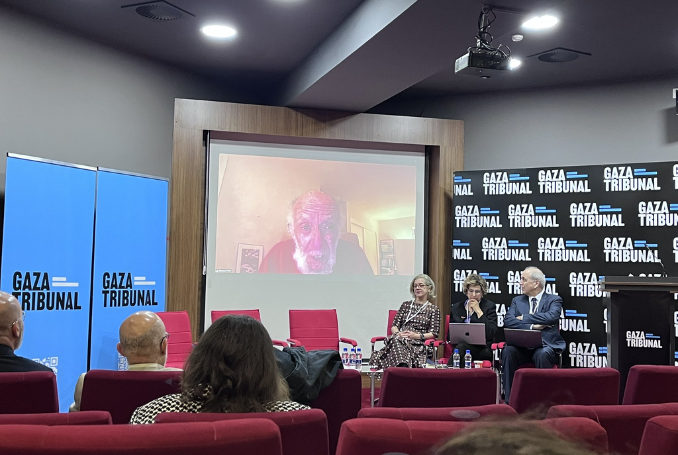
Doctors, lawyers and academics and witnesses to the ongoing genocide in Gaza are meeting in Sarajevo in the second phase of preparing a people’s tribunal on Gaza for later in the year.
This will echo the 1966 Russell-Sartre private people’s tribunal, which investigated and strongly criticised US foreign policy and military intervention in Vietnam. As with that one, evidence presented by witnesses from the frontline has moved the audience to tears.
Bertrand Russell, the British philosopher and Nobel Prize winner, and the leading French writers Jean-Paul Sartre and Simone de Beauvoir, were among those who set up the group, based, according to Russell, on the words of the post World War 2 Nuremberg War Crimes Trials chief prosecutor, Justice Robert H. Jackson: If certain acts and violations of Treaties are crimes, they are crimes whether the US does them or Germany does them.
We are not prepared to lay down a rule of criminal conduct against others which we would not be willing to have invoked against us.
🚨 The Gaza Tribunal @gazatribunal is holding its first Public Assembly in Sarajevo from May 26–29, bringing global attention to Israel’s war crimes and genocide in Gaza.
-International University of Sarajevo
– WATCH LIVE: https://t.co/UbEyviRHho
– More info:… pic.twitter.com/vE8dX18EV3— Gaza Notifications (@gazanotice) May 26, 2025
Former UN Special Rapporteur on human rights in the West Bank, Gaza and East Jerusalem, Canadian law professor Michael Lynk, opened the meeting evoking war crimes of Guernica, Dresden, Rwanda, Beirut, and then Gaza, subjected to “a medieval siege, and now an open-air cemetery.”
Lynk was followed by academic Dr Nimer Sultany, a Palestinian citizen of Israel at the School of Oriental and African Studies in London who set the tone of the meeting saying, “Naming the colonial condition of Palestine has been delayed too long, we are seeing another Nakba, a genocide, and this is not the first genocide against Palestine.”
Dr Sultany underlined the context of “the nature of Zionism, apartheid, a 17-year siege of Gaza, occupation, racial segregation,” which was emphasised in the landmark South African case against Israel in the International Court of Justice on December 29 2023. “It is the most barbaric this century,” Sultany said.
Partial written testimonies of five Palestinians from two leading Palestinian human rights organizations, Al Haq, and Badil, were read, revealing the genocide’s intimate details they described, “living days of death, famine, fear and horror”.
Other witnesses gave pre-recorded audio recordings, their voices bravely reliving the deepest pain and echoing through the shocked, silent hall in Sarajevo.
Gaza tribunal holds first public session in Sarajevo https://t.co/OMEUUGsf2S
— Live Stream (@Stream_liv) May 27, 2025
Each one speaks of his family repeatedly forced to move from one area to another, from shelter in hospital grounds, to UNRWA school, to family or friends’ crowded homes, to tents, hour after hour on foot, carrying the old and sick on their shoulders, pushing the very sick on hospital beds, losing family members to bombing or snipers along the way, loss of belongings, no food in markets, broken families with no breadwinner alive, families homeless for more than a year.
The stark atmosphere in every testimony is here: “Death is better than this.” “I can’t describe, people sleeping in the streets, horrifying dark scenes never seen.”
“People moving in an endless human torrent…falling.” “We are in a state of psychological exhaustion.” “They are efficiently killing people with fatigue.” “There is no horizon for the future.”
Professor Susan Akram from Boston University School of Law, co-chair with Mr Lynk of this first part of the proceedings, and reader of several witnesses’ words, said sombrely, “we don’t know the fate of any of our witnesses.” Whatever their fate, their personal testimonies are a small part of the available evidence of massive crimes which will be in the final record of the Gaza Tribunal.
Thank you to @DropSiteNews for covering the very important work @gazatribunal is doing. https://t.co/Ss3iKEzulO
— Dr. Mimi Syed (@Memers1st) May 27, 2025
Wesam Ahmad, head of Al Huq’s Centre for Applied International Law, presented the organisation’s authoritative report from January 2025 on the “ systematic destruction of Gaza’s Health System,” killing health care workers, destroying hospitals (…) completely destroying the ground from beneath Al Shifa hospital.”
Doctors have been detained, starved, tortured to death in prison, including by rape. In the case of one surgeon, prison guards were instructed to damage his hands. His presentation included the iconic photograph of the writing left on the damaged wall of Al Shifa hospital when the Israeli army took it over: “WE DID WHAT WE COULD, REMEMBER US. 21 Nov 2023”.
In-person testimonies from two American doctors with direct experience working in Nasser hospital during the genocide brought cruelty sharply into the room.
Dr Thaer Ahmad from Chicago described lines of full aid trucks lining the roadside for miles outside Rafah; destroyed ambulances everywhere; foreign volunteer doctors refused entry at the border; mass casualty events many times a day, “ no hospital in Chicago would have handled this.” He was inside Nasser hospital when it was ringed with Israeli tanks, Palestinians fled, and his doctor colleagues were abducted.
Dr Mimi Syed from Washington State spoke movingly of some of her individual patients, such as a mother with breast cancer, who refused evacuation, was untreated because the necessary drugs could not enter Gaza, and died on a cot with her three children. She called for “action, sanctions, ceasefire and no forced evacuation.”
Ending the first day, Professor Susan Akram said, “The Gaza Tribunal is one action, modest, but not insignificant, to stop the genocide, end decades-long Israeli impunity … Today we have begun the challenge to civil society around the world: to speak, to act, to rage, and to refuse to allow Israel and its allies to destroy humanity over the bodies of Palestinians and at the expense of all of us.”
(The Palestine Chronicle)

– Victoria Brittain worked at The Guardian for many years and has lived and worked in Washington, Saigon, Algiers, Nairobi, and reported from many African, Asian and Middle Eastern countries. She is the author of a number of books. She contributed this article to the Palestine Chronicle.