
Since the beginning of the war in 2023, Israel has prevented the entry of new currency into Gaza. As a result, the existing cash in circulation has become worn, torn, and in many cases, unfit for daily use.
Israel’s two-year genocidal war on Gaza has generated a deep transportation crisis, one of the clearest signs of how life has deteriorated across the Strip. It has aggravated people’s suffering to the extent that it now shapes even the simplest daily decisions, like where and when to go, and even whether to accept or reject a job based on distance.
That is exactly what happened to me almost two months ago, when I rejected a job offer as a project coordinator at a non-governmental organization, a situation I had never imagined myself in.
Having a job in Gaza today feels almost like a miracle, amid a collapsing economy and the devastation left by two years of genocide. For many graduates, securing a position in a reliable institution is not just a goal, but a distant dream.
I needed that job very much. I worked hard, passed the test and the interview, and finally received the official acceptance. I was overwhelmed with joy. It felt like a breakthrough, not only professionally but personally. Even the salary was satisfying, something rare under these conditions.
But in Gaza, reality always has the final word.
I accepted the offer and attended work for two days before I fully realized the harshness of the situation. The distance between my home and the workplace is about four kilometres. Before the war, that distance would have meant nothing. Today, it feels insurmountable.
The problem was not only the distance, but the nature of the roads. The route between my house and the workplace runs through side streets rather than main roads. Due to the high cost of fuel and spare parts, drivers now avoid these roads and stick to main, relatively undamaged streets to protect their vehicles from breakdowns that could cost them a fortune.
Homes, Not Illusions – Inside Gaza’s Rejection of Kushner’s Vision for ‘Rebuilding’ the Strip
The scale of the crisis is staggering. A single vehicle tire, which once cost $45, now costs around $1,500. A liter of engine oil, once $3, now reaches up to $300. Under these conditions, drivers cannot risk damaged or unpaved roads.
On the first day, I walked about a kilometre before I managed to find a car. On my way back, I walked nearly two kilometres. On the second day, it was even harder. I walked almost half the distance to work, and then the entire way back home.
Realizing how difficult it was to find transportation, I had to leave my house very early, around 7 AM, and only return at around 4 PM. By the time I got home, I was completely exhausted. I could not do any house chores. I could not even take care of my baby, Lya.
That was the moment I started asking myself: how long can I continue like this?
Though I needed that job deeply, I could not compromise my physical and mental health, nor my ability to care for my child and my family. With great sorrow, I decided to give it up.
Before the war, transportation in Gaza was simple and taken for granted. The moment you stepped outside, you could easily find a car to take you wherever you needed to go. Gaza is small; it rarely took more than five minutes to get anywhere within the city.
Now, transportation has become one of the heaviest burdens people face.
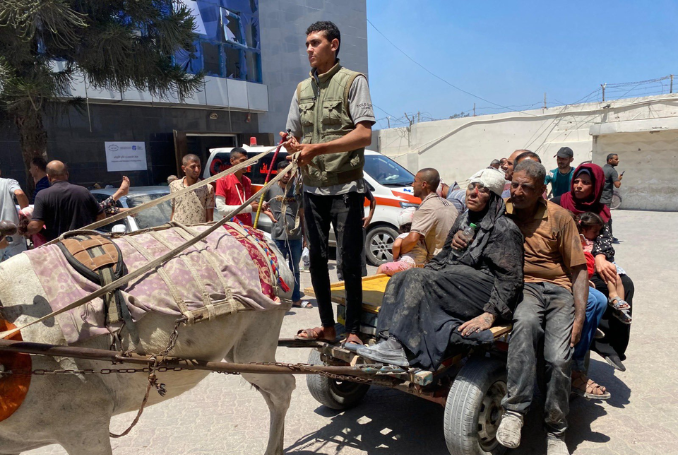
Donkey Carts — Or Simply Walking
With around 70% of Gaza’s vehicles damaged, and with new cars not allowed into the Strip since the beginning of the war, even the shortest outings have become exhausting journeys.
Nermeen Mazen, 32, explained: “Whenever I want to go to a medical appointment, visit family, or even go shopping, I walk almost a kilometre and a half to reach Al-Samer junction, the closest point to my residence where cars can move.”
“This distance alone makes me think hundreds of times before leaving the house,” Asmaa said. “And the suffering doesn’t end when I find a car.”
With approximately 945 kilometres of roads destroyed, cars cannot reach many areas. Instead, drivers drop passengers at fixed points along main roads, such as Al-Ghefari junction, Al-Saraya junction, or near Al-Shifa Hospital. From there, people must continue on foot.
For many, the situation becomes even harsher when traveling with children, elderly family members, or patients.
“I struggle even more when I have to take my youngest child with me, who is three years old,” Nermeen said. “He is too young to walk long distances, so I have to carry him the entire way. It leaves me completely drained. Sometimes I choose to leave him at home, even though he is too young for that, just to avoid the journey.”
In areas where roads are completely destroyed, cars do not pass at all. Instead, donkey-drawn carts have become the only option. This is the case on the road connecting Al-Sheikh Radwan neighbourhood to Al-Karama, which Nermeen takes to visit her family.
“At first, I felt embarrassed. I never imagined myself riding a donkey cart,” Nermeen said. “But now, there is no room for embarrassment. What matters is arriving. Sometimes, even that is not guaranteed, so I just walk.”
In a rare moment of humour, she added that her children, Mariam and Mohammed, actually enjoy riding donkey carts. “They like the open air and the freedom to move,” she said. “They don’t understand the hardship we are living through. They don’t even remember how life was before the war. Mariam was five, and Mohammed was only one before the war started.”
‘We Could Be Pushed Back to Zero’: Gaza Families Face Renewed Uncertainty
Citizens Always Pay the Price
The ongoing US-Israeli aggression on Iran has placed further strain on already fragile supply chains. Fuel and spare parts enter Gaza in extremely limited quantities, driving transportation costs even higher.
Today, the shortest ride within Gaza City costs between 3–5 ILS ($1–1.5). Before the war, a much longer trip from northern Gaza City to the central Strip cost only 3 ILS. For many, the burden is even heavier.
“When I travel from Deir Al-Balah to Gaza City, I feel almost broken,” Abeer, 34, said. “The trip costs me around 30 ILS ($9) for a round journey.”
“And paying in cash makes it even worse,” she added.
The war has created a severe liquidity crisis. Small denominations are scarce, making everyday transactions, especially transportation, extremely difficult.
Before the war, people in Gaza relied mostly on cash, as digital payment systems were limited due to the lack of 4G and stable connectivity. Today, bank transfers have become more common despite weak internet access.
“I use bank transfers for buying food, clothes, and medicine,” Abeer explained. “But transportation is different.”
“Sometimes I don’t have internet access. I try to pay with a 20 or 50 ILS bill, but drivers refuse because they cannot provide change.”
Since the beginning of the war in 2023, Israel has prevented the entry of new currency into Gaza. As a result, the existing cash in circulation has become worn, torn, and in many cases, unfit for daily use after repeated handling among millions of people.
All conditions in Gaza contribute to making life increasingly unbearable for its residents.
(The Palestine Chronicle)

– Noor Alyacoubi is a Gaza-based writer. She studied English language and literature at al-Azhar university in Gaza City. She is part of the Gaza-based writers’ collective We Are Not Numbers. She contributed this article to The Palestine Chronicle.





Be the first to comment