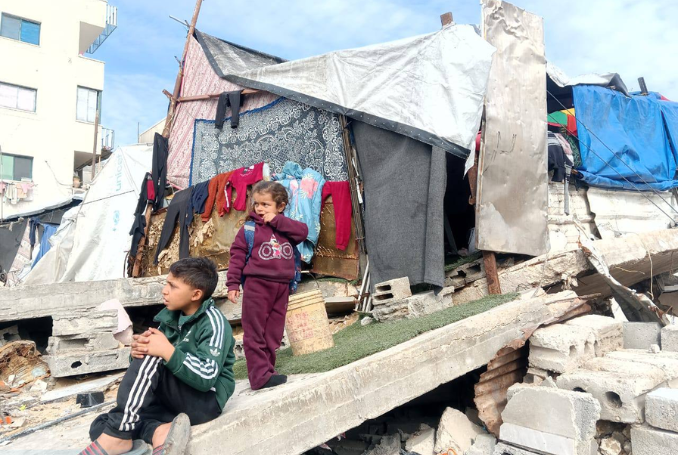
With no clarity on the ceasefire’s second phase and humanitarian aid under threat, families in Gaza remain trapped between fragile calm and renewed war.
People in Gaza have been awaiting any sign of hope regarding the second phase of the ceasefire, which has so far remained shrouded in ambiguity, leaving residents in a state of deep skepticism.
“Since the beginning of the ceasefire, we have received nothing but frequent promises,” Abu Yahya, a resident of central Gaza City, tells The Palestine Chronicle. “Promises of peace, stability, and reconstruction. But in real life, nothing has changed.”
Hoping for clarity about the when, what, and how of the second phase, residents closely follow every announcement and cling to every upcoming meeting. Many had expected the meeting held last week in Florida between US President Donald Trump and Israeli Prime Minister Benjamin Netanyahu to produce some reassuring outcome. Instead, the statements that followed deepened uncertainty and despair.
“We’ve been hearing about the second phase for months,” Abu Yahya says. “But no one knows anything about it so far. When would it start? How? What does the ceasefire actually include? No one knows.”
Living under the Yellow Line: Life, Water, and Displacement in Northern Gaza
Trump announced that the second phase of the ceasefire would not begin until January 15, 2026. He provided no further details, instead tying its implementation to the disarmament of Hamas and warning that Gaza would face severe consequences if the group did not comply. Reflecting his clear bias toward Israel, Trump made no mention of Israel’s 1,193 ceasefire violations, including restrictions on the entry of aid, tents, and caravans, as well as continued killings and bombardment since October 10, which have resulted in the deaths of more than 411 Palestinians and injuries to at least 1,100 others.
The statements following the meeting have heightened fear among families already living on the edge.
“What if Hamas doesn’t abandon its weapons?” Abu Yahya asks. “Does that mean the war could resume at any moment?”
He cannot shake the sense that stability is temporary—if it exists at all. “Israel does not honor promises or agreements,” he says.
That fear shapes even the smallest decisions. Two months before the ceasefire, when his family fled to southern Gaza, Abu Yahya bought a tent for 3,500 shekels—nearly $1,000.
“I had no other option,” he says. “I have a baby. I couldn’t let her sleep in the street.”
At the time, tents and plastic sheets were scarce and prohibitively expensive due to Israeli restrictions on their entry into Gaza. “I paid everything I owned,” he recalls.
After the ceasefire began, Abu Yahya was able to return to his partially destroyed home in central Gaza. Friends and relatives urged him to sell the tent and recover some of his losses. He refused.
Even today, despite his urgent need for money, he still refuses to sell it.
‘Tashrifeh,’ Beatings, Starvation: Gaza Detainees Detail Israeli Prison Torture
“I don’t really believe the war has ended,” he says. “The first phase was breached dozens of times, the second phase has not been settled, and the occupation can resume the war at any moment, under any pretext.”
“We could be pushed back to zero at any time,” he adds.
For now, the tent is folded and stored on the roof, unused. Still, Abu Yahya will not part with it.
“I’m keeping it,” he says. “It’s my anytime and everywhere shelter.”
A Ceasefire Without Aid
Just days after the meeting, Israel announced it would revoke the licenses of 37 international non-governmental organizations operating in Gaza, claiming they failed to meet new requirements under revised registration rules.
The decision has intensified fear across the Strip, including for 29-year-old Ghadeer and her family.
“If aid stops,” she asks, “how are we supposed to survive?”
With her father unemployed since the very beginning of the war, Ghadeer’s family of eight—like thousands of others in Gaza—has survived entirely on humanitarian aid provided by international organizations.
“Aid has been the line between hunger and survival,” she says. “They cover a large part of our basic daily needs.”
Although assistance arrives only once every three or four weeks, it provides essential items needed to prepare even the simplest meals. “We receive sugar, oil, rice, pasta, beans, and canned food,” she explains.
This limited support eases some of the burden the family carries, allowing them to use any financial assistance from friends or relatives to cover other necessities—such as charging phones, purchasing medications, transportation, or school supplies for her siblings.
A Voice Silenced: Gaza Imam Needs Urgent Treatment to Speak to His Children Again
With fresh produce, chicken, and meat largely absent from markets for nearly two years, people long for such food but are unable to afford it due to widespread unemployment and the lack of aid. Ghadeer’s family, like many others, can only afford a meat or chicken meal once a week—if they are lucky.
“The rest of the time, we survive on rice, pasta, and canned food,” she says.
“But when aid stops?” Ghadeer asks. “I doubt we’d even be able to afford flour and rice once a week.”
Like Ghadeer’s family, more than 90 percent of Gaza’s population relies entirely on humanitarian assistance, according to a November statement by UNRWA. Many Palestinians, the agency noted, survive on only one meal every 24 hours.
At the same time, Israeli restrictions on aid entry have left organizations struggling to meet overwhelming needs. Under the current ceasefire, agreements called for 500 to 600 aid trucks per day to enter Gaza—a target that has never been met. According to OCHA, only 3,185 trucks entered the Strip between October 10 and November 10, averaging just 102 trucks per day.
(The Palestine Chronicle)

– Noor Alyacoubi is a Gaza-based writer. She studied English language and literature at al-Azhar university in Gaza City. She is part of the Gaza-based writers’ collective We Are Not Numbers. She contributed this article to The Palestine Chronicle.