
By Shaimaa Eid
Israeli threats against kites have deepened fear among Gaza’s displaced children, depriving them of another simple joy of childhood itself.
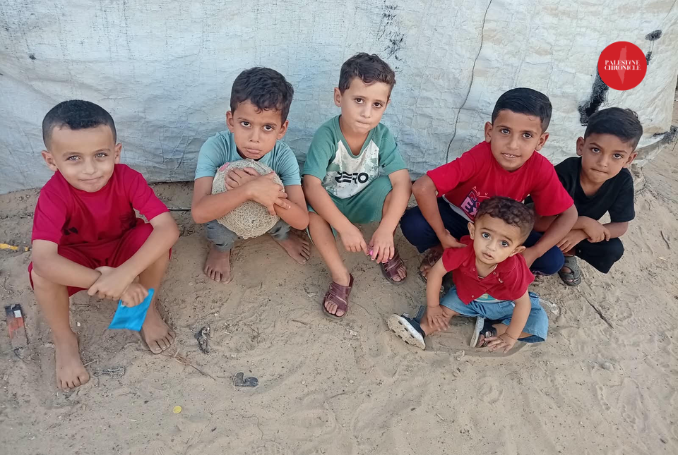
At our camp in Al-Mawasi, in southern Gaza, I walk among the tents at midday. The heat is suffocating. Children sit at the entrances of their tents, searching for a breath of air because the tents offer no protection from the summer heat.
At this hour, children should be busy playing. They should be running after a ball, racing one another, or flying their kites, as children do everywhere in the world.
But the children of Gaza no longer even have the luxury of playing without fear.
As I walk through the camp, I try to spot even one child carrying a kite. I am looking for a scene I had grown accustomed to seeing here: a child running between the tents, holding a long string as his kite rises into the sky above him.
But I find no one. Not a single kite.
Instead, I find children talking about bombardment, aircraft, missiles, killing, and explosions—words that have become part of their daily vocabulary, replacing the games and dreams of childhood.
I approach Bashir, a six-year-old who lives near us in the camp. I used to see him holding what we call here a “flying saucer,” playing with it and smiling whenever he managed to send it soaring into the sky.
“Where is your flying saucer, Bashir?” I asked him.
After Two Years of Genocidal War, Gaza Residents Insist on Reviving Eid Rituals
He immediately jumped toward me and placed his tiny hands over my mouth, trying to silence me.
“Don’t talk about a flying saucer … Netanyahu will bomb us,” he said in a frightened voice.
His words left me stunned. Bashir was not simply talking about a toy. He was talking about the fear that the war had planted in his heart, to the point that a simple toy had become associated in his mind with bombing and death.
“We used to play with it and were very happy, but my mother warned me. She told me that it was dangerous to play with it and that Netanyahu does not want us to play with it,” Bashir said.
Here was a small child talking about the Israeli prime minister, aware that flying a kite could make him a target of bombardment.
In Gaza, children have grown up before their time. They have learned the names of different weapons and aircraft and can distinguish the sounds of bombardment, though they should instead be learning the names of toys, cartoon characters, and football players.
This new fear emerged following Israeli threats concerning kites, balloons, and drones that Israel said were being launched from the Gaza Strip.
According to reports in Israeli and Palestinian media, Israeli Prime Minister Benjamin Netanyahu threatened action against those launching such devices. His threats included targeting those he said were responsible and evacuating the areas from which the devices were launched.
For the people of Gaza, such threats are not political statements detached from their lives. Here, people know all too well that a threat of bombardment can, at any moment, result in a missile striking a tent, a home, or a street crowded with civilians.
‘When I Slept Hungry’: My Testimony on the Exhausting Hunger in Gaza
That is why some parents have begun warning their children against flying kites and even preventing them from doing so, although kites are among the simplest forms of entertainment available to children in displacement camps.
Fares al-Farra, a father of two, recalled that his children used to fly kites for fun every summer.
“My children used to wait for summer so they could fly kites and play with them, but when I heard the threats, I became afraid for their lives. I stopped them from playing with kites altogether so they would not come under bombardment, because Netanyahu does not distinguish between one child and another,” al-Farra said.
In the camp, a kite is more than just a toy.
It offers a child a simple way to forget, even for a few minutes, that they live in a tent after losing their home and that the war has deprived their family of so many things that once seemed ordinary.
But even this small joy is now under threat.
Yousef Wahab, who oversees children’s activities at the Sham camp in Al-Mawasi, Khan Yunis, was trying to find alternatives for children who had become afraid of kites.
“Every day, I try to bring together the children who have become sad and terrified by the threats concerning kites. I give them football training to help lift them out of their sadness,” Wahab told The Palestine Chronicle.
One Thousand Days of Genocide: Gaza’s Story beyond the Numbers
“I tried to reassure them that their parents had stopped them from playing with kites because they were afraid for them and wanted to protect them,” he added.
But Wahab found it difficult to explain the situation to the children.
“It is difficult to convince a six-year-old child that they could be targeted by an Israeli missile simply for playing and flying a kite,” he said.
To children, the idea makes no sense. How can a toy made of paper and string turn a child into a target?
But children in Gaza do not have the luxury of not understanding war.
Wahab also questioned the role of child protection organizations in responding to what he considered open threats against children in the Gaza Strip.

– Shaimaa Eid is a Gaza-based writer. She contributed this article to the Palestine Chronicle.



In spite of the sadistic genocide the israelites have committed, Palestine’s future is in the hands of the greatest, the bravest, the most inspiring children in the world. Palestine will prevail because the israelites have already lost.
It’s amazing to me that some of Gaza’s children remember how to smile after all they’ve been through, and all the fear they’ve inherited. The Israeli ” Jewish ” Nazis are inhuman: sociopaths, scummy, trashy rapists. Child-killers. They have no redeeming qualities, and deserve to be banished to Siberia, stranded with no resources: naked and afraid. Let them rot.
From The River To The Sea, Palestine Will Be Free!
Banished to Siberia? Never! Banish them to florida.
いつも貴重な情報を提供していただきありがとうございます。
パレスチナの解放を!
凧が武器にされてしまった悲しい歴史をわすれないように、素手や石で戦車に立ち向かって行かなくてはならないパレスチナの子どもたち、、、一刻も早くミサイルやドローンに脅かされずに子どもたちが安心して大空を見上げる日が実現するように、わたしたちになにができるか教えてください‼️