By Romana Rubeo 
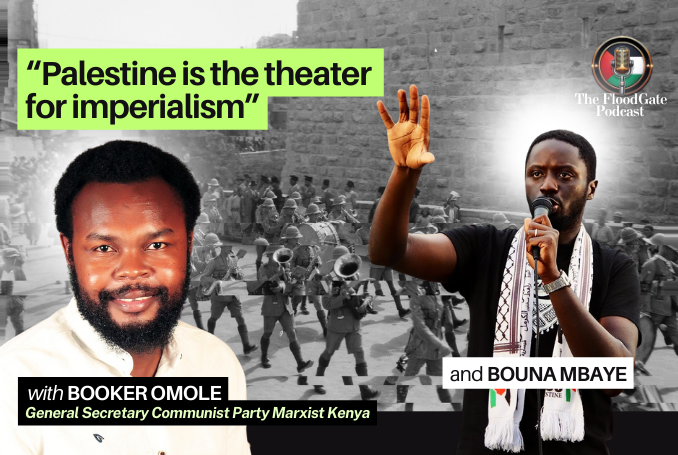
Kenya’s communist leader tells the Palestine Chronicle’s Floodgate podcast that struggles in Nairobi and Gaza share one reality: settler colonialism can only be defeated through resistance.
In this powerful episode, Kenyan communist leader Booker Omole confronts global imperialism, draws solidarity with Palestine, and insists on revolution as the only means to transform material conditions.
The interview was conducted for the Palestine Chronicle’s Floodgate podcast by Pan-African activist Bouna Mbaye.
Kenya’s Struggle is Part of the Global Crisis of Imperialism
For Omole, Kenya’s current turmoil cannot be explained as the product of “bad governance” or even corruption alone. Instead, it is tied directly to the mechanisms of global capitalism and imperial domination.
Kenya’s debt obligations to the International Monetary Fund, World Bank, and the Paris Club have placed the state under what he calls “indirect imperial rule.”
“Kenya is facing a very acute imperialism crisis… the only way that the Kenyan people can liberate themselves is by undertaking their own revolution,” he said.
Omole noted that while Kenya is often portrayed as a stable, capitalist hub in East Africa, the reality is much bleaker: 70% of the population still lives in rural areas under semi-feudal conditions. Nairobi itself, he argues, is not an industrial city but “a big imperialist warehouse” sustained only by services and financial flows.
“Even though we are dealing with a neocolonial state, this is just another puppet of United States imperialism.”
For Omole, the protests and social explosions in the streets of Nairobi reflect not isolated discontent but the inevitable outcome of an economic system that offers no dignity, no employment, and no sovereignty.
Palestine as a Mirror of Africa’s Past and Present
Omole insisted that Africa’s colonial past and Palestine’s ongoing dispossession are inseparably linked. He recalled how the Mau Mau struggle in Kenya, led by Field Marshal Dedan Kimathi, was vilified by the British and Americans as “terrorism,” a label now deployed against Palestinian resistance.
“The legacy of Dedan Kimathi is that you cannot defeat colonialism by negotiating with the people who have taken your land,” Omole said.
Just as Kenyan peasants were forced into concentration camps while settlers seized their land, Palestinians, he argued, are subjected to the open-air prison of Gaza. The parallels are clear: settler colonialism depends on theft, expulsion, and the dehumanization of indigenous peoples.
“The African liberation is incomplete when the Palestinian is still being dominated by Zionism,” he noted.
Omole stressed that solidarity with Palestine is not an act of charity or sympathy but a recognition of shared history.
Iran and the Global South Challenge the ‘Invincible’ Empire
A significant portion of Omole’s analysis was devoted to Iran’s resistance to US and Israeli aggression. For him, Iran’s ability to retaliate against Israeli strikes—breaking the myth of invincibility surrounding both Israel and the US—has inspired people across the Global South.
“The Iranian people cannot relent on their sovereignty or their right to defend their state and their people,” he explained.
In contrast to African governments that “prostitute themselves to Western powers,” Omole pointed to Iran as an example of a nation that refuses to submit to imperial dictates.
For Kenyan communists, this has direct implications: sovereignty must come before socialism, and resisting imperial domination is the first necessary stage of revolution.
“We see a lot of hope in Iran contributing to the strategic decline of United States imperialism,” he declared.
Omole also underlined the hypocrisy of Western powers who deny others the right to nuclear deterrence while sustaining Israel’s undeclared nuclear arsenal. In his view, the lesson for the Global South is that only resistance—backed by material strength—can make imperial powers think twice.
Armed Resistance as a Historical Necessity
Omole did not shy away from the question of armed struggle: just as the Mau Mau could not win through petitions or negotiations, Palestinians cannot expect their occupiers to voluntarily return stolen land.
He described the calls for “peace” in Europe and North America as hollow if they ignore the structural violence of settler colonialism.
“Wherever there is oppression, there is also resistance,” he said, explaining that “you cannot negotiate with people who have actually grabbed land and are not willing to give it back.”
For him, armed struggle is not a matter of ideology but of historical necessity. From Hamas in Gaza to Hezbollah in Lebanon, Omole identified the “resistance axis” as the only force capable of standing up to Zionism and imperialism. He insisted that it is these movements—not Western peace initiatives—that are defending dignity.
Reviving Pan-Africanism
Finally, Omole called for a revival of Pan-Africanism, but not in its diluted, symbolic form. He argued that Pan-Africanism must be rooted in scientific socialism if it is to have substance.
For him, Palestine can and must serve as a rallying point for African unity, just as the anti-colonial struggles of the 20th century once did.
“Being in solidarity is not about being sympathetic. It is to see Palestine as a vanguard against imperialism,” the Kenyan political leader explained.
Omole acknowledged that the African left is fragmented and weakened after decades of neoliberal dominance, but insists that a new generation of youth is once again asking fundamental questions: why does Africa remain poor despite its wealth, and why is exploitation always blamed on Africans themselves?
“The total liberation of the African continent can only be realized through scientific socialism,” he insisted.
By rooting Pan-Africanism in class struggle and aligning it with Palestine’s liberation, Omole envisions a movement capable of confronting imperialism both on the continent and globally.
(PC, AJA)
– Romana Rubeo is an Italian writer and the managing editor of The Palestine Chronicle. Her articles appeared in many online newspapers and academic journals. She holds a Master’s Degree in Foreign Languages and Literature and specializes in audio-visual and journalism translation.