
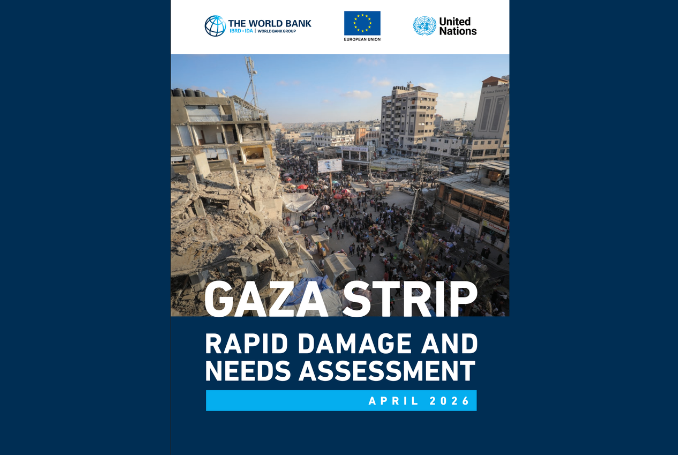

A joint UN, EU, and World Bank report estimates $71.4 billion needed to rebuild Gaza after two years of war.
A joint assessment by the European Union, the United Nations, and the World Bank has estimated that Gaza will require $71.4 billion for recovery and reconstruction following two years of war.
The Gaza Rapid Damage and Needs Assessment (RDNA), released in April 2026, provides a comprehensive evaluation of the destruction caused between October 2023 and October 2025, as well as the scale of resources required for recovery.
According to the report, $26.3 billion will be needed within the first 18 months alone to restore essential services, rebuild critical infrastructure, and stabilize the economy.
Destruction Across All Sectors
The assessment found that physical damage to infrastructure reached approximately $35.2 billion, while economic and social losses totaled $22.7 billion.
Housing was identified as the most severely affected sector, accounting for $18 billion—more than half of total physical damage.
Other heavily impacted sectors include:
- Commerce and industry: $6.35 billion in damage.
- Transport: $3.2 billion.
- Water and sanitation: $1.7 billion.
- Health and education systems also sustained extensive losses.
The report notes that the scale of destruction is “unprecedented,” exceeding levels recorded in previous wars in Gaza.
Collapse of Housing and Mass Displacement
The housing crisis is among the most severe consequences of the war.
According to the assessment, more than 371,000 housing units have been damaged or destroyed, leaving over 60 percent of Gaza’s population without homes.
Approximately 1.9 million Palestinians—nearly the entire population—have been displaced, often multiple times.
The report states that housing losses alone amount to over $19 billion when combining physical damage and economic impact.
Health, Education, and Services Near Collapse
The RDNA documents widespread degradation of essential services.
Less than half of Gaza’s hospitals remain partially functional, while fewer than 38 percent of primary healthcare centers are operational.
The education sector has also been severely disrupted. Nearly all schools have been damaged or destroyed, and approximately 728,000 children have been out of formal education for over two years.
Many school buildings are now being used as shelters for displaced families.
Water, sanitation, and waste management systems have also been heavily damaged, creating conditions that expose the population to disease outbreaks.
Economic Collapse and Job Losses
The report highlights a near-total collapse of Gaza’s economy.
Economic activity contracted by approximately 83–84 percent in 2024, with only a limited recovery in 2025 due to temporary ceasefire conditions.
Nearly three-quarters of Gaza’s workforce lost their jobs, and over 80 percent of employees were unable to work due to destruction, displacement, and infrastructure collapse.
The employment-to-population ratio fell to just 9.3 percent, among the lowest recorded globally.
Human Development Set Back by Decades
The report estimates that Gaza’s human development has been set back by approximately 77 years.
The Human Development Index is projected to fall to 0.339, the lowest level ever recorded for the territory.
The population is experiencing simultaneous crises in housing, food security, healthcare, education, and livelihoods.
Women and children have been disproportionately affected. More than 40 percent of pregnant and breastfeeding women are severely malnourished, while nearly all children require mental health support.
Massive Reconstruction Needs Across Key Sectors
The report outlines detailed reconstruction needs across sectors, with housing, agriculture, health, and commerce identified as top priorities.
- Housing: $16.2 billion.
- Agriculture and food systems: $10.5 billion.
- Health: $10 billion.
- Commerce and industry: $9 billion.
Together, these sectors account for nearly two-thirds of total reconstruction needs.
Immediate priorities include restoring basic services, clearing debris, addressing food insecurity, and rebuilding critical infrastructure.
The removal of more than 68 million metric tons of debris alone is expected to cost over $1.7 billion.
Conditions for Reconstruction
The report emphasizes that reconstruction cannot proceed without key conditions.
These include:
- A sustained ceasefire.
- Unimpeded humanitarian access.
- Free movement of goods and materials.
- Functioning governance and financial systems.
- Protection of housing, land, and property rights.
It also stresses that recovery efforts must be Palestinian-led and coordinated with broader political processes.
Top Findings from the RDNA Report:
- Total reconstruction needs estimated at $71.4 billion.
- $35.2 billion in physical damage and $22.7 billion in economic losses.
- Housing accounts for 51 percent of total damage.
- Over 371,000 housing units damaged or destroyed.
- Around 1.9 million Palestinians displaced, many repeatedly.
- More than 60 percent of the population has lost their homes.
- Less than half of hospitals remain partially functional.
- Nearly all schools damaged or destroyed; 728,000 children out of school.
- Gaza’s economy contracted by over 80 percent in 2024.
- Employment collapsed, with only 9.3 percent employment-to-population ratio.
- Human development set back by 77 years.
- Over 68 million metric tons of debris require removal.
- Health sector recorded the highest economic losses at $6.8 billion.
- Agriculture and food systems require the largest short-term funding response.
- Women, children, and persons with disabilities face the greatest burden.
Editor’s Note: Minor variations between figures in the press statement and the full report reflect standard rounding and differing presentation methods, not substantive discrepancies.
Read the full report here: PDF.
(EU, UN, World Bank – Gaza Rapid Damage and Needs Assessment, April 2026)




maybe dont attack you neighbor next time