
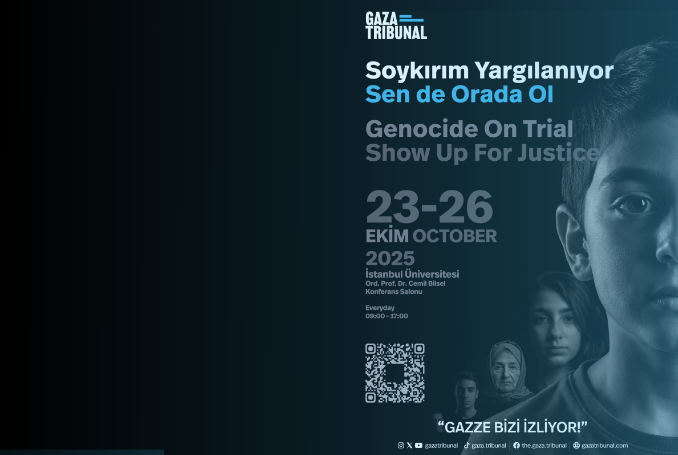

The four-day session at Istanbul University brings together legal experts, survivors, and academics to evaluate evidence of Israeli genocide and systemic violations of international law in Gaza.
The final session of the Gaza Tribunal, an independent international initiative investigating alleged war crimes and acts of genocide committed by Israel in the Gaza Strip, opened on Thursday at Istanbul University.
The four-day public hearing, which runs until October 26, brings together international jurists, scholars, and civil society representatives to present findings and ongoing testimonies. The proceedings are presided over by Richard Falk, former UN Special Rapporteur on human rights in the occupied Palestinian territories.
The Gaza Tribunal, organized by a coalition of academics and human rights advocates, operates through three chambers: International Law, International Relations and World Order, and History, Ethics, and Philosophy. Its final verdict is expected to be issued at the conclusion of the Istanbul session.
Testimonies presented so far include statements from survivors and experts addressing what participants describe as systematic destruction in Gaza and the failure of international mechanisms to prevent it. Joining remotely from South Africa, Dr. Haider Eid, a displaced academic formerly at Al-Aqsa University, recounted his repeated displacements and the loss of family members, colleagues, and students during Israel’s military campaign.
Palestinian-American legal scholar Noura Erakat, addressing the tribunal under the title “We Charge Nakba: Colonial Genocide of the Palestinian People,” argues that Israel’s long-standing impunity stems from the normalization of what she calls “legal exception” since the state’s founding in 1948. She criticizes the International Court of Justice and the Genocide Convention for their failure to address the colonial dimensions of genocide.
The chamber on International Law, chaired by Boston University professor Susan Akram, focuses on what it describes as gaps in existing international legal frameworks. “Our overall challenge is to the international ecosystem itself that has utterly failed in its most critical task — preventing and halting genocide,” Akram says, according to the Anadolu news agency.
The chamber on International Relations and World Order, led by former senior UN human rights official Craig Mokhiber, examines the response of international institutions to Israel’s military operations. Anadolu quoted Mokhiber as saying that the “live-streaming of Israeli crimes” has not led to action, describing the international system as “paralyzed by political interests.”
The chamber on History, Ethics, and Philosophy, chaired by historian Cemil Aydin of the University of North Carolina, explores the ideological and historical underpinnings of Israeli settler colonialism, describing genocide as part of a “security logic” rooted in colonial governance.
Gaza Tribunal Calls for Urgent Armed Intervention to Stop Israel’s Genocide
Several international figures are contributing to the ongoing hearings through written and recorded statements. Indian author Arundhati Roy describes Israel’s war on Gaza as a “live-streamed genocide,” while musician Roger Waters and scholar Omer Suleiman call for continued global advocacy and documentation of the crimes committed.
Raji Sourani, director of the Palestinian Center for Human Rights, says the tribunal convenes “at a time when the international justice system is under unprecedented attack,” and reiterates that Palestinians cannot achieve peace without self-determination.
Earlier sessions in Sarajevo resulted in a declaration demanding Israel’s withdrawal from Gaza, the release of Palestinian prisoners, and the restoration of unrestricted humanitarian access.
The tribunal’s final report, to be issued at the conclusion of the Istanbul hearings on Sunday, October 26, is expected to consolidate testimonies and findings gathered over the past year.
(PC, TRT, AA)

Be the first to comment